Institute for Immunological Research, University of Cartagena, Cartagena 130014, Colombia.
Servicio de Alergología Fundación Jiménez Díaz IIS CIBERES (Ciber de Enfermedades Respiratorias) Unidad Multidisciplinar de Asma, Madrid 28040, Spain.
Biomed Res Int. 2022 May 2;2022:5753524. doi: 10.1155/2022/5753524. eCollection 2022.
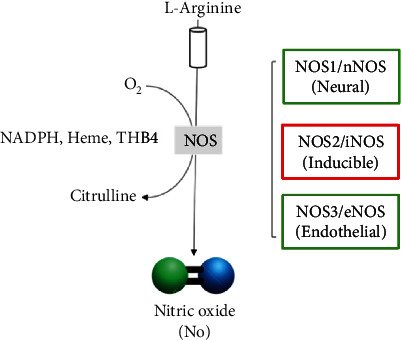
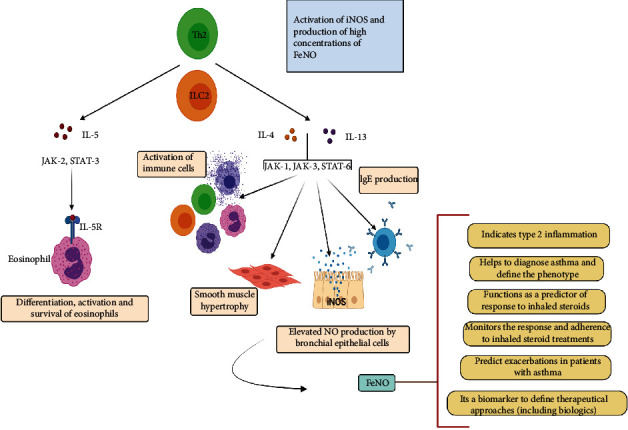
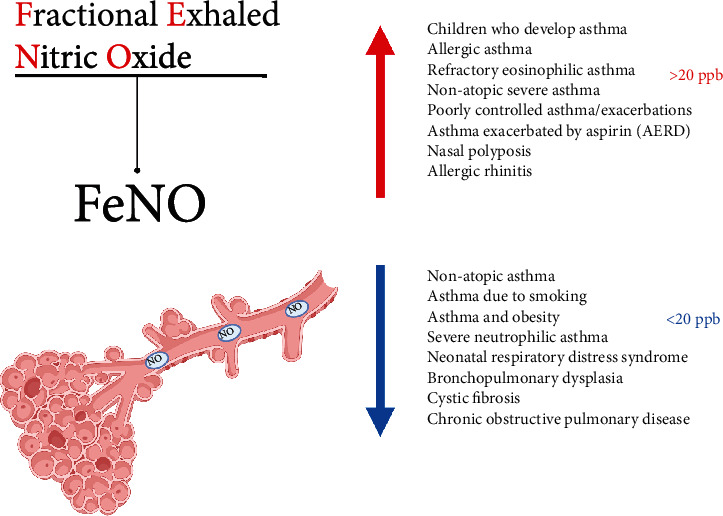
Fractional exhaled nitric oxide (FeNO) has gained great clinical importance as a biomarker of type 2 inflammation in chronic airway diseases such as asthma. FeNO originates primarily in the bronchial epithelium and is produced in large quantities by the enzyme inducible nitric oxide synthase (iNOS). It should be noted that nitric oxide (NO) produced at femtomolar to picomolar levels is fundamental for respiratory physiology. This basal production is induced in the bronchial epithelium by interferon gamma (IFN) via Janus kinases (JAK)/STAT-1 signaling. However, when there is an increase in the expression of type 2 inflammatory cytokines such as IL-4 and IL-13, the STAT-6 pathway is activated, leading to overexpression of iNOS and consequently to an overproduction of airway NO. Increased NO levels contributes to bronchial hyperreactivity and mucus hypersecretion, increases vascular permeability, reduces ciliary heartbeat, and promotes free radical production, airway inflammation, and tissue damage. In asthmatic patients, FeNO levels usually rise above 25 parts per billion (ppb) and its follow-up helps to define asthma phenotype and to monitor the effectiveness of corticosteroid treatment and adherence to treatment. FeNO is also very useful to identify those severe asthma patients that might benefit of personalized therapies with monoclonal antibodies. In this review, we revised the cellular and molecular mechanisms of NO production in the airway and its relevance as a biomarker of type 2 inflammation in asthma.
呼出气一氧化氮(FeNO)作为 2 型炎症的生物标志物,在哮喘等慢性气道疾病中的临床重要性日益增加。FeNO 主要来源于支气管上皮细胞,由诱导型一氧化氮合酶(iNOS)大量产生。需要指出的是,呼吸生理学所必需的是在飞摩尔到皮摩尔水平产生的一氧化氮(NO)。这种基础产生是由干扰素 γ(IFN)通过 Janus 激酶(JAK)/STAT-1 信号通路在支气管上皮细胞中诱导的。然而,当 2 型炎症细胞因子(如 IL-4 和 IL-13)的表达增加时,STAT-6 途径被激活,导致 iNOS 过度表达,进而导致气道 NO 过度产生。NO 水平升高可导致支气管高反应性和黏液高分泌,增加血管通透性,降低纤毛搏动,并促进自由基产生、气道炎症和组织损伤。在哮喘患者中,FeNO 水平通常超过 25 皮克/每十亿(ppb),其随访有助于确定哮喘表型,并监测皮质类固醇治疗的效果和治疗依从性。FeNO 也非常有助于识别那些可能受益于个体化治疗的严重哮喘患者,如使用单克隆抗体。在这篇综述中,我们回顾了气道中 NO 产生的细胞和分子机制及其作为哮喘 2 型炎症生物标志物的相关性。