
利用商业可穿戴传感器估算人群中流感样疾病对日常活动的负担。
Estimating the Burden of Influenza-like Illness on Daily Activity at the Population Scale Using Commercial Wearable Sensors.
机构信息
Evidation Health Inc, Menlo Park, California.
Paul G. Allen School of Computer Science & Engineering, University of Washington, Seattle.
出版信息
JAMA Netw Open. 2022 May 2;5(5):e2211958. doi: 10.1001/jamanetworkopen.2022.11958.
IMPORTANCE
The severity of viral infections can vary widely, from asymptomatic cases to complications leading to hospitalizations and death. Milder cases, despite being more prevalent, often go undocumented, and their public health burden is not accurately estimated.
OBJECTIVE
To estimate the true burden of influenza-like illness (ILI) in the US population using a surrogate measure of daily steps lost as measured by commercial wearable sensors.
DESIGN, SETTING, AND PARTICIPANTS: This cohort study modeled data from 15 122 US adults who reported ILI symptoms during the 2018-2019 influenza season (before the COVID-19 pandemic) and who had a sufficient density of wearable sensor data at symptom onset. Participants' minute-level step data as measured by commercial wearable sensors were collected from October 1, 2018, through June 30, 2019. Minute-level activity time series were transformed into day-level time series per user, indicating the total number of steps daily.
MAIN OUTCOMES AND MEASURES
The primary end point was the number of steps lost during the period of 4 days before symptom onset (the latent phase) through 11 days after symptom onset (the symptomatic phase). The association between covariates and steps lost during this interval was also examined.
RESULTS
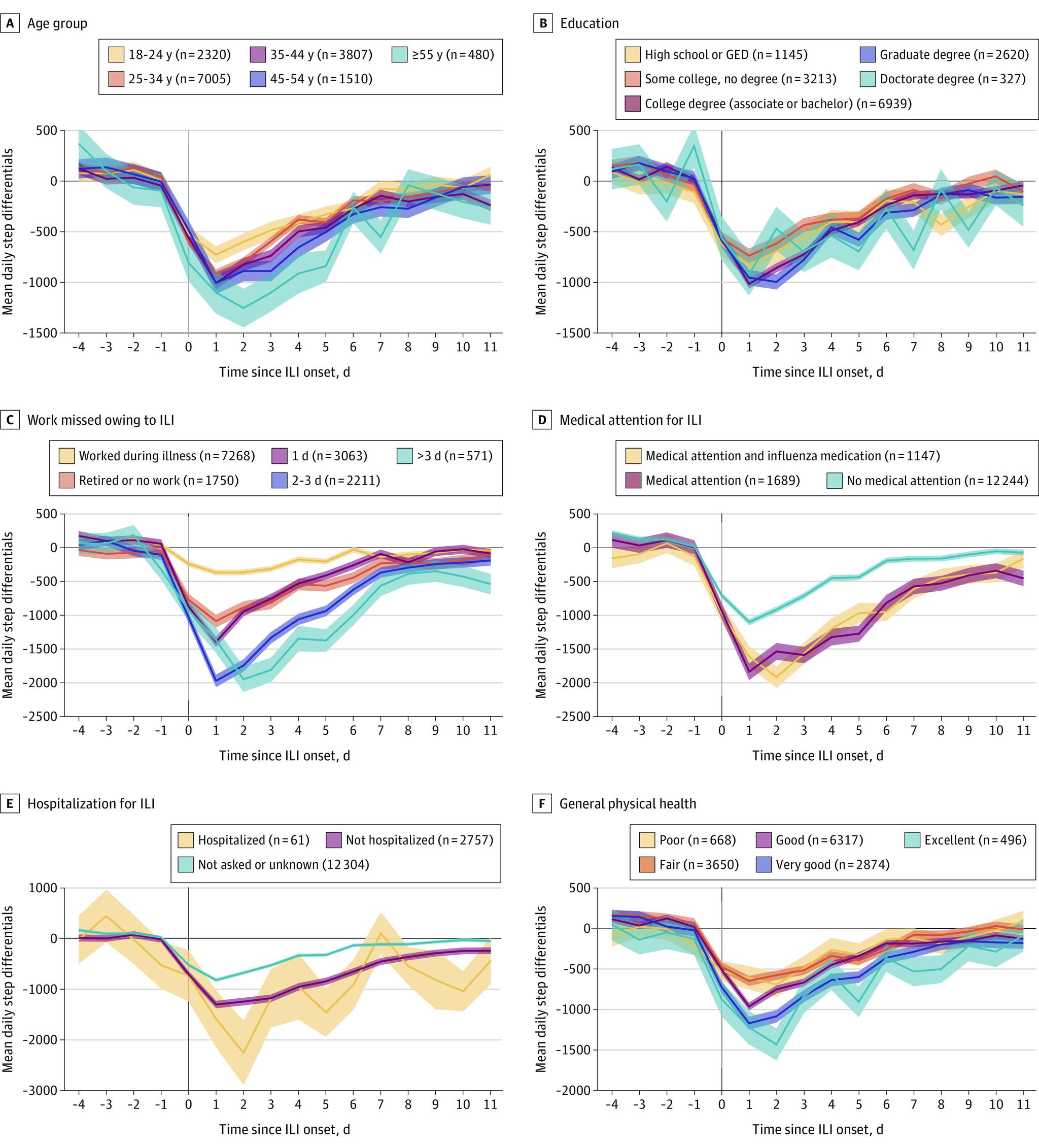
Of the 15 122 participants in this study, 13 108 (86.7%) were women, and the median age was 32 years (IQR, 27-38 years). For their ILI event, 2836 of 15 080 participants (18.8%) sought medical attention, and only 61 (0.4%) were hospitalized. Over the course of an ILI lasting 10 days, the mean cumulative loss was 4437 steps (95% CI, 4143-4731 steps). After weighting, there was an estimated overall nationwide reduction in mobility equivalent to 255.2 billion steps (95% CI, 232.9-277.6 billion steps) lost because of ILI symptoms during the study period. This finding reflects significant changes in routines, mobility, and employment and is equivalent to 15% of the active US population becoming completely immobilized for 1 day. Moreover, 60.6% of this reduction in steps (154.6 billion steps [95% CI, 138.1-171.2 billion steps]) occurred among persons who sought no medical care. Age and educational level were positively associated with steps lost.
CONCLUSIONS AND RELEVANCE
These findings suggest that most of the burden of ILI in this study would have been invisible to health care and public health reporting systems. This approach has applications for public health, health care, and clinical research, from estimating costs of lost productivity at population scale, to measuring effectiveness of anti-ILI treatments, to monitoring recovery after acute viral syndromes such as during long COVID-19.
重要性
病毒感染的严重程度差异很大,从无症状病例到导致住院和死亡的并发症都有。尽管轻症更为普遍,但往往未被记录在案,其对公共卫生的负担也没有得到准确估计。
目的
使用商业可穿戴传感器测量的日常步数损失的替代指标来估计美国人群中流感样疾病(ILI)的真实负担。
设计、地点和参与者:本队列研究使用 2018-2019 年流感季节(在 COVID-19 大流行之前)报告 ILI 症状的 15122 名美国成年人的数据进行建模,这些参与者在症状发作时有足够密度的可穿戴传感器数据。参与者的分钟级步数据由商业可穿戴传感器测量,收集时间为 2018 年 10 月 1 日至 2019 年 6 月 30 日。每分钟的活动时间序列转换为每个用户的日常时间序列,指示每天的总步数。
主要结局和措施
主要终点是在症状发作前 4 天(潜伏期)至 11 天后(症状发作期)期间损失的步数。还检查了协变量与这一间隔内损失的步数之间的关联。
结果
在这项研究中,15122 名参与者中,有 13108 名(86.7%)为女性,中位年龄为 32 岁(IQR,27-38 岁)。对于他们的 ILI 事件,15080 名参与者中的 2836 名(18.8%)寻求了医疗帮助,只有 61 名(0.4%)住院。在持续 10 天的 ILI 期间,平均累计损失为 4437 步(95%CI,4143-4731 步)。经过加权处理,估计在研究期间,因 ILI 症状导致全国范围内的整体移动性减少了 2552 亿步(95%CI,2329-2776 亿步)。这一发现反映了日常生活、流动性和就业方面的重大变化,相当于美国 15%的活跃人口完全停摆一天。此外,这一减少的 60.6%(1546 亿步[95%CI,1381-1712 亿步])发生在未寻求医疗护理的人群中。年龄和教育水平与损失的步数呈正相关。
结论和相关性
这些发现表明,本研究中 ILI 的大部分负担对于医疗保健和公共卫生报告系统来说都是不可见的。这种方法在公共卫生、医疗保健和临床研究方面具有应用价值,从估计人群规模上因生产力下降造成的成本,到衡量抗 ILI 治疗的效果,再到监测急性病毒综合征(如长 COVID-19 期间)后的恢复情况。


 Zotero 插件