Center for Oral Health Services and Research, Mid-Norway (TkMidt), Trondheim, Norway.
Department of Public Health and Nursing, Norwegian University of Science and Technology (NTNU), Trondheim, Norway.
Eur Arch Paediatr Dent. 2022 Aug;23(4):557-566. doi: 10.1007/s40368-022-00712-y. Epub 2022 May 12.
The study aimed to investigate associations between maternal vitamin D status during pregnancy and molar incisor hypomineralisation (MIH) and hypomineralised second primary molars (HSPM) among children.
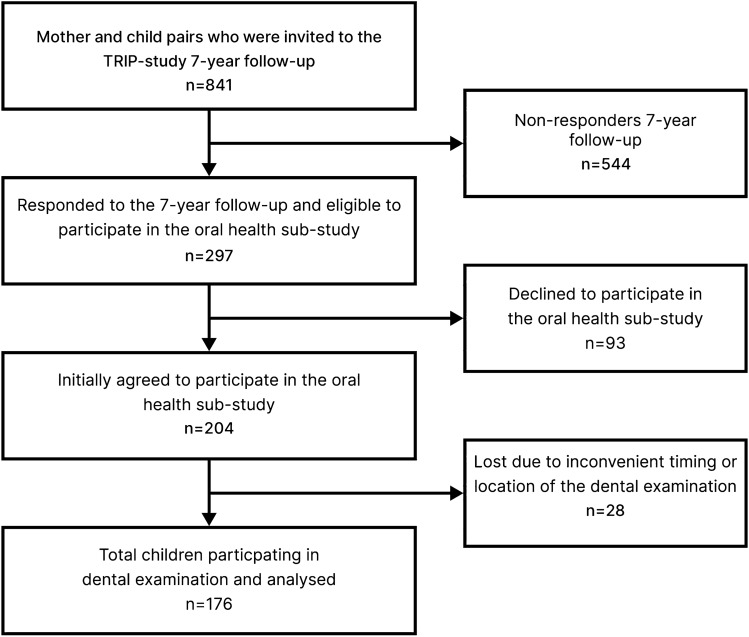
The study had a longitudinal design using prospectively collected data from 176 mother and child pairs. Mothers were initially recruited in a randomised controlled trial to assess a pregnancy exercise programme. Along with the 7-year follow-up, we invited the children to a dental examination. The exposure variable was maternal serum 25-hydroxyvitamin D in gestational weeks 18-22 and 32-36, categorised as insufficient (< 50 nmol/l) and sufficient (≥ 50 nmol/l). Negative binomial hurdle models were used to analyse potential associations between the exposure variables and MIH or HSPM. The models were adjusted for potential confounders.
Among the children (7-9 years old), 32% and 22% had at least one tooth with MIH or HSPM, respectively. A significant association was found between insufficient maternal vitamin D measured in gestational weeks 18-22 and the number of affected teeth among those with MIH at 7-9 years (adjusted RR = 1.82, 95% CI 1.13-2.93).
Considering any limitations of the present study, it has been shown that insufficient maternal serum vitamin D at mid-pregnancy was associated with a higher number of affected teeth among the offspring with MIH at 7-9 years of age. Further prospective studies are needed to investigate whether this finding is replicable and to clarify the role of maternal vitamin D status during pregnancy and MIH, as well as HSPM, in children.
本研究旨在探讨妊娠期间母体维生素 D 状况与儿童恒侧切牙釉质发育不全(MIH)和第二恒前磨牙釉质发育不全(HSPM)之间的关系。
该研究采用前瞻性收集的 176 对母婴数据进行纵向设计。母亲最初在一项随机对照试验中被招募,以评估妊娠运动计划。在 7 年随访的同时,我们邀请孩子们进行牙科检查。暴露变量是妊娠 18-22 周和 32-36 周时母体血清 25-羟维生素 D,分为不足(<50nmol/L)和充足(≥50nmol/L)。使用负二项式障碍模型分析暴露变量与 MIH 或 HSPM 之间的潜在关联。模型调整了潜在混杂因素。
在 7-9 岁的儿童中,分别有 32%和 22%的儿童至少有一颗牙齿患有 MIH 或 HSPM。在妊娠 18-22 周时母体维生素 D 不足与 7-9 岁时患有 MIH 的儿童受影响牙齿数量之间存在显著关联(调整后的 RR=1.82,95%CI 1.13-2.93)。
考虑到本研究的局限性,结果表明妊娠中期母体血清维生素 D 不足与 7-9 岁时 MIH 儿童受影响牙齿数量增加有关。需要进一步的前瞻性研究来验证这一发现的可重复性,并阐明妊娠期间母体维生素 D 状况与 MIH 以及 HSPM 之间的关系。