Lebe Karen E, Cox Russell J
Institute for Organic Chemistry, BMWZ, Leibniz Universität Hannover Schneiderberg 38 30167 Hannover Germany
RSC Adv. 2019 Oct 4;9(54):31527-31531. doi: 10.1039/c9ra06412e. eCollection 2019 Oct 1.
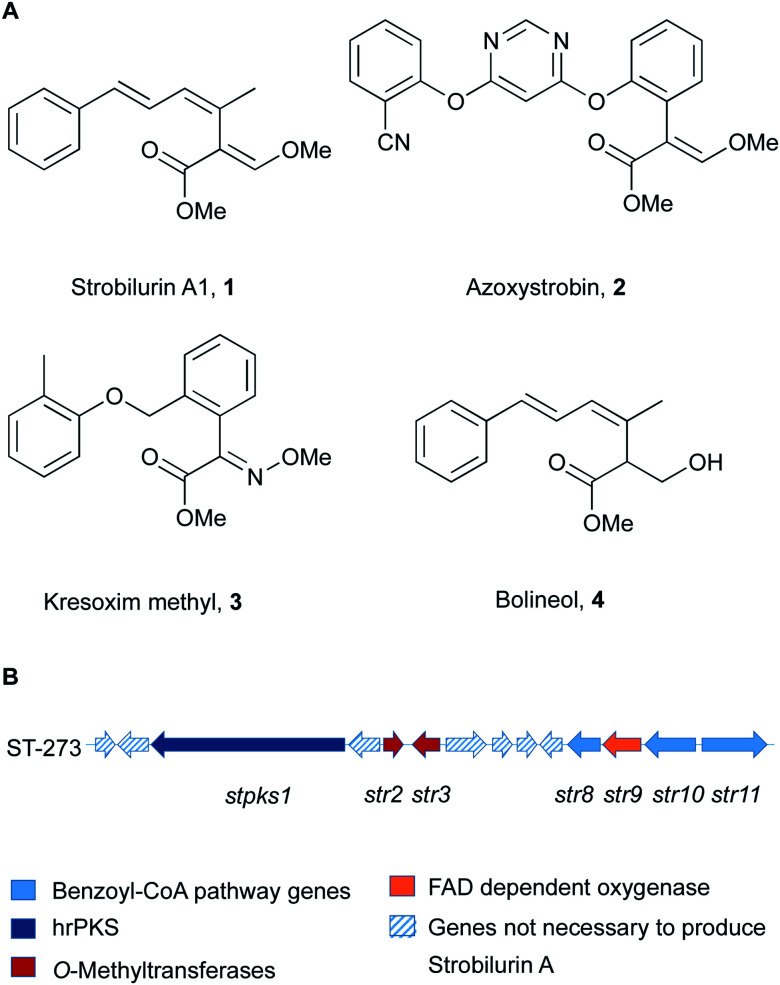
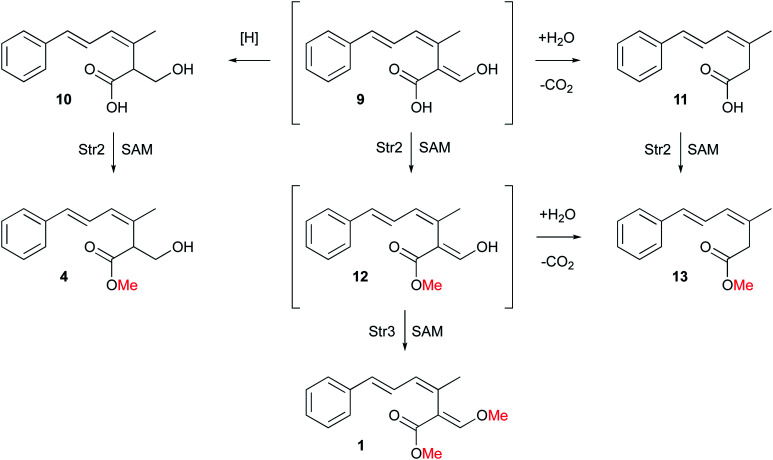
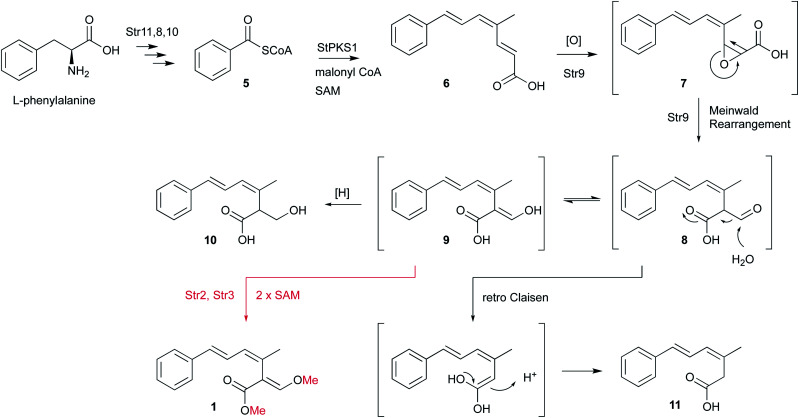
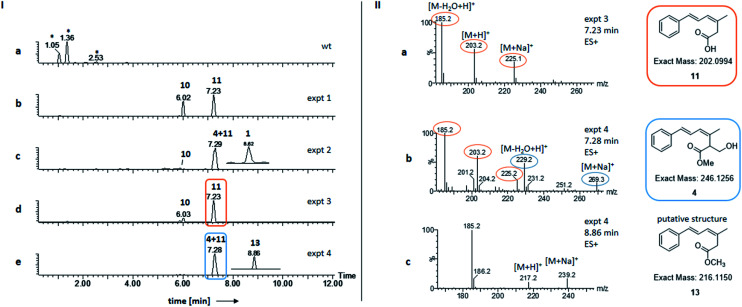
Strobilurins are potent antifungal polyketides produced by basidiomycete fungi. Two genes encoding -methyltransferases (-MeT) are present in the biosynthetic gene cluster of strobilurin A 1. In previous studies, the two -MeT enzymes Str2 and Str3 were found to catalyse the final steps of the biosynthesis of 1. Here, we show by expression experiments, that -methylation during strobilurin biosynthesis is regiospecific. -MeT Str2 acts first and selectively catalyses the methylation of the carboxyl group of strobilurin and bolineol precursors. Str3 catalyses the subsequent methyl transfer to the enol group to form strobilurin A 1, but cannot methylate bolineol 4. Toxicity tests showed increasing antifungal activity of intermediates through the pathway and that bolineol 4 shows antifungal activity against NSAR1 with an MIC of 0.1 mg ml.
嗜球果伞素是担子菌纲真菌产生的强效抗真菌聚酮化合物。编码甲基转移酶(-MeT)的两个基因存在于嗜球果伞素A1的生物合成基因簇中。在之前的研究中,发现两种-MeT酶Str2和Str3催化了1生物合成的最后步骤。在此,我们通过表达实验表明,嗜球果伞素生物合成过程中的甲基化具有区域特异性。-MeT Str2首先起作用,选择性地催化嗜球果伞素和波林醇前体羧基的甲基化。Str3催化随后向烯醇基团的甲基转移以形成嗜球果伞素A1,但不能使波林醇4甲基化。毒性测试表明,该途径中的中间体抗真菌活性不断增强,并且波林醇4对NSAR1显示出抗真菌活性,最低抑菌浓度为0.1毫克/毫升。