Institute of Health and Nursing Science, Charité-Universitätsmedizin Berlin, Corporate Member of Freie Universität Berlin and Humboldt-Universität zu Berlin, Augustenburger Platz 1, 13353 Berlin, Germany.
Unit for Health Promotion Research, Department of Public Health, University of Southern Denmark, Degnevej 14, 6705 Esbjerg, Denmark.
Int J Environ Res Public Health. 2022 Apr 25;19(9):5221. doi: 10.3390/ijerph19095221.
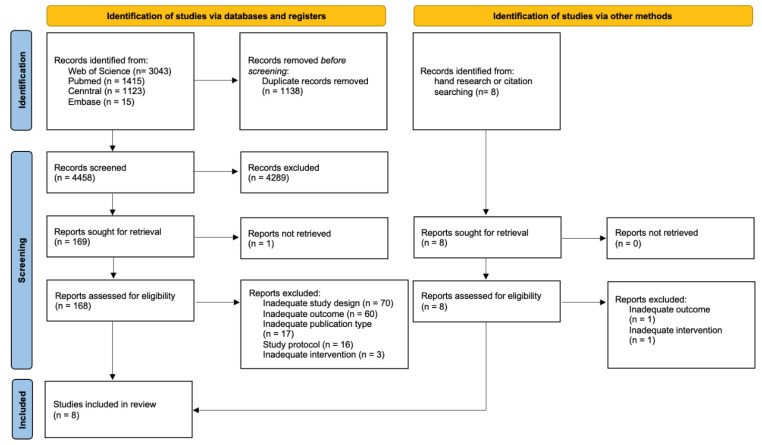
Despite the potential of digital health interventions (DHIs), evaluations of their effectiveness face challenges. DHIs are complex interventions and currently established evaluation methods, e.g., the randomised controlled trial (RCT), are limited in their application. This study aimed at identifying alternatives to RCTs as potentially more appropriate evaluation approaches. A scoping review was conducted to provide an overview of existing evaluation methods of DHIs beyond the RCT. Cochrane Central Register of Controlled Trials, MEDLINE, Web of Science, and EMBASE were screened in May 2021 to identify relevant publications, while using defined inclusion and exclusion criteria. Eight studies were extracted for a synthesis comprising four alternative evaluation designs. Factorial designs were mostly used to evaluate DHIs followed by stepped-wedge designs, sequential multiple assignment randomised trials (SMARTs), and micro randomised trials (MRTs). Some of these methods allow for the adaptation of interventions (e.g., SMART or MRT) and the evaluation of specific components of interventions (e.g., factorial designs). Thus, they are appropriate for addressing some specific needs in the evaluation of DHIs. However, it remains unsolved how to establish these alternative evaluation designs in research practice and how to deal with the limitations of the designs.
尽管数字健康干预(DHIs)具有潜力,但评估其有效性仍面临挑战。DHIs 是复杂的干预措施,目前已建立的评估方法(如随机对照试验(RCT))在应用上存在局限性。本研究旨在确定替代 RCT 的方法,这些方法可能更适合作为评估方法。本研究进行了范围综述,以提供超出 RCT 范围的 DHI 现有评估方法的概述。2021 年 5 月, Cochrane 对照试验中心注册库、MEDLINE、Web of Science 和 EMBASE 被筛选以确定相关出版物,同时使用了明确的纳入和排除标准。有八项研究被提取用于综合分析,其中包括四种替代评估设计。析因设计主要用于评估 DHI,其次是阶梯式楔形设计、序贯多重分配随机试验(SMARTs)和微型随机试验(MRTs)。这些方法中的一些允许干预措施的适应性(例如 SMART 或 MRT)和干预措施特定组件的评估(例如析因设计)。因此,它们适用于解决 DHI 评估中的一些特定需求。然而,如何在研究实践中建立这些替代评估设计以及如何处理设计的局限性仍然没有得到解决。