Department of Treatment of Obesity, Metabolic Disorders and Clinical Dietetics, Poznań University of Medical Sciences, 84 Szamarzewskiego Street, 60-569 Poznań, Poland.
Nutrients. 2022 Apr 20;14(9):1714. doi: 10.3390/nu14091714.
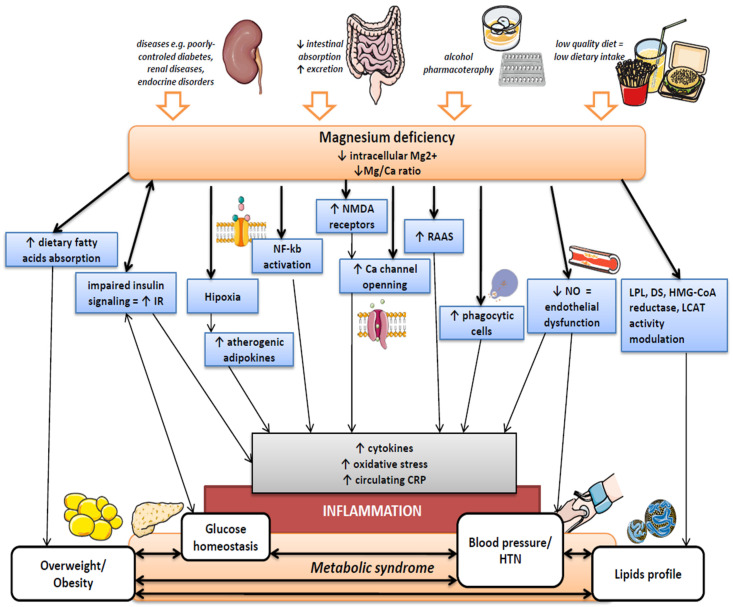
Magnesium (Mg) is an essential nutrient for maintaining vital physiological functions. It is involved in many fundamental processes, and Mg deficiency is often correlated with negative health outcomes. On the one hand, most western civilizations consume less than the recommended daily allowance of Mg. On the other hand, a growing body of evidence has indicated that chronic hypomagnesemia may be implicated in the pathogenesis of various metabolic disorders such as overweight and obesity, insulin resistance (IR) and type 2 diabetes mellitus (T2DM), hypertension (HTN), changes in lipid metabolism, and low-grade inflammation. High Mg intake with diet and/or supplementation seems to prevent chronic metabolic complications. The protective action of Mg may include limiting the adipose tissue accumulation, improving glucose and insulin metabolism, enhancing endothelium-dependent vasodilation, normalizing lipid profile, and attenuating inflammatory processes. Thus, it currently seems that Mg plays an important role in developing metabolic disorders associated with obesity, although more randomized controlled trials (RCTs) evaluating Mg supplementation strategies are needed. This work represents a review and synthesis of recent data on the role of Mg in the pathogenesis of metabolic disorders.
镁(Mg)是维持重要生理功能的必需营养素。它参与许多基本过程,镁缺乏通常与不良健康结果相关。一方面,大多数西方文明的人群镁的摄入量都低于推荐的每日摄入量。另一方面,越来越多的证据表明,慢性低镁血症可能与各种代谢紊乱的发病机制有关,如超重和肥胖、胰岛素抵抗(IR)和 2 型糖尿病(T2DM)、高血压(HTN)、脂质代谢改变和低度炎症。通过饮食和/或补充摄入高镁似乎可以预防慢性代谢并发症。镁的保护作用可能包括限制脂肪组织堆积、改善葡萄糖和胰岛素代谢、增强内皮依赖性血管舒张、使血脂谱正常化和减轻炎症过程。因此,目前似乎镁在与肥胖相关的代谢紊乱的发展中起着重要作用,尽管需要更多评估镁补充策略的随机对照试验(RCT)。这项工作是对镁在代谢紊乱发病机制中的作用的最新数据的综述和综合。