Castillo-Felipe Candela, Tvarijonaviciute Asta, López-Arjona Marina, Pardo-Marin Luis, Pons-Fuster Eduardo, López-Jornet Pia
Colaborate Department Stomatology School of Medicine, Oral Medicine University of Murcia, 30100 Murcia, Spain.
Interdisciplinary Laboratory of Clinical Analysis, Interlab-UMU, Regional Campus of International Excellence 'Campus Mare Nostrum', University of Murcia, 30100 Murcia, Spain.
J Clin Med. 2022 Apr 29;11(9):2516. doi: 10.3390/jcm11092516.
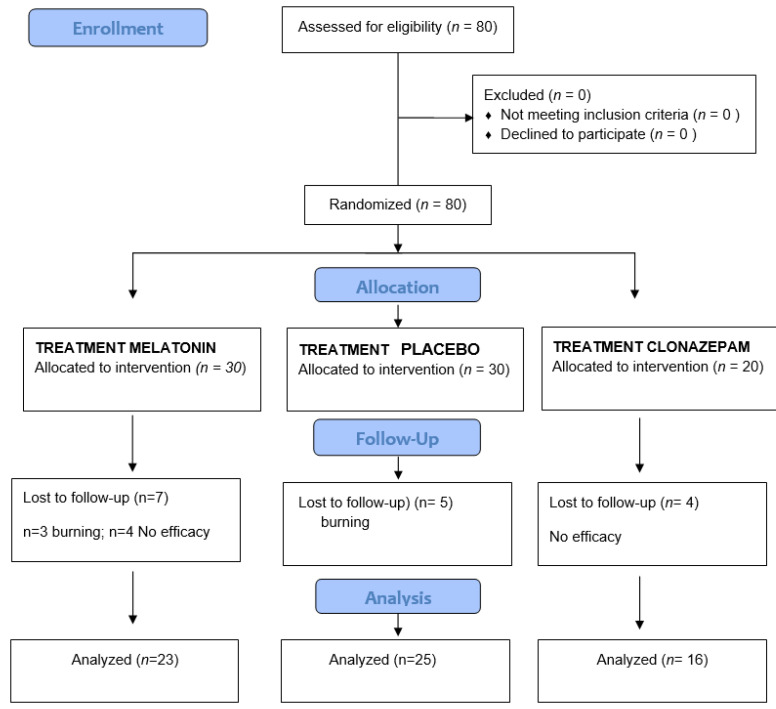
Objective: to evaluate the efficacy of melatonin and clonazepam versus placebo in patients with burning mouth syndrome (BMS). Methods: a prospective double-blind study was carried out in patients with BMS and randomized to three groups: melatonin (1 mg once a day), clonazepam (0.5 mg/twice a day), or a placebo once a day, for 8 weeks. The clinical changes were evaluated, including xerostomia, the Oral Health Impact Profile 14 (OHIP-14) score, Pittsburg Sleep Quality Index, and the Hospital Anxiety and Depression Scale (HADS). Oxygen saturation and heart rate were recorded, with an analysis of salivary biomarkers in the forms of oxytocin, ferritin, adenosine deaminase (ADA), total proteins, and alpha-amylase. Results: a total of 64 patients were analyzed. A significant decrease in burning sensation was recorded with melatonin (7.8 ± 1.54 pre-treatment, 5.78 ± 2.54 post-treatment; p < 0.001) and clonazepam (8.75 ± 1.2 pre-treatment, 5.5 ± 3.6 post-treatment (p < 0.01). With regard to quality of life (OHIP-14), significant improvements were observed before and after the administration of melatonin (p < 0.001) and clonazepam (p = 0.001). On the other hand, with regard to the changes in salivary biomarkers following treatment, negative correlations were found between oxytocin and drainage (r = −0.410; p = 0.009) and between the HADS-D score and ferritin (r = −0.312; p = 0.05). While salivary amylase showed positive correlation with heart rate (r = 0.346; p = 0.029) and oxygen saturation (r = 0.419; p = 0.007). Conclusions: melatonin and clonazepam were shown to be effective at reducing the burning sensation and improving quality of life. Both drugs were found to be safe, with no major adverse effects in patients with BMS. Melatonin may be regarded as an alternative treatment for patients with BMS, though further studies are needed to confirm its effectiveness.
评估褪黑素和氯硝西泮对比安慰剂治疗灼口综合征(BMS)患者的疗效。方法:对BMS患者进行一项前瞻性双盲研究,随机分为三组:褪黑素组(每日1毫克)、氯硝西泮组(每日两次,每次0.5毫克)或安慰剂组,治疗8周。评估临床变化,包括口干、口腔健康影响程度量表14项(OHIP - 14)评分、匹兹堡睡眠质量指数以及医院焦虑抑郁量表(HADS)。记录血氧饱和度和心率,并分析唾液生物标志物,包括催产素、铁蛋白、腺苷脱氨酶(ADA)、总蛋白和α -淀粉酶。结果:共分析64例患者。褪黑素组(治疗前7.8 ± 1.54,治疗后5.78 ± 2.54;p < 0.001)和氯硝西泮组(治疗前8.75 ± 1.2,治疗后5.5 ± 3.6;p < 0.01)的灼痛感觉显著降低。关于生活质量(OHIP - 14),褪黑素组(p < 0.001)和氯硝西泮组(p = 0.001)给药前后均有显著改善。另一方面,关于治疗后唾液生物标志物的变化,催产素与引流之间呈负相关(r = -0.410;p = 0.009),HADS - D评分与铁蛋白之间呈负相关(r = -0.312;p = 0.05)。而唾液淀粉酶与心率呈正相关(r = 0.346;p = 0.029),与血氧饱和度呈正相关(r = 0.419;p = 0.007)。结论:褪黑素和氯硝西泮在减轻灼痛感觉和改善生活质量方面显示出有效性。两种药物均被发现是安全的,对BMS患者无重大不良反应。褪黑素可被视为BMS患者的一种替代治疗方法,不过需要进一步研究来证实其有效性。