Centre for Ophthalmology and Visual Science (Incorporating the Lions Eye Institute), University of Western Australia, Perth, WA, Australia.
Centre for Eye Research Australia, Royal Victorian Eye and Ear Hospital, University of Melbourne, East Melbourne, VIC, Australia.
Front Public Health. 2022 Apr 27;10:861044. doi: 10.3389/fpubh.2022.861044. eCollection 2022.
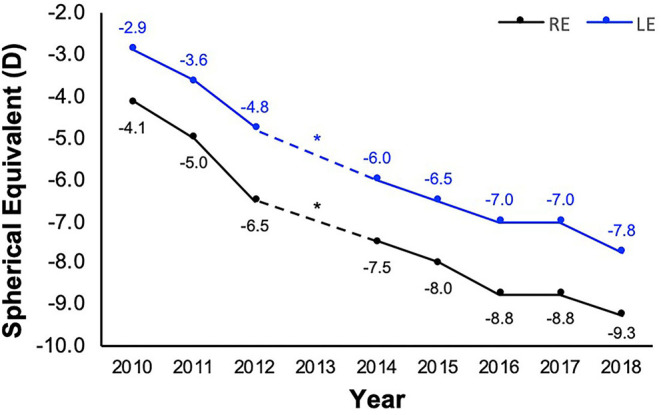
Myopia tends to develop and progress fastest during childhood, and the age of stabilization has been reported to be 15-16 years old. Thus, most studies on myopia have centered on children. Data on the refractive error profile in young adulthood - a time in life when myopia is thought to have stabilized and refractive error is unaffected by age-related pathology such as cataract - are limited. The Raine Study has been following a community-based cohort of young adults representative of the general Western Australia population since their prenatal periods in 1989-1991, with eye examinations performed when participants were 20 and 28 years old. At 20 years old, prevalence of myopia in the cohort was 25.8%. Using long-term trajectory of serum vitamin D levels and conjunctival ultraviolet autofluorescence (CUVAF) area to objectively quantify sun exposure, the Raine Study confirmed a negative relationship between time spent outdoors and myopia prevalence. However, prospective studies are required to determine the amount of CUVAF area or serum vitamin D levels associated with time duration. Combining data from the Raine Study and several other cohorts, Mendelian randomization studies have confirmed a link between myopia and a genetic predisposition toward higher education. Several novel potential associations of myopia or ocular biometry were investigated, including fetal growth trajectory, which was found to be significantly associated with corneal curvature at 20 years. By age 28, myopia prevalence had increased to 33.2%. Between 20 and 28 years old, myopia progressed and axial length elongated, on average, by -0.041D/year and 0.02 mm/year, respectively. Smaller CUVAF area at follow-up, female sex, and parental myopia were significant risk factors for myopia incidence and progression between 20 and 28 years. Given the limited research in young adults, further investigations are warranted to confirm the Raine Study findings, as well as identify novel genetic or environmental factors of myopia incidence and progression in this age group.
近视在儿童时期发展和进展最快,稳定年龄据报道为 15-16 岁。因此,大多数近视研究都集中在儿童身上。关于年轻人(此时近视被认为已经稳定,并且屈光不正不受白内障等与年龄相关的病理学影响)的屈光误差谱的数据有限。雷因研究自 1989-1991 年以来一直在对一个基于社区的年轻成年人队列进行跟踪,这些人在产前就已经参与了研究,当参与者 20 岁和 28 岁时进行了眼部检查。在 20 岁时,该队列中近视的患病率为 25.8%。雷因研究使用长期的血清维生素 D 水平轨迹和结膜紫外线自发荧光(CUVAF)面积来客观地量化阳光暴露,证实了户外活动时间与近视患病率之间的负相关关系。然而,需要前瞻性研究来确定与时间持续时间相关的 CUVAF 面积或血清维生素 D 水平的量。将雷因研究的数据与其他几个队列的数据相结合,孟德尔随机化研究证实了近视与更高教育程度的遗传易感性之间的联系。研究调查了近视或眼部生物测量的几个新的潜在关联,包括胎儿生长轨迹,发现其与 20 岁时的角膜曲率显著相关。到 28 岁时,近视的患病率已上升到 33.2%。在 20 岁到 28 岁之间,近视进展,眼轴平均每年延长-0.041D 和 0.02 毫米。随访时 CUVAF 面积较小、女性和父母近视是 20 岁到 28 岁之间近视发病率和进展的显著危险因素。鉴于年轻人的研究有限,需要进一步调查来确认雷因研究的结果,并确定该年龄组近视发病率和进展的新的遗传或环境因素。