School of Computational Science and Engineering, College of Computing, Georgia Institute of Technology, Atlanta, GA, 30308, USA.
Department of Computer Science, Aalto University, 02150, Espoo, Finland.
Sci Rep. 2022 May 16;12(1):8045. doi: 10.1038/s41598-022-11488-y.
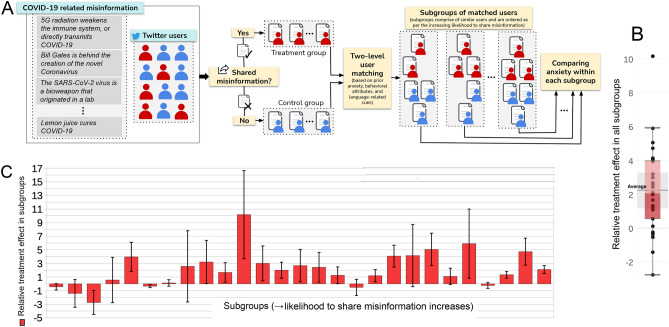
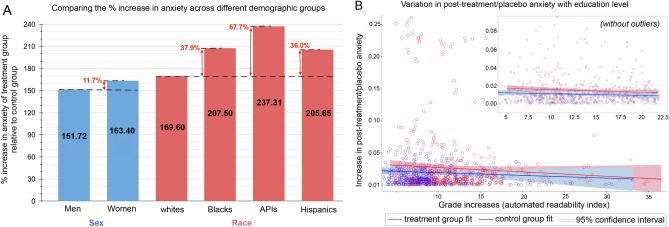
Misinformation about the COVID-19 pandemic proliferated widely on social media platforms during the course of the health crisis. Experts have speculated that consuming misinformation online can potentially worsen the mental health of individuals, by causing heightened anxiety, stress, and even suicidal ideation. The present study aims to quantify the causal relationship between sharing misinformation, a strong indicator of consuming misinformation, and experiencing exacerbated anxiety. We conduct a large-scale observational study spanning over 80 million Twitter posts made by 76,985 Twitter users during an 18.5 month period. The results from this study demonstrate that users who shared COVID-19 misinformation experienced approximately two times additional increase in anxiety when compared to similar users who did not share misinformation. Socio-demographic analysis reveals that women, racial minorities, and individuals with lower levels of education in the United States experienced a disproportionately higher increase in anxiety when compared to the other users. These findings shed light on the mental health costs of consuming online misinformation. The work bears practical implications for social media platforms in curbing the adverse psychological impacts of misinformation, while also upholding the ethos of an online public sphere.
在新冠疫情期间,社交媒体平台上广泛传播了有关新冠疫情的错误信息。专家推测,在网上消费错误信息可能会通过引起更高的焦虑、压力,甚至自杀意念,潜在地恶化个人的心理健康。本研究旨在量化分享错误信息(消费错误信息的一个强烈指标)与经历焦虑加剧之间的因果关系。我们进行了一项大规模的观察性研究,涵盖了 76985 名推特用户在 18.5 个月期间发布的超过 8000 万条推特。这项研究的结果表明,与没有分享错误信息的类似用户相比,分享新冠错误信息的用户的焦虑感增加了约两倍。社会人口分析表明,与其他用户相比,美国的女性、少数族裔和受教育程度较低的人焦虑感增加的幅度不成比例。这些发现揭示了消费在线错误信息的心理健康代价。这项工作对社交媒体平台具有实际意义,它们可以遏制错误信息的不良心理影响,同时维护在线公共领域的精神。