Walczak Marek, Juszkiewicz Małgorzata, Szymankiewicz Krzesimir, Szczotka-Bochniarz Anna, Woźniakowski Grzegorz
Department of Swine Diseases, National Veterinary Research Institute, 24-100 Puławy, Poland.
Department of Diagnostics and Clinical Sciences, Faculty of Biological and Veterinary Sciences, Nicolaus Copernicus University in Toruń, 87-100 Toruń, Poland.
J Vet Res. 2022 Mar 25;66(1):21-27. doi: 10.2478/jvetres-2022-0016. eCollection 2022 Mar.
African swine fever virus (ASFV) causes one of the most dangerous diseases of pigs and wild boar - African swine fever (ASF). Since its second introduction into Europe (in 2007), the disease has been spreading consistently, and now ASF-free European countries are at risk. Complex interactions between the host's immune system and the virus have long prevented the development of a safe vaccine against ASF. This study analysed the possibility of neutralisation of the ASFV by sera collected from ASF-survivor animals.
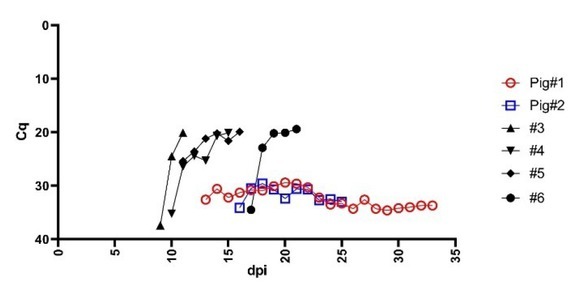
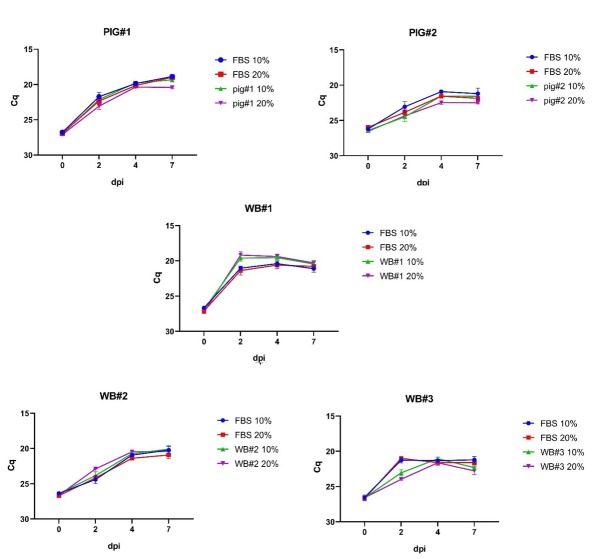
Two pig and three wild boar serum samples were collected from previously selected potential ASF survivors. All sera presented high antibody titres (>5 log/mL). Primary alveolar macrophages were cultured in growth medium containing 10% and 20% concentrations of selected sera and infected with a haemadsorbing ASFV strain (Pol18_28298_O111, genotype II). The progress of infection was investigated under a light microscope by observing the cytopathic effect (CPE) and the haemadsorption phenomenon. Growth kinetics were investigated using a real-time PCR assay.
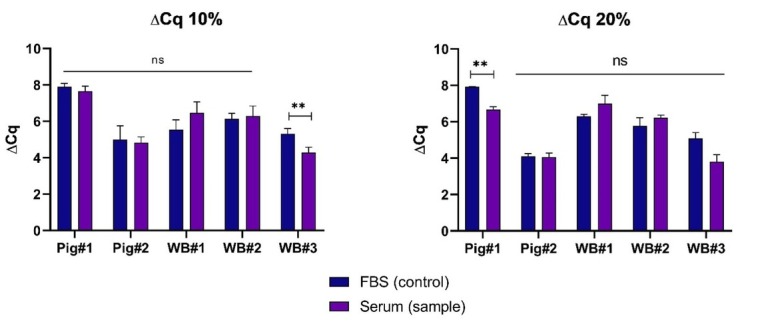
Haemadsorption inhibition was detected in the presence of almost all selected sera; however, the inhibition of virus replication was excluded. In all samples, a CPE and decreasing quantification cycle values of the viral DNA were found.
Anti-ASFV antibodies alone are not able to inhibit virus replication. Interactions between the humoral and cellular immune response which effectively combat the disease are implicated in an ASF-survivor's organism.
非洲猪瘟病毒(ASFV)引发了猪和野猪最危险的疾病之一——非洲猪瘟(ASF)。自2007年第二次传入欧洲以来,该疾病一直在持续传播,如今无ASF的欧洲国家面临风险。长期以来,宿主免疫系统与病毒之间复杂的相互作用阻碍了针对ASF的安全疫苗的研发。本研究分析了从ASF康复动物采集的血清中和ASFV的可能性。
从先前选定的潜在ASF康复动物中采集了两份猪血清样本和三份野猪血清样本。所有血清均呈现高抗体滴度(>5 log/mL)。将原代肺泡巨噬细胞在含有10%和20%选定血清浓度的生长培养基中培养,并感染一种具有血细胞吸附能力的ASFV毒株(Pol18_28298_O111,基因型II)。通过观察细胞病变效应(CPE)和血细胞吸附现象,在光学显微镜下研究感染进程。使用实时PCR测定法研究生长动力学。
在几乎所有选定血清存在的情况下均检测到血细胞吸附抑制;然而,排除了病毒复制的抑制。在所有样本中,均发现了CPE以及病毒DNA定量循环值的降低。
单独的抗ASFV抗体无法抑制病毒复制。体液免疫和细胞免疫反应之间有效对抗该疾病的相互作用与ASF康复动物的机体有关。