Institute of Zoology, Chinese Academy of Sciences, Beijing, China.
School of Life Science, Beijing Institute of Technology, Beijing, China.
Cell Prolif. 2022 Aug;55(8):e13239. doi: 10.1111/cpr.13239. Epub 2022 May 17.
The rapid development of cerebral organoid technology and the gradual maturity of cerebral organoids highlight the necessity of foresighted research on relevant ethical concerns. We employed knowledge graphs and conducted statistical analysis with CiteSpace for a comprehensive analysis of the status quo of the research on the ethical concerns of cerebral organoids from a bibliometric perspective.
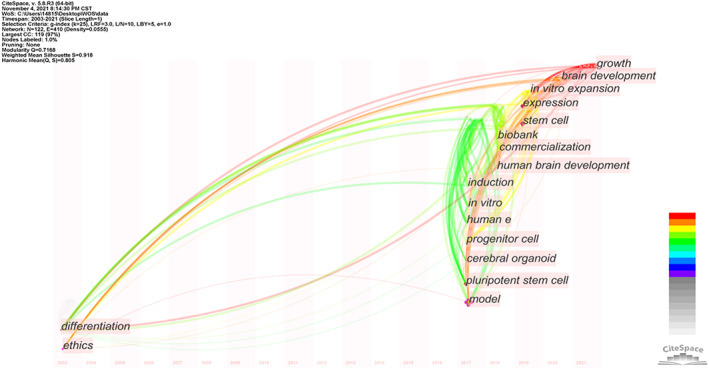
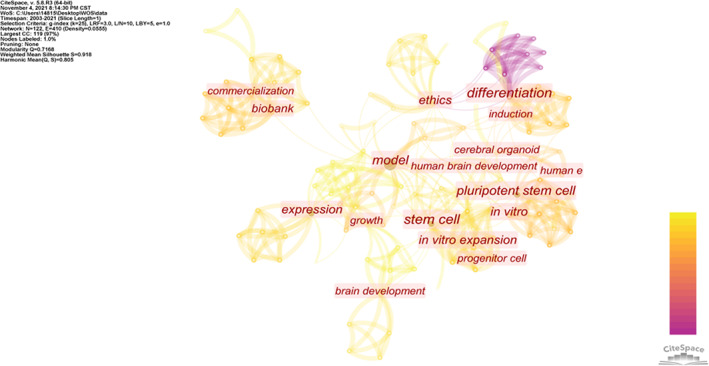
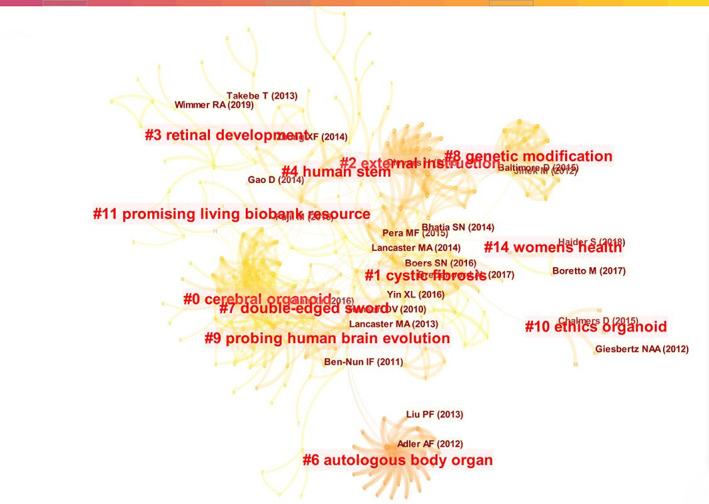
We performed a statistical analysis of published papers on cerebral organoid ethics, keyword co-occurrence graph, literature co-citation and knowledge clustering graph to examine the status of the ethics research, internal relationship between technological development and ethical research, and ethical concerns of the academia. Finally, we used a keyword time zone graph and related statistics to analyze and predict the trends and popular topics of future cerebral organoids ethics research.
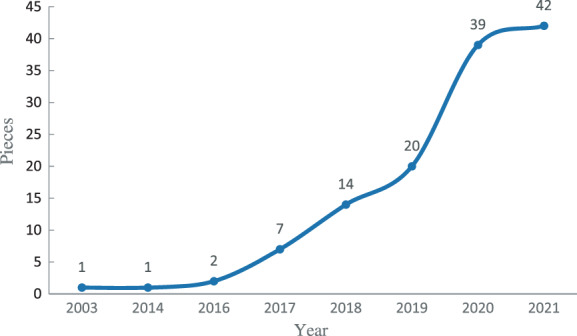
We demonstrated that although the ethical concerns of cerebral organoids have long been discussed, it was not until 2017 that the ethical issues began to receive more attention, when cerebral organoids were gradually mimicking the human brain more closely and increasingly being combined with chimera research. The recent key ethical concerns are primarily divided into three categories: concerns that are common in life sciences, specific to cerebral organoids, and present in cross-fields. These increasing ethical concerns are inherently related to the continual development of technology. The analysis pointed out that future research should focus on the ethical concerns of consciousness that are unique to cerebral organoids, ethical concerns of cross-fields, and construction and improvement of legislative and regulatory systems.
Although research on cerebral organoids can benefit the biomedicine field, the relevant ethical concerns are significant and have received increasing attention, which are inherently related to the continual development of technology. Future studies in ethics regarding cerebral organoid research should focus on the ethical concerns of consciousness, and cross-fields, as well as the improvement of regulatory systems.
脑类器官技术的快速发展和脑类器官的逐渐成熟突出了前瞻性研究相关伦理问题的必要性。我们利用知识图谱并采用 CiteSpace 进行统计分析,从文献计量学的角度全面分析脑类器官伦理研究的现状。
我们对脑类器官伦理学的已发表论文进行了统计分析,绘制了关键词共现图谱、文献共被引和知识聚类图谱,以考察伦理学研究的现状、技术发展与伦理研究的内在关系以及学术界对脑类器官的伦理关注。最后,我们利用关键词时间轴图及相关统计数据来分析和预测未来脑类器官伦理学研究的趋势和热门话题。
我们表明,尽管脑类器官的伦理问题早已被讨论,但直到 2017 年,随着脑类器官越来越接近模拟人类大脑并越来越多地与嵌合体研究相结合,伦理问题才开始受到更多关注。最近的关键伦理问题主要分为三类:生命科学中常见的问题、脑类器官特有的问题以及跨领域的问题。这些日益增加的伦理问题与技术的持续发展密切相关。分析指出,未来的研究应侧重于脑类器官特有的意识伦理问题、跨领域的伦理问题以及立法和监管体系的构建和完善。
虽然脑类器官的研究可以有益于生物医学领域,但相关的伦理问题非常重要且受到越来越多的关注,这些问题与技术的持续发展密切相关。未来脑类器官研究伦理学的研究应关注意识伦理问题、跨领域问题以及监管体系的完善。