Chuang Yu-Chia, Chen Chih-Cheng
Institute of Biomedical Sciences, Academia Sinica, Taipei, Taiwan.
Neuroscience Program of Academia Sinica, Academia Sinica, Taipei, Taiwan.
Front Cell Dev Biol. 2022 May 2;10:886048. doi: 10.3389/fcell.2022.886048. eCollection 2022.
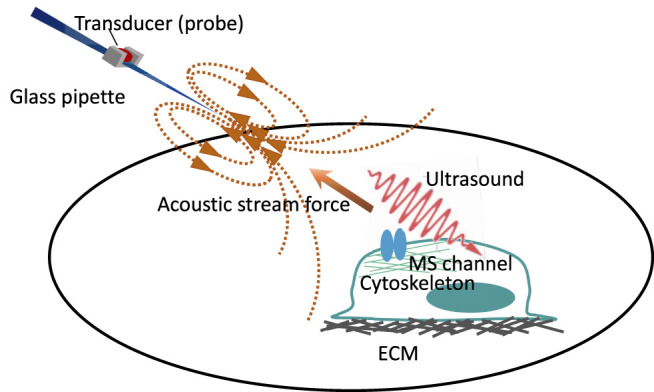
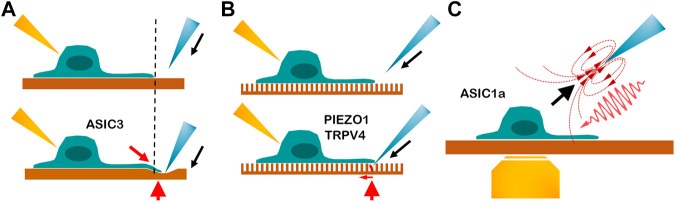
The senses of proprioception, touch, hearing, and blood pressure on mechanosensitive ion channels that transduce mechanical stimuli with high sensitivity and speed. This conversion process is usually called mechanotransduction. From nematode MEC-4/10 to mammalian PIEZO1/2, mechanosensitive ion channels have evolved into several protein families that use variant gating models to convert different forms of mechanical force into electrical signals. In addition to the model of channel gating by stretching from lipid bilayers, another potent model is the opening of channels by force tethering: a membrane-bound channel is elastically tethered directly or indirectly between the cytoskeleton and the extracellular molecules, and the tethering molecules convey force to change the channel structure into an activation form. In general, the mechanical stimulation forces the extracellular structure to move relative to the cytoskeleton, deforming the most compliant component in the system that serves as a gating spring. Here we review recent studies focusing on the ion channel mechanically activated by a tethering force, the mechanotransduction-involved cytoskeletal protein, and the extracellular matrix. The mechanosensitive channel PIEZO2, DEG/ENaC family proteins such as acid-sensing ion channels, and transient receptor potential family members such as NompC are discussed. State-of-the-art techniques, such as polydimethylsiloxane indentation, the pillar array, and micropipette-guided ultrasound stimulation, which are beneficial tools for exploring the tether model, are also discussed.
本体感觉、触觉、听觉和血压等感觉都依赖于机械敏感离子通道,这些通道能够以高灵敏度和速度传导机械刺激。这个转换过程通常被称为机械转导。从线虫的MEC - 4/10到哺乳动物的PIEZO1/2,机械敏感离子通道已经进化成几个蛋白质家族,它们使用不同的门控模型将不同形式的机械力转化为电信号。除了通过脂质双层拉伸来进行通道门控的模型外,另一个有效的模型是通过力系链使通道打开:一个膜结合通道直接或间接地弹性系链在细胞骨架和细胞外分子之间,系链分子传递力以将通道结构改变为激活形式。一般来说,机械刺激迫使细胞外结构相对于细胞骨架移动,使系统中最具顺应性的成分变形,该成分充当门控弹簧。在这里,我们综述了最近的研究,重点关注由系链力机械激活的离子通道、参与机械转导的细胞骨架蛋白和细胞外基质。讨论了机械敏感通道PIEZO2、DEG/ENaC家族蛋白(如酸敏感离子通道)以及瞬时受体电位家族成员(如NompC)。还讨论了一些先进技术,如聚二甲基硅氧烷压痕、柱阵列和微吸管引导超声刺激,这些都是探索系链模型的有益工具。