Section of Endocrinology, School of Medicine, Yale University, New Haven, CT, USA.
Division of Infection and Immunity, School of Medicine, Cardiff University, Cardiff, UK.
Diabetologia. 2022 Aug;65(8):1398-1411. doi: 10.1007/s00125-022-05711-8. Epub 2022 May 19.
AIMS/HYPOTHESIS: IgM is the primary antibody produced by B cells and we hypothesise that IgM antibodies to gut microbiota may play a role in immunometabolism in obesity and type 2 diabetes. To test our hypothesis, we used B6 mice deficient in activation-induced cytidine deaminase (Aid [also known as Aicda]) which secrete only IgM antibodies, and human faecal samples.
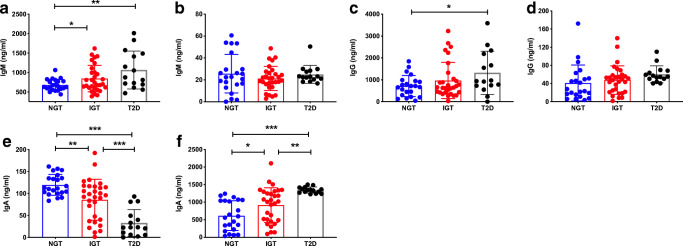
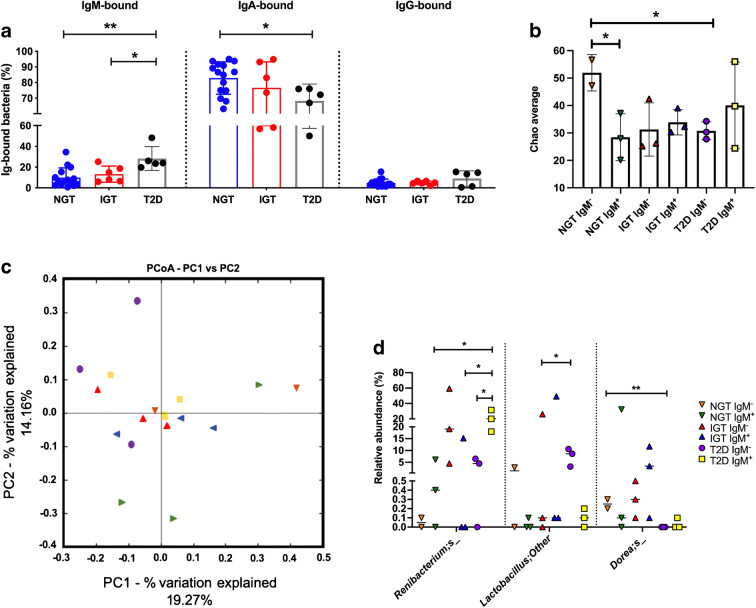
We studied the immunometabolic effects and gut microbial changes in high-fat-diet-induced obesity (HFDIO) in Aid B6 mice compared with wild-type mice. To determine similarities between mice and humans, human stool samples were collected from children and adolescents who were obese with normal glucose tolerance (NGT), obese with glucose intolerance (IGT), or obese and newly diagnosed with type 2 diabetes, for faecal microbiota transplant (FMT) into germ-free (GF) B6 mice and we assessed IgM-bound bacteria and immune responses.
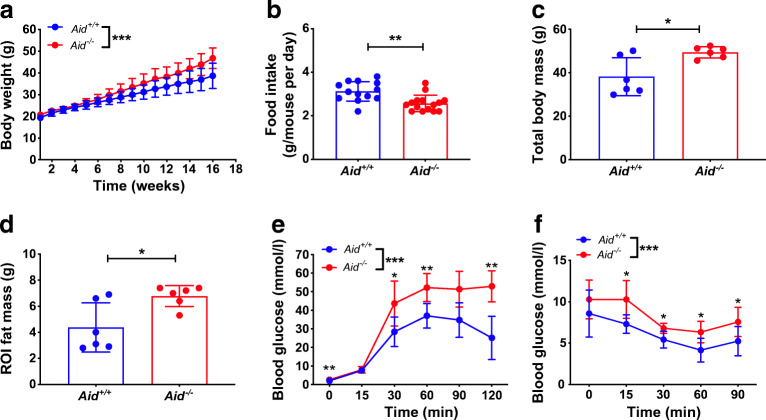
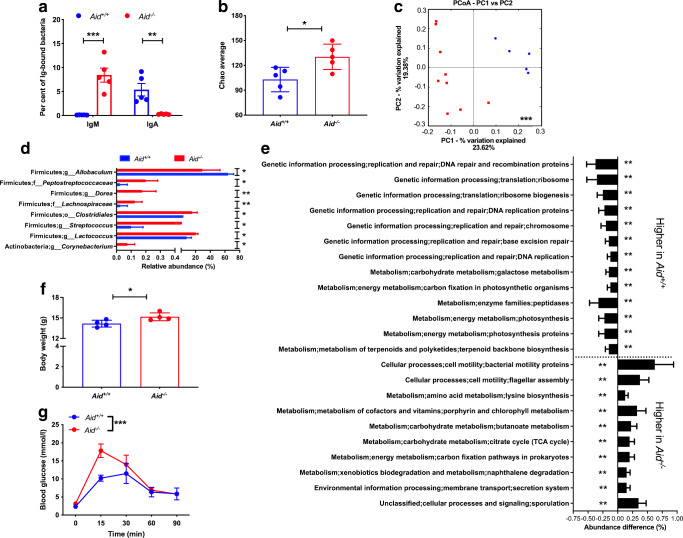
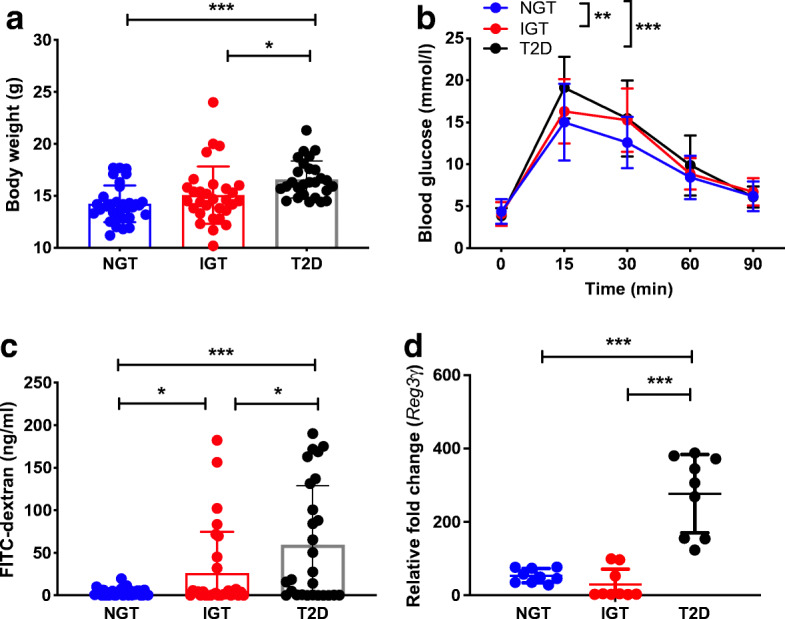
Compared with wild-type mice, Aid B6 mice developed exacerbated HFDIO due to abundant levels of IgM. FMT from Aid B6 to GF B6 mice promoted greater weight gain in recipient mice compared with FMT using wild-type mouse faecal microbiota. Obese youth with type 2 diabetes had more IgM-bound gut bacteria. Using the stools from the obese youth with type 2 diabetes for FMT to GF B6 mice, we observed that the gut microbiota promoted body weight gain and impaired glucose tolerance in the recipient GF B6 mice. Importantly, some clinical features of these obese young individuals were mirrored in the GF B6 mice following FMT.
CONCLUSIONS/INTERPRETATION: Our results suggest that IgM-bound gut microbiota may play an important role in the immuno-pathogenesis of obesity and type 2 diabetes, and provide a novel link between IgM in obesity and type 2 diabetes in both mice and humans.
The 16s rRNA sequencing datasets supporting the current study have been deposited in the NCBI SRA public repository ( https://www.ncbi.nlm.nih.gov/sra ; accession no. SAMN18796639).
目的/假设:IgM 是 B 细胞产生的主要抗体,我们假设针对肠道微生物群的 IgM 抗体可能在肥胖和 2 型糖尿病的免疫代谢中发挥作用。为了验证我们的假设,我们使用缺乏激活诱导的胞嘧啶脱氨酶(Aid[也称为 Aicda])的 B6 小鼠进行实验,这些小鼠只分泌 IgM 抗体,并使用人类粪便样本。
我们研究了在高脂肪饮食诱导的肥胖(HFDIO)中,与野生型小鼠相比,Aid B6 小鼠的免疫代谢效应和肠道微生物变化。为了确定小鼠和人类之间的相似性,我们从肥胖但糖耐量正常(NGT)、肥胖但糖耐量受损(IGT)或肥胖且新诊断为 2 型糖尿病的儿童和青少年中收集了粪便样本,进行粪便微生物群移植(FMT)到无菌(GF)B6 小鼠中,并评估了 IgM 结合细菌和免疫反应。
与野生型小鼠相比,由于 IgM 水平丰富,Aid B6 小鼠发展出更严重的 HFDIO。与使用野生型小鼠粪便微生物群进行的 FMT 相比,Aid B6 到 GF B6 小鼠的 FMT 促进了受体小鼠更大的体重增加。患有 2 型糖尿病的肥胖青少年有更多的 IgM 结合肠道细菌。使用来自患有 2 型糖尿病的肥胖青少年的粪便进行 FMT 到 GF B6 小鼠,我们观察到肠道微生物群促进了受体 GF B6 小鼠的体重增加和葡萄糖耐量受损。重要的是,在接受 FMT 后的 GF B6 小鼠中,这些肥胖年轻个体的一些临床特征得到了反映。
结论/解释:我们的结果表明,IgM 结合的肠道微生物群可能在肥胖和 2 型糖尿病的免疫发病机制中发挥重要作用,并为肥胖和 2 型糖尿病中 IgM 的作用提供了一个新的联系,在小鼠和人类中均如此。
支持本研究的 16s rRNA 测序数据集已存入 NCBI SRA 公共存储库(https://www.ncbi.nlm.nih.gov/sra;访问号 SAMN18796639)。