Department of Chemistry, Macalester College, Saint Paul, Minnesota, United States of America.
Department of Sociology, Macalester College, Saint Paul, Minnesota, United States of America.
PLoS One. 2022 May 19;17(5):e0267580. doi: 10.1371/journal.pone.0267580. eCollection 2022.
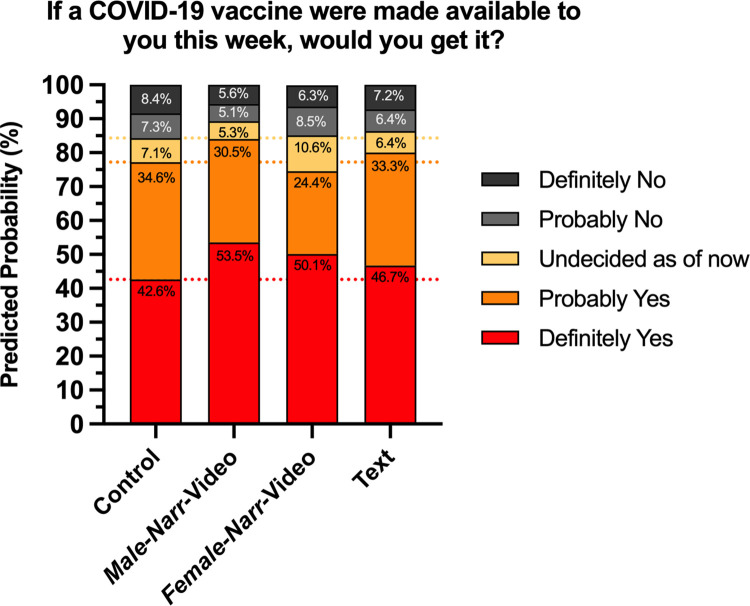
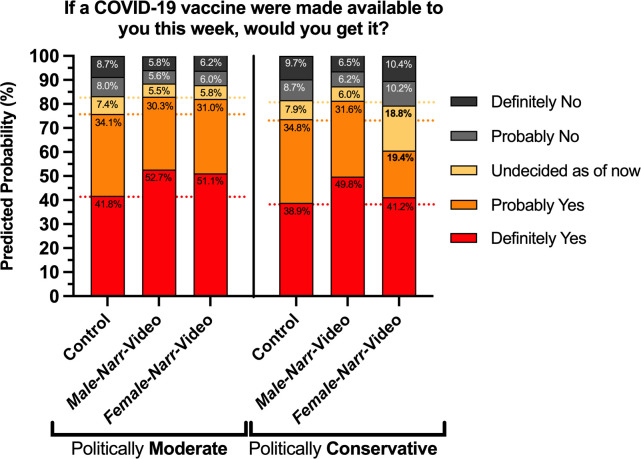
Increasing acceptance of COVID-19 vaccines is imperative for public health. Previous research on educational interventions to overcome vaccine hesitancy have shown mixed effects in increasing vaccination intention, although much of this work has focused on parental attitudes toward childhood vaccination. In this study, we conducted a randomized controlled trial to investigate whether vaccination intention changes after viewing an animated YouTube video explaining how COVID-19 mRNA vaccines work. We exposed participants to one of four interventions-watching the video with a male narrator, watching the same video with a female narrator, reading the text of the transcript of the video, or receiving no information (control group). We found that participants who watched the version of the video with a male narrator expressed statistically significant increased vaccination intention compared to the control group. The video with a female narrator had more variation in results. As a whole, there was a non-significant increased vaccination intention when analyzing all participants who saw the video with a female narrator; however, for politically conservative participants there was decreased vaccination intention for this intervention compared to the control group at a threshold between being currently undecided and expressing probable interest. These results are encouraging for the ability of interventions as simple as YouTube videos to increase vaccination propensity, although the inconsistent response to the video with a female narrator demonstrates the potential for bias to affect how certain groups respond to different messengers.
提高公众对 COVID-19 疫苗的接受程度对公共卫生至关重要。先前关于克服疫苗犹豫的教育干预的研究表明,这些干预措施在增加接种意愿方面的效果不一,尽管其中大部分研究都集中在父母对儿童疫苗接种的态度上。在这项研究中,我们进行了一项随机对照试验,以调查观看一个解释 COVID-19 mRNA 疫苗如何工作的动画 YouTube 视频后,接种意愿是否会发生变化。我们让参与者接触到四种干预措施中的一种——观看带有男性解说员的视频、观看带有女性解说员的相同视频、阅读视频文字记录或不接受任何信息(对照组)。我们发现,与对照组相比,观看带有男性解说员的视频的参与者表示接种意愿显著增加。带有女性解说员的视频的结果变化更大。总的来说,当分析所有观看带有女性解说员的视频的参与者时,接种意愿有非显著增加;然而,对于政治保守派参与者来说,与对照组相比,这种干预措施的接种意愿降低,因为这一干预措施在目前犹豫不决和表达可能的兴趣之间的门槛上。这些结果令人鼓舞,因为像 YouTube 视频这样简单的干预措施能够提高接种意愿,尽管对带有女性解说员的视频的反应不一致表明,偏见有可能影响某些群体对不同信息传递者的反应。