Division of Health Systems and Public Health, Department of Global Health, Faculty of Medicine and Health Sciences, Stellenbosch University, Cape Town, Western Cape, South Africa
Cochrane South Africa, South African Medical Research Council, Cape Town, Western Cape, South Africa.
BMJ Open. 2019 Dec 11;9(12):e033245. doi: 10.1136/bmjopen-2019-033245.
Vaccine hesitancy, defined as the delay in acceptance or refusal of vaccination despite availability of vaccination services is responsible in part for suboptimal levels of vaccination coverage worldwide. The WHO recommends that countries incorporate plans to measure and address vaccine hesitancy into their immunisation programmes. This requires that governments and health institutions be able to detect concerns about vaccination in the population and monitor changes in vaccination behaviours. To do this effectively, tools to detect and measure vaccine hesitancy are required. The purpose of this scoping review is to give a broad overview of currently available vaccine hesitancy measuring tools and present a summary of their nature, similarities and differences.
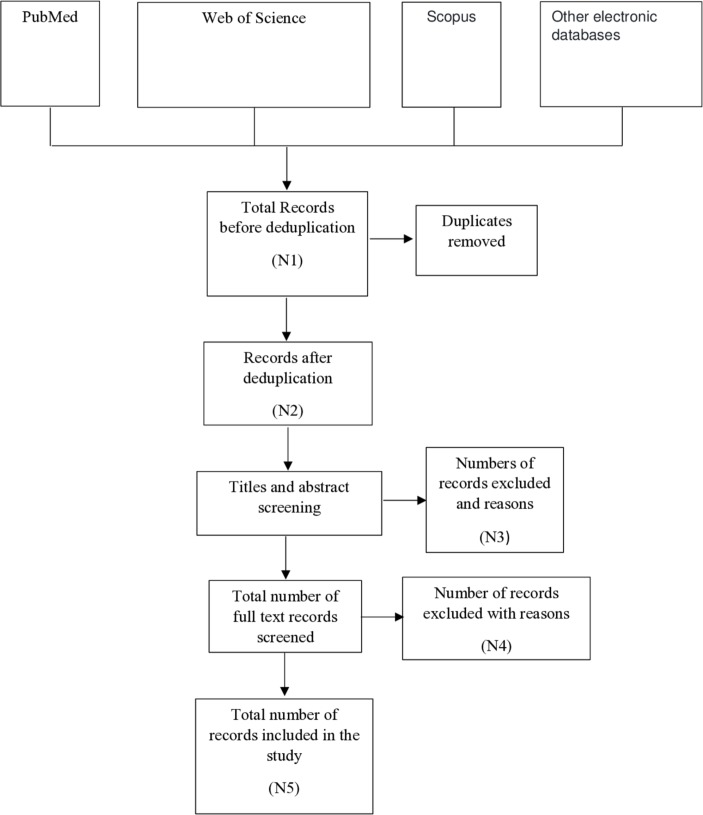
The review will be conducted using the framework for scoping review proffered by Arksey and O'Malley. It will comply with the Preferred Reporting Items for Systematic reviews and Meta-Analyses extension for Scoping Reviews' guidelines. The broader research question of this review is: what vaccine hesitancy measuring tools are currently available?Search strategies will be developed using controlled vocabulary and selected keywords. PubMed, Web of Science, Scopus and reference lists of relevant publications will be searched. Titles and abstracts will be independently screened by two authors and data from full-text articles meeting the inclusion criteria will be extracted independently by two authors using a pretested data charting form. Discrepancies will be resolved by discussion and consensus. Results will be presented using descriptive statistics such as percentages, tables, charts and flow diagrams as appropriate. Narrative analysis will be used to summarise the findings of the review.
Ethics approval is not required for the review. It will be submitted as part of a doctoral thesis, presented at conferences and published in a peer-reviewed journal.
疫苗犹豫是指尽管可获得疫苗接种服务,但仍延迟接受或拒绝接种疫苗,这在一定程度上导致了全球疫苗接种覆盖率不理想。世界卫生组织建议各国将衡量和解决疫苗犹豫情绪的计划纳入其免疫规划。这要求政府和卫生机构能够在人群中发现对疫苗的担忧,并监测接种行为的变化。为了有效地做到这一点,需要有工具来发现和衡量疫苗犹豫。本研究旨在广泛概述当前可用的疫苗犹豫衡量工具,并对其性质、相似点和差异进行总结。
本综述将采用 Arksey 和 O'Malley 提出的综述框架进行。它将符合系统评价和 Meta 分析扩展的首选报告项目对范围综述的指南。本综述更广泛的研究问题是:目前有哪些疫苗犹豫测量工具?将使用受控词汇和选定的关键词制定搜索策略。将搜索 PubMed、Web of Science、Scopus 和相关出版物的参考文献列表。两位作者将独立筛选标题和摘要,符合纳入标准的全文文章的数据将由两位作者使用预测试的数据图表表格独立提取。如有分歧,将通过讨论和达成共识来解决。结果将使用适当的描述性统计数据(如百分比、表格、图表和流程图)呈现。叙事分析将用于总结综述结果。
本综述不需要伦理批准。它将作为博士论文的一部分提交,在会议上展示,并在同行评议的期刊上发表。