The Kirby Institute, University of New South Wales, Sydney, Australia.
The University of Melbourne, Melbourne, Australia.
PLoS Negl Trop Dis. 2022 May 23;16(5):e0010350. doi: 10.1371/journal.pntd.0010350. eCollection 2022 May.
The Kato-Katz microscopy technique is the global standard for assessment of soil-transmitted helminth (STH) burden. However, major limitations include its poor sensitivity, requirement for rapid sample processing, and inability to differentiate hookworm species nor detect Strongyloides spp. infections. We assessed the prevalence and intensity of STH species in Solomon Islands by conducting a province-wide survey using quantitative PCR (qPCR) for diagnosis, which can provide much better characterisation of STH burden than microscopy.
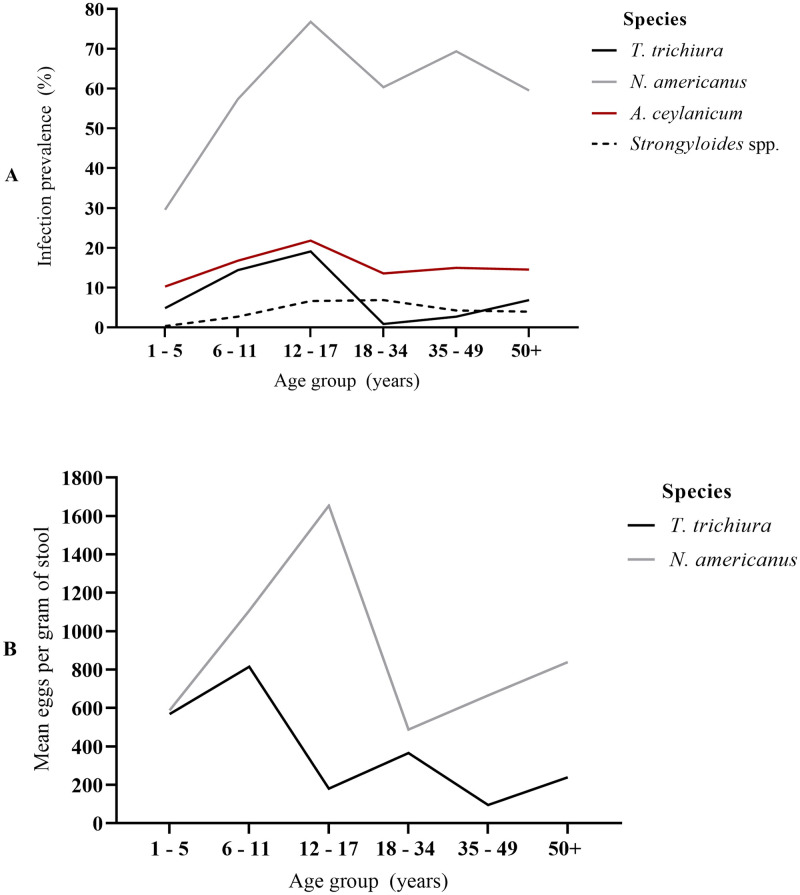
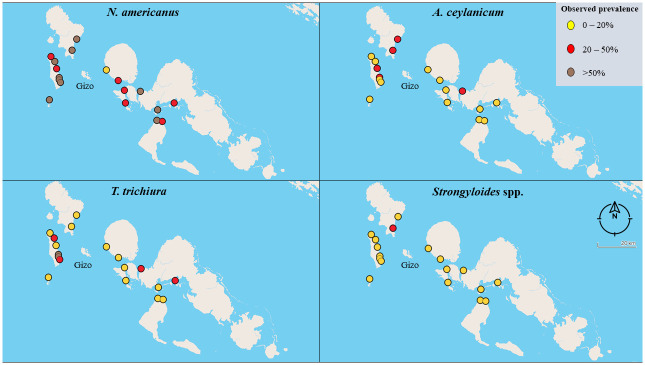
METHODOLOGY/PRINCIPAL FINDINGS: We conducted a cross-sectional survey in 18 villages in Western Province to detect infections with six STH species and quantify intensity with three. We used linear mixed model regression to identify potential water, sanitation, and hygiene (WASH) and environmental risk factors for infection. We collected stool specimens from 830 village residents. Overall STH prevalence was 63.3% (range 27.5 to 91.5% across villages), led by Necator americanus (54.5% [range 17.5-89.4%]), followed by Ancylostoma ceylanicum (15.5% [range 2.8-45.8%]), Trichuris trichiura (9.1% [range 0-79.2%]), and Strongyloides spp. (3.2% [range 0-29.2%]). Most infections were of light intensity for N. americanus (85.7%) and T. trichiura (90.7%). Owning a household latrine was associated with a lower risk of N. americanus infection (AOR 0.41, 95% CI 0.24-0.68) while greater precipitation was linked to more common T. trichiura infection (AOR 1.14, 95% CI 1.04-1.25).
CONCLUSION/SIGNIFICANCE: In this first large-scale population survey of STH in the Pacific using qPCR, we found evidence that ivermectin should be incorporated into STH control programmes because of the presence of T. trichiura and Strongyloides spp., both of which are poorly responsive to albendazole. Furthermore, One Health strategies are needed for improved A. ceylanicum and Strongyloides spp. control, WASH access and use should be improved to complement deworming programmes, and control efforts should ideally be expanded to entire communities.
ClinicalTrials.gov Australian and New Zealand Clinical Trials Registry ACTRN12618001086257.
加藤厚涂片显微镜检查法是评估土壤传播性蠕虫(STH)负担的全球标准。然而,其主要局限性包括敏感性差、需要快速处理样本以及无法区分钩虫种类或检测到类圆线虫感染。我们通过使用定量 PCR(qPCR)进行诊断,对所罗门群岛进行了全省范围的调查,以评估 STH 物种的流行率和强度,这可以比显微镜检查更好地描述 STH 负担。
方法/主要发现:我们在西部省的 18 个村庄进行了横断面调查,以检测六种 STH 物种的感染,并通过三种方法对其强度进行量化。我们使用线性混合模型回归来确定潜在的水、环境卫生和个人卫生(WASH)和环境危险因素与感染之间的关系。我们从 830 名村民中收集了粪便样本。总的 STH 流行率为 63.3%(村庄间的流行率范围为 27.5%至 91.5%),由美洲钩虫(54.5%[范围为 17.5%至 89.4%])引起,其次是钩虫(15.5%[范围为 2.8%至 45.8%])、鞭虫(9.1%[范围为 0%至 79.2%])和类圆线虫(3.2%[范围为 0%至 29.2%])。大多数 N. americanus(85.7%)和 T. trichiura(90.7%)感染的强度较轻。拥有家庭厕所与 N. americanus 感染的风险降低有关(AOR 0.41,95%CI 0.24-0.68),而降水较多则与更常见的 T. trichiura 感染有关(AOR 1.14,95%CI 1.04-1.25)。
结论/意义:在使用 qPCR 对太平洋地区进行的首次大型 STH 人群调查中,我们发现有证据表明,应该将伊维菌素纳入 STH 控制计划,因为存在鞭虫和类圆线虫,而这两种寄生虫对阿苯达唑的反应都很差。此外,需要采取“同一健康”策略来更好地控制 A. ceylanicum 和类圆线虫,应改善水环境卫生和个人卫生条件的获取和使用,以补充驱虫方案,并且最好将控制工作扩大到整个社区。
ClinicalTrials.gov 澳大利亚和新西兰临床试验注册 ACTRN12618001086257。