Elmose Signe F, Andersen Gustav O, Carreon Leah Yacat, Sigmundsson Freyr G, Andersen Mikkel O
Center for Spine Surgery and Research, Spine Center of Southern Denmark, 371420Lillebaelt Hospital, Middelfart, Denmark.
Department of Orthopaedic surgery, 98837Örebro University Hospital, Örebro, Sweden.
Global Spine J. 2023 Mar;13(2):523-533. doi: 10.1177/21925682221099854. Epub 2022 May 23.
Systematic Review.
To collect and group definitions of segmental instability, reported in surgical studies of patients with lumbar spinal stenosis (LSS) and/or lumbar degenerative spondylolisthesis (LDS). To report the frequencies of these definitions. To report on imaging measurement thresholds for instability in patients and compare these to those reported in biomechanical studies and studies of spine healthy individuals.To report on studies that include a reliability study.
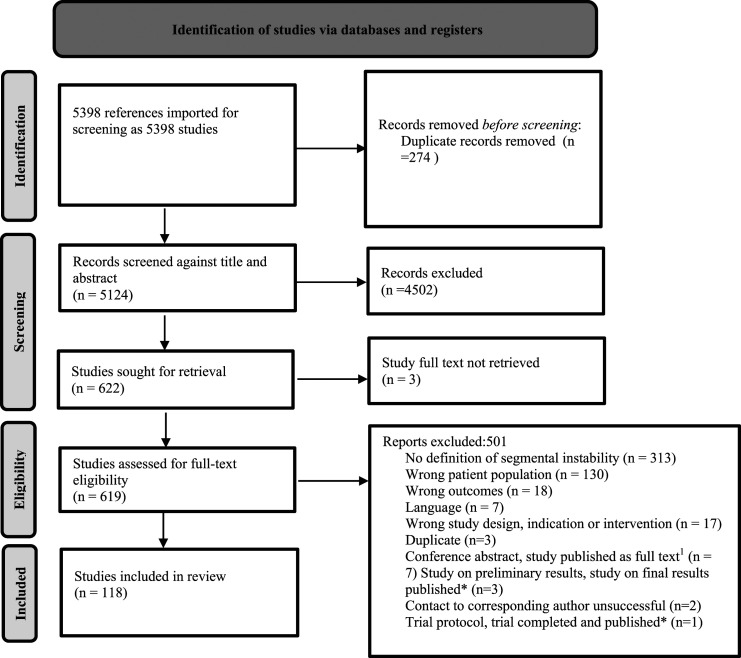
This review was conducted according to Preferred Reporting Items for Systematic Reviews and Meta-Analysis (PRISMA) guidelines. Studies eligible for inclusion were clinical and biomechanical studies on adult patients with LDS and/or LSS who underwent surgical treatment and had data on diagnostic imaging. A systematic literature search was conducted in relevant literature databases. Full text screening inclusion criteria was definition of segmental instability or any synonym. Two reviewers independently screened articles in a two-step process. Data synthesis presented by tabulate form and narrative synthesis.
We included 118 studies for data extraction, 69% were surgical studies with decompression or fusion as interventions, 31% non-interventional studies. Grouping the definitions of segmental instability according similarities showed that 24% defined instability by dynamic sagittal translation, 26% dynamic translation and dynamic angulation, 8% used a narrative definition. Comparison showed that non-interventional studies with a healthy population more often had a narrative definition.
Despite a reputation of non-consensus, segmental instability in the degenerative lumbar spine can radiologically be defined as > 3 mm dynamic sagittal translation.
系统评价。
收集并整理腰椎管狭窄症(LSS)和/或腰椎退行性滑脱症(LDS)患者手术研究中报道的节段性不稳定的定义,并进行分组。报告这些定义的出现频率。报告患者不稳定的影像学测量阈值,并与生物力学研究及脊柱健康个体研究中报道的阈值进行比较。报告包含可靠性研究的相关研究。
本评价按照系统评价和Meta分析的首选报告项目(PRISMA)指南进行。纳入的研究为对接受手术治疗且有诊断性影像学数据的LDS和/或LSS成年患者进行的临床和生物力学研究。在相关文献数据库中进行系统的文献检索。全文筛选的纳入标准为节段性不稳定或任何同义词的定义。两名研究者分两步独立筛选文章。数据综合以表格形式呈现并进行叙述性综合。
我们纳入了118项研究进行数据提取,69%为以减压或融合为干预措施的手术研究,31%为非干预性研究。根据相似性对节段性不稳定的定义进行分组后发现,24%通过动态矢状面移位定义不稳定,26%通过动态移位和动态成角定义,8%使用叙述性定义。比较发现,针对健康人群的非干预性研究更常采用叙述性定义。
尽管存在定义不统一的情况,但退行性腰椎节段性不稳定在影像学上可定义为动态矢状面移位>3mm。