Kumar Yogesh, Tarafdar Ayon, Kumar Deepak, Saravanan Chakkaravarthi, Badgujar Prarabdh C, Pharande Aparna, Pareek Sunil, Fawole Olaniyi Amos
Department of Food Science and Technology, National Institute of Food Technology Entrepreneurship and Management, Kundli, Sonipat 131028, Haryana, India.
Department of Food Engineering, National Institute of Food Technology Entrepreneurship and Management, Kundli, Sonipat 131028, Haryana, India.
Antioxidants (Basel). 2022 May 19;11(5):993. doi: 10.3390/antiox11050993.
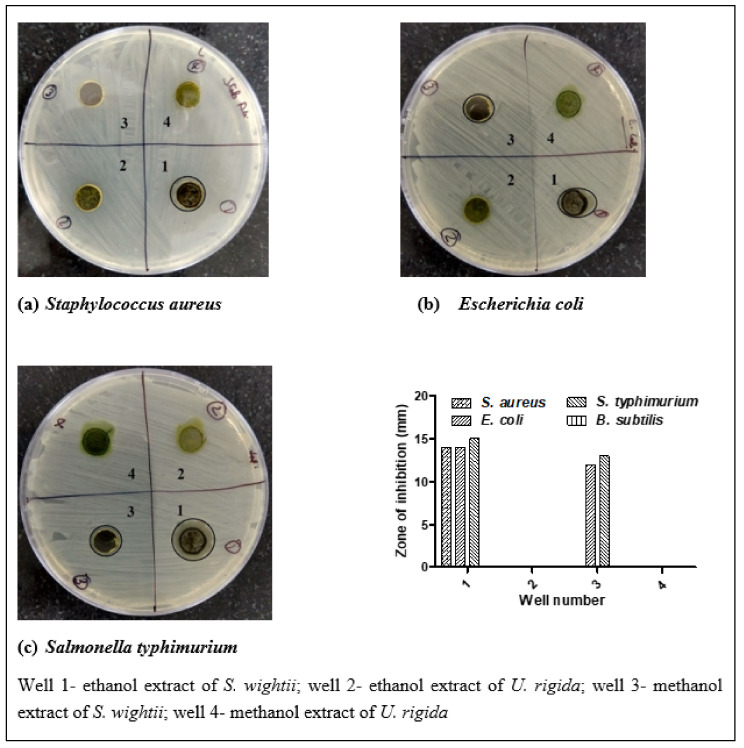
Macroalgae are a rich source of polyphenols, and their ingestion promotes various health benefits. However, information on factors contributing to health benefits such as antioxidants, antimicrobial properties, bioaccessibility, and cytotoxicity is less explored and often unavailable. Therefore, this study aims to investigate the above-mentioned parameters for the brown and green macroalgae Sargassum wightii and Ulva rigida, respectively, collected from the southeast coast of India. S. wightii exhibited higher antioxidant activity and moderate antimicrobial activity against major food pathogens in an agar well diffusion assay and in the broth microdilution method (MIC50 being <0.5 mg/mL for all microorganisms tested). Both macroalgae extracts exhibited significantly high bioaccessibility of polyphenols. To evaluate the safety of the extracts, in vitro cytotoxicity by a 3-(4,5-dimethylthiazol-2-yl)-2,5-diphenyl tetrazolium bromide (MTT) assay was carried out on the primary cells: mouse splenic lymphocytes. An almost complete decline in the cell viability was seen at considerably high concentration (50 mg/mL), expressing the reasonably high safety of the extracts. The extracts of both macroalgae were quantified for polyphenols, wherein fucoxanthin (9.27 ± 2.28 mg/kg DW) and phloroglucinol (17.96 ± 2.80 mg/kg DW) were found to be greater in the S. wightii apart from other phenolics, like gallic acid, quercetin, vanillin, and ferulic acid. The results signify the tremendous scope for the value addition of S. wightii through extraction and purification of polyphenols for its potential exploitation in functional foods and nutraceuticals or as an antimicrobial ingredient in active or smart packaging.
大型藻类是多酚的丰富来源,摄入后对健康有多种益处。然而,关于有助于健康的因素,如抗氧化剂、抗菌特性、生物可及性和细胞毒性等方面的信息研究较少,且往往难以获取。因此,本研究旨在分别调查从印度东南海岸采集的褐藻和绿藻——半叶马尾藻和硬石莼的上述参数。在琼脂扩散法和肉汤微量稀释法中,半叶马尾藻对主要食品病原体表现出较高的抗氧化活性和中等抗菌活性(所有测试微生物的MIC50均<0.5 mg/mL)。两种大型藻类提取物均表现出显著高的多酚生物可及性。为评估提取物的安全性,采用3-(4,5-二甲基噻唑-2-基)-2,5-二苯基四氮唑溴盐(MTT)法对原代细胞——小鼠脾淋巴细胞进行了体外细胞毒性试验。在相当高的浓度(50 mg/mL)下,细胞活力几乎完全下降,表明提取物具有相当高的安全性。对两种大型藻类的提取物进行了多酚定量分析,结果发现,除了没食子酸、槲皮素、香草醛和阿魏酸等其他酚类物质外,半叶马尾藻中的岩藻黄质(9.27±2.28 mg/kg干重)和间苯三酚(17.96±2.80 mg/kg干重)含量更高。这些结果表明,通过提取和纯化多酚,半叶马尾藻在功能性食品和营养保健品中的潜在应用,或作为活性或智能包装中的抗菌成分,具有巨大的增值潜力。