Cantoni Orazio, Zito Ester, Guidarelli Andrea, Fiorani Mara, Ghezzi Pietro
Department of Biomolecular Sciences, University of Urbino Carlo Bo, 61029 Urbino, Italy.
Istituto di Ricerche Farmacologiche Mario Negri IRCCS, 20156 Milan, Italy.
Antioxidants (Basel). 2022 May 23;11(5):1034. doi: 10.3390/antiox11051034.
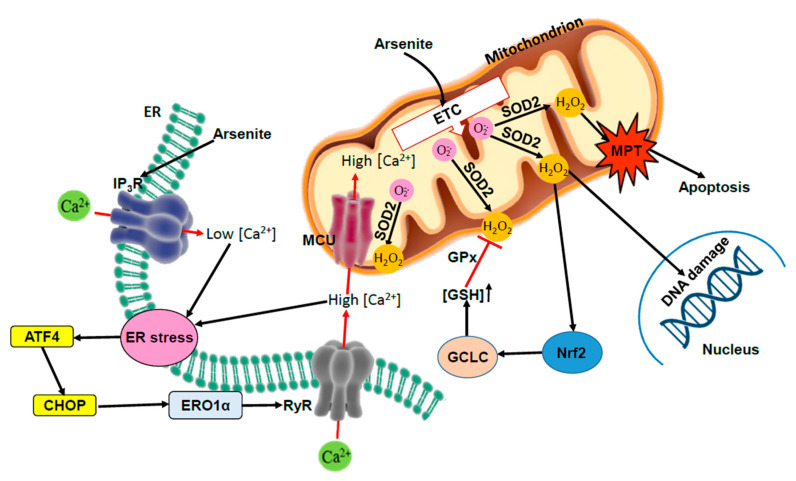
Long-term ingestion of arsenicals, a heterogeneous group of toxic compounds, has been associated with a wide spectrum of human pathologies, which include various malignancies. Although their mechanism of toxicity remains largely unknown, it is generally believed that arsenicals mainly produce their effects via direct binding to protein thiols and ROS formation in different subcellular compartments. The generality of these mechanisms most probably accounts for the different effects mediated by different forms of the metalloid in a variety of cells and tissues. In order to learn more about the molecular mechanisms of cyto- and genotoxicity, there is a need to focus on specific arsenic compounds under tightly controlled conditions. This review focuses on the mechanisms regulating the mitochondrial formation of ROS after exposure to low concentrations of a specific arsenic compound, NaAsO, and their crosstalk with the nuclear factor (erythroid-2 related) factor 2 antioxidant signaling and the endoplasmic reticulum stress response.
长期摄入砷化合物(一类异质性的有毒化合物)与多种人类疾病有关,其中包括各种恶性肿瘤。尽管它们的毒性机制在很大程度上仍不清楚,但一般认为砷化合物主要通过直接结合蛋白质硫醇以及在不同亚细胞区室中形成活性氧(ROS)来产生其效应。这些机制的普遍性很可能解释了不同形式的类金属在多种细胞和组织中介导的不同效应。为了更多地了解细胞毒性和遗传毒性的分子机制,有必要在严格控制的条件下关注特定的砷化合物。本综述聚焦于暴露于低浓度特定砷化合物偏亚砷酸钠(NaAsO₂)后线粒体ROS形成的调控机制,以及它们与核因子(红系衍生2样)因子2抗氧化信号通路和内质网应激反应之间的相互作用。