Auer David L, Mao Xiaojun, Anderson Annette Carola, Muehler Denise, Wittmer Annette, von Ohle Christiane, Wolff Diana, Frese Cornelia, Hiller Karl-Anton, Maisch Tim, Buchalla Wolfgang, Hellwig Elmar, Al-Ahmad Ali, Cieplik Fabian
Department of Conservative Dentistry and Periodontology, University Hospital Regensburg, 93053 Regensburg, Germany.
Department of Operative Dentistry and Periodontology, Center for Dental Medicine, Faculty of Medicine, University of Freiburg, 79085 Freiburg im Breisgau, Germany.
Antibiotics (Basel). 2022 May 19;11(5):688. doi: 10.3390/antibiotics11050688.
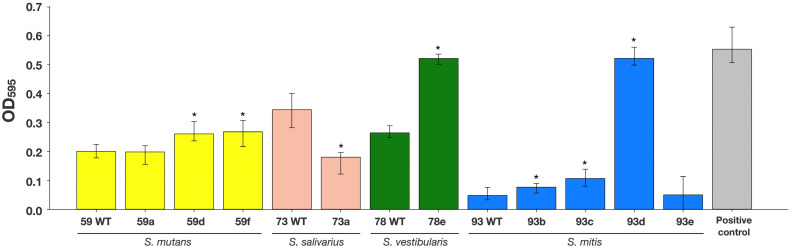
Despite the wide-spread use of antiseptics in dental practice and oral care products, there is little public awareness of potential risks associated with antiseptic resistance and potentially concomitant cross-resistance. Therefore, the aim of this study was to investigate potential phenotypic adaptation in 177 clinical isolates of early colonizers of dental plaque (, , and spp.) upon repeated exposure to subinhibitory concentrations of chlorhexidine digluconate (CHX) or cetylpyridinium chloride (CPC) over 10 passages using a modified microdilution method. Stability of phenotypic adaptation was re-evaluated after culture in antiseptic-free nutrient broth for 24 or 72 h. Strains showing 8-fold minimal inhibitory concentration (MIC)-increase were further examined regarding their biofilm formation capacity, phenotypic antibiotic resistance and presence of antibiotic resistance genes (ARGs). Eight-fold MIC-increases to CHX were detected in four isolates. These strains mostly exhibited significantly increased biofilm formation capacity compared to their respective wild-type strains. Phenotypic antibiotic resistance was detected to tetracycline and erythromycin, consistent with the detected ARGs. In conclusion, this study shows that clinical isolates of early colonizers of dental plaque can phenotypically adapt toward antiseptics such as CHX upon repeated exposure. The underlying mechanisms at genomic and transcriptomic levels need to be investigated in future studies.
尽管防腐剂在牙科实践和口腔护理产品中广泛使用,但公众对与抗菌剂耐药性以及潜在的伴随交叉耐药性相关的潜在风险知之甚少。因此,本研究的目的是使用改良的微量稀释法,在10代培养过程中,对177株牙菌斑早期定植菌(、、和 spp.)的临床分离株反复暴露于亚抑菌浓度的葡萄糖酸洗必泰(CHX)或氯化十六烷基吡啶(CPC)后,研究其潜在的表型适应性。在无防腐剂的营养肉汤中培养24或72小时后,重新评估表型适应性的稳定性。对显示最低抑菌浓度(MIC)增加8倍的菌株,进一步检测其生物膜形成能力、表型抗生素耐药性以及抗生素耐药基因(ARG)的存在情况。在4株分离株中检测到对CHX的MIC增加了8倍。与各自的野生型菌株相比,这些菌株大多表现出生物膜形成能力显著增强。检测到对四环素和红霉素的表型抗生素耐药性,与检测到的ARG一致。总之,本研究表明,牙菌斑早期定植菌的临床分离株在反复暴露后可在表型上适应CHX等防腐剂。基因组和转录组水平的潜在机制需要在未来的研究中进行调查。