Raj Anish, Tollens Fabian, Hansen Laura, Golla Alena-Kathrin, Schad Lothar R, Nörenberg Dominik, Zöllner Frank G
Computer Assisted Clinical Medicine, Mannheim Institute for Intelligent Systems in Medicine, Medical Faculty Mannheim, Heidelberg University, 68167 Mannheim, Germany.
Department of Radiology and Nuclear Medicine, University Medical Centre Mannheim, Medical Faculty Mannheim, Heidelberg University, 68167 Mannheim, Germany.
Diagnostics (Basel). 2022 May 7;12(5):1159. doi: 10.3390/diagnostics12051159.
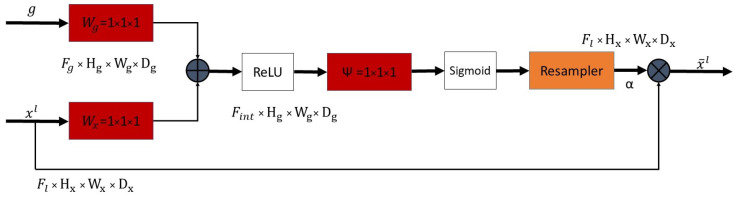
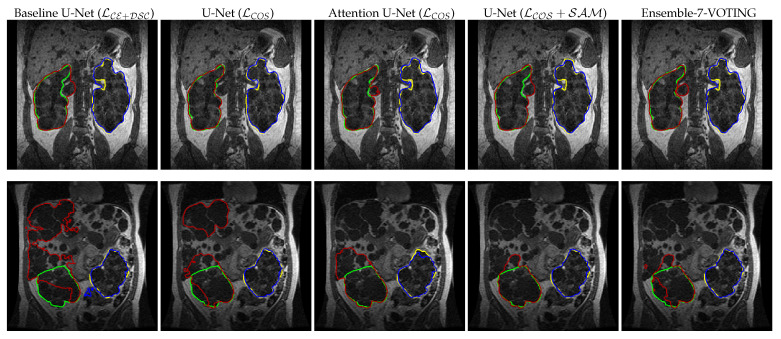
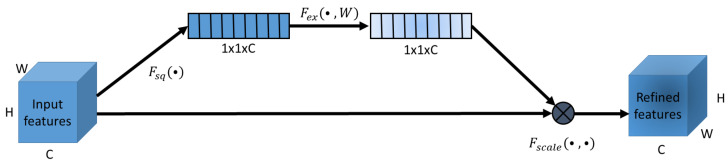
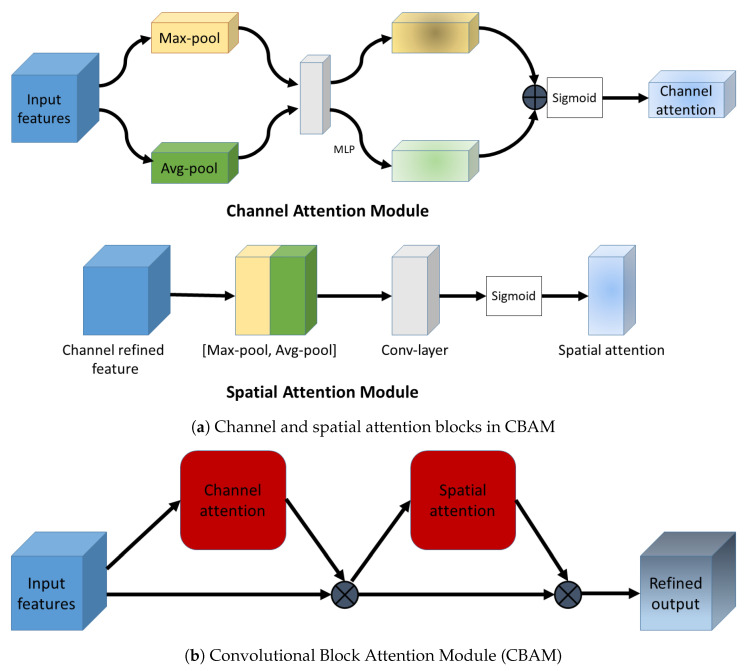
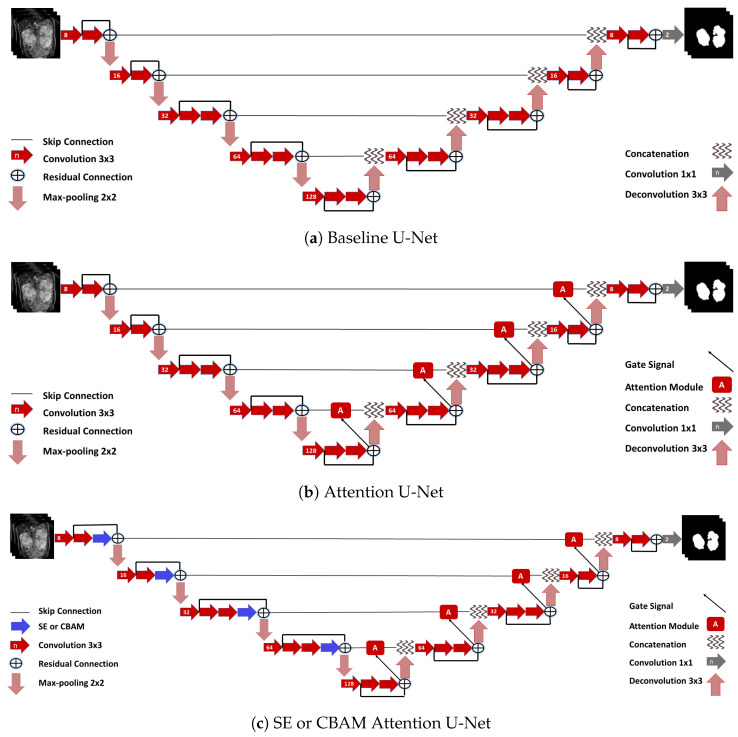
Early detection of the autosomal dominant polycystic kidney disease (ADPKD) is crucial as it is one of the most common causes of end-stage renal disease (ESRD) and kidney failure. The total kidney volume (TKV) can be used as a biomarker to quantify disease progression. The TKV calculation requires accurate delineation of kidney volumes, which is usually performed manually by an expert physician. However, this is time-consuming and automated segmentation is warranted. Furthermore, the scarcity of large annotated datasets hinders the development of deep learning solutions. In this work, we address this problem by implementing three attention mechanisms into the U-Net to improve TKV estimation. Additionally, we implement a cosine loss function that works well on image classification tasks with small datasets. Lastly, we apply a technique called sharpness aware minimization (SAM) that helps improve the generalizability of networks. Our results show significant improvements (p-value < 0.05) over the reference kidney segmentation U-Net. We show that the attention mechanisms and/or the cosine loss with SAM can achieve a dice score (DSC) of 0.918, a mean symmetric surface distance (MSSD) of 1.20 mm with the mean TKV difference of −1.72%, and R2 of 0.96 while using only 100 MRI datasets for training and testing. Furthermore, we tested four ensembles and obtained improvements over the best individual network, achieving a DSC and MSSD of 0.922 and 1.09 mm, respectively.
常染色体显性多囊肾病(ADPKD)的早期检测至关重要,因为它是终末期肾病(ESRD)和肾衰竭最常见的病因之一。总肾体积(TKV)可作为一种生物标志物来量化疾病进展。TKV的计算需要准确勾勒出肾脏体积,这通常由专家医生手动完成。然而,这很耗时,因此需要自动化分割。此外,大型标注数据集的稀缺阻碍了深度学习解决方案的开发。在这项工作中,我们通过在U-Net中实现三种注意力机制来解决这个问题,以改进TKV估计。此外,我们实现了一种余弦损失函数,该函数在小数据集的图像分类任务中表现良好。最后,我们应用了一种称为锐度感知最小化(SAM)的技术,该技术有助于提高网络的泛化能力。我们的结果显示,与参考肾脏分割U-Net相比有显著改进(p值<0.05)。我们表明,注意力机制和/或结合SAM的余弦损失在仅使用100个MRI数据集进行训练和测试时,可实现骰子系数(DSC)为0.918,平均对称表面距离(MSSD)为1.20毫米,平均TKV差异为-1.72%,R2为0.96。此外,我们测试了四个集成模型,与最佳单个网络相比有改进,分别实现了DSC为0.922和MSSD为1.09毫米。