Yan Fei, Qu Dong, Chen Xiaohua, Zeng Haitao, Li Xinsheng, Hu Ching Yuan
Shaanxi Provincial Bioresource Key Laboratory, College of Biological Science and Engineering, Shaanxi University of Technology, Hanzhong 723000, China.
Qinling-Bashan Mountains Bioresources Comprehensive Development C. I. C, Hanzhong 723001, China.
Metabolites. 2022 Apr 26;12(5):392. doi: 10.3390/metabo12050392.
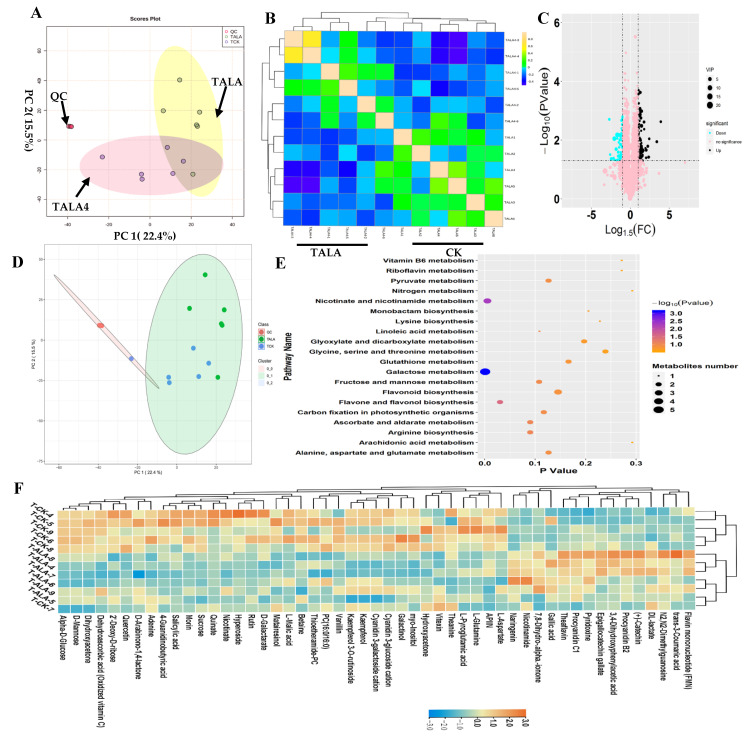
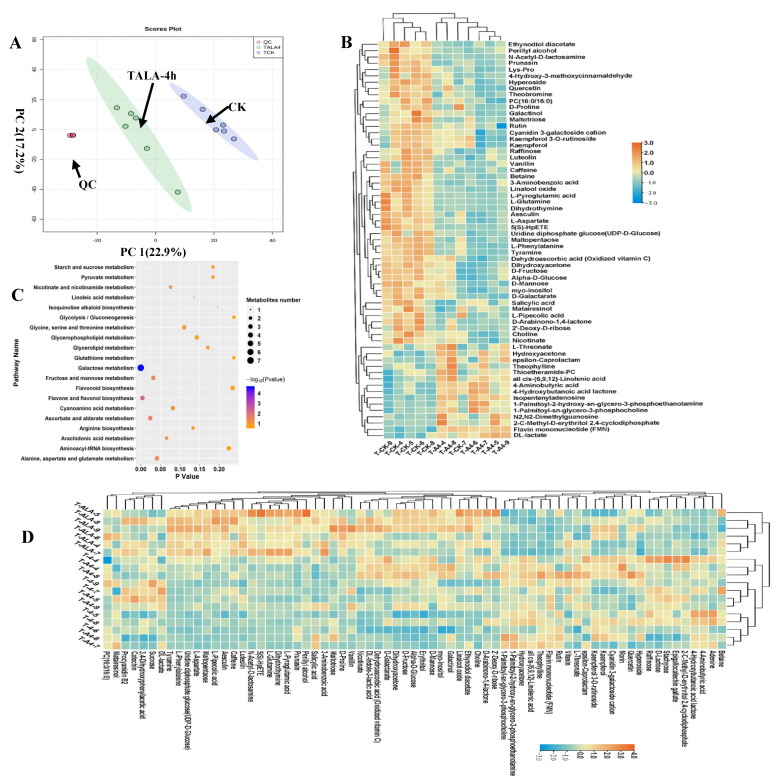
Tea is an important woody crop whose cultivation is severely limited by cold stress. Although 5-aminolevulinic acid (ALA) is known to be effective in alleviating abiotic stresses in plants, knowledge of the detailed metabolic response of tea plants to exogenous ALA-induced cold resistance is still limited-a lack which restricts our ability to protect tea plants from cold stress. In the present study, we performed an in-depth metabolomics analysis to elucidate the metabolic responses of tea plants to cold stress and explore the role of ALA in improving tea plants' cold-resistance capability. Metabolic profiles showed that cold stress altered various metabolisms in tea plants, especially galactose composition and flavonoid contents. Furthermore, exogenous ALA application altered a series of metabolisms associated with cold stress. Importantly, increases in metabolites, including catechin, 3,4-dihydroxyphenylacetic acid and procyanidin B2, involved in the mechanisms of ALA improved tea plants' cold resistance. Overall, our study deciphered detailed metabolic responses of tea plants to cold stress and elucidated the mechanisms of ALA in enhancing cold resistance through rebuilding compositions of soluble carbohydrates and flavonoids. Therefore, we have provided a basis for exogenous usage of ALA to protect tea plants from cold stress.
茶树是一种重要的木本作物,其种植受到冷胁迫的严重限制。尽管已知5-氨基乙酰丙酸(ALA)能有效缓解植物的非生物胁迫,但关于茶树对外源ALA诱导的抗寒性的详细代谢反应的了解仍然有限,这一不足限制了我们保护茶树免受冷胁迫的能力。在本研究中,我们进行了深入的代谢组学分析,以阐明茶树对冷胁迫的代谢反应,并探索ALA在提高茶树抗寒能力中的作用。代谢谱表明,冷胁迫改变了茶树的各种代谢,尤其是半乳糖组成和类黄酮含量。此外,外源施用ALA改变了一系列与冷胁迫相关的代谢。重要的是,包括儿茶素、3,4-二羟基苯乙酸和原花青素B2在内的代谢物增加,参与了ALA提高茶树抗寒性的机制。总体而言,我们的研究破译了茶树对冷胁迫的详细代谢反应,并阐明了ALA通过重建可溶性碳水化合物和类黄酮的组成来增强抗寒性的机制。因此,我们为外源使用ALA保护茶树免受冷胁迫提供了依据。