Division of Neurosurgery, Department of Surgery, Kaohsiung Medical University Hospital, Kaohsiung Medical University, Kaohsiung 807, Taiwan.
Department of Surgery, Kaohsiung Medical University Hospital, Kaohsiung Medical University, Kaohsiung 807, Taiwan.
Medicina (Kaunas). 2022 May 23;58(5):688. doi: 10.3390/medicina58050688.
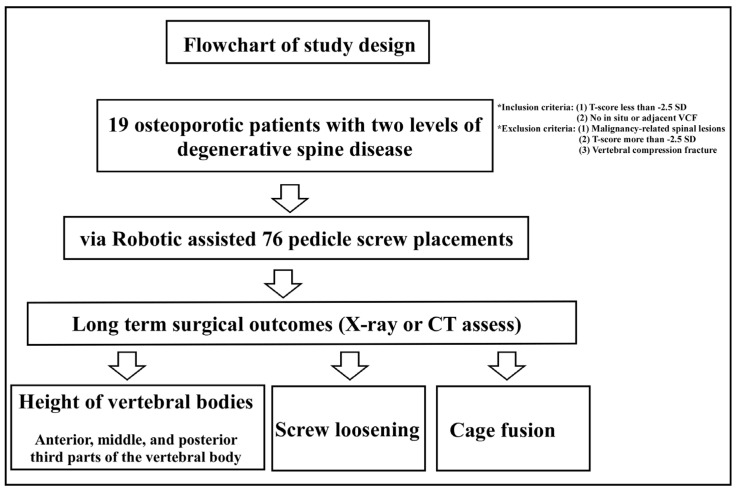
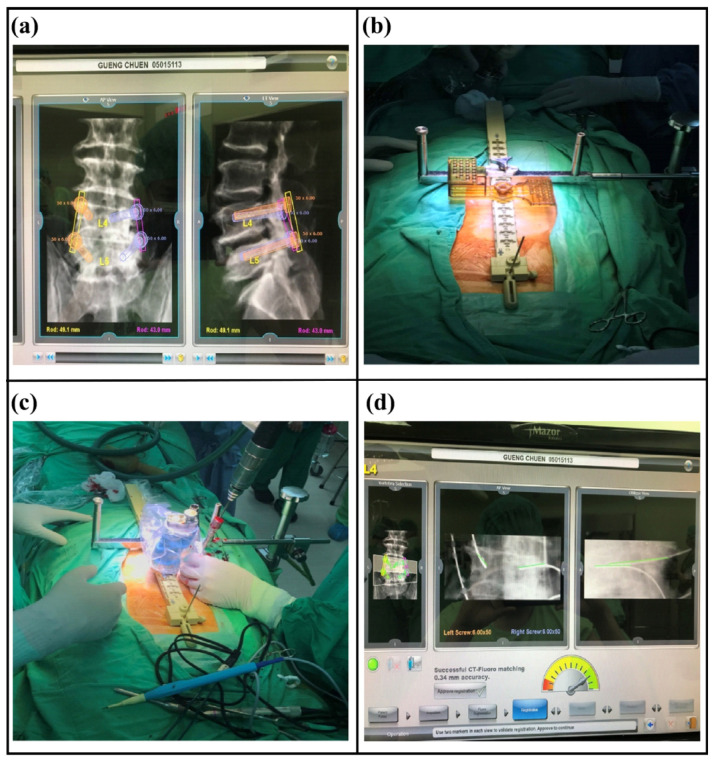
Minimally invasive spine surgery reduces destruction of the paraspinal musculature and improves spinal stability. Nevertheless, screw loosening remains a challenging issue in osteoporosis patients receiving spinal fixation and fusion surgery. Moreover, adjacent vertebral compression fracture is a major complication, particularly in patients with osteoporosis. We assessed long-term imaging results to investigate the outcomes of osteoporosis patients with two-level degenerative spine disease receiving minimally invasive surgery with the assistance of a robotic system. We retrospectively analyzed consecutive osteoporosis patients who underwent minimally invasive surgery with the assistance of a robotic system at our institution during 2013-2016. All patients were diagnosed with osteoporosis according to the World Health Organization criteria. All patients were diagnosed with two levels of spinal degenerative disease, including L34, L45, or L5S1. The study endpoints included screw-loosening condition, cage fusion, and vertebral body heights of the adjacent, first fixation segment, and second fixation segments before and after surgery, including the anterior, middle, and posterior third parts of the vertebral body. Differences in vertebral body heights before and after surgery were evaluated using the F-test. Nineteen consecutive osteoporosis patients were analyzed. A lower rate of screw loosening was observed in osteoporosis patients in our study. There were no significant differences between the preoperative and postoperative vertebral body heights, including adjacent and fixation segments. According to our retrospective study, we report that minimally invasive surgery with the assistance of a robotic system provided better screw fixation, a lower rate of screw loosening, and a lesser extent of vertebral compression fracture after spinal fixation and fusion surgery in osteoporosis patients.
微创脊柱手术减少了脊柱旁肌肉的破坏,提高了脊柱的稳定性。然而,在接受脊柱固定融合手术的骨质疏松症患者中,螺钉松动仍然是一个具有挑战性的问题。此外,邻近椎体压缩性骨折是一个主要的并发症,特别是在骨质疏松症患者中。我们评估了长期影像学结果,以研究接受机器人辅助微创脊柱手术的 2 个节段退行性脊柱疾病骨质疏松症患者的结局。
我们回顾性分析了 2013 年至 2016 年期间在我院接受机器人辅助微创脊柱手术的连续骨质疏松症患者。所有患者均根据世界卫生组织标准诊断为骨质疏松症。所有患者均诊断为两节段脊柱退行性疾病,包括 L34、L45 或 L5S1。研究终点包括螺钉松动情况、 cage 融合情况以及手术前后相邻、第一固定节段和第二固定节段的椎体高度,包括椎体的前、中、后三部分。采用 F 检验评估手术前后椎体高度的差异。
共分析了 19 例连续骨质疏松症患者。在本研究中,骨质疏松症患者的螺钉松动率较低。术前和术后相邻和固定节段的椎体高度无显著差异。
根据我们的回顾性研究,我们报告称,在骨质疏松症患者中,机器人辅助微创脊柱手术提供了更好的螺钉固定、较低的螺钉松动率以及脊柱固定融合术后较小程度的椎体压缩性骨折。