Department of Dermatology, Kyorin University Faculty of Medicine, Tokyo, Japan.
Clinical Development, Research and Development Headquarters Self-Medication, Taisho Pharmaceutical Co.Ltd, Tokyo, Japan.
J Dermatol. 2022 Oct;49(10):939-947. doi: 10.1111/1346-8138.16475. Epub 2022 May 27.
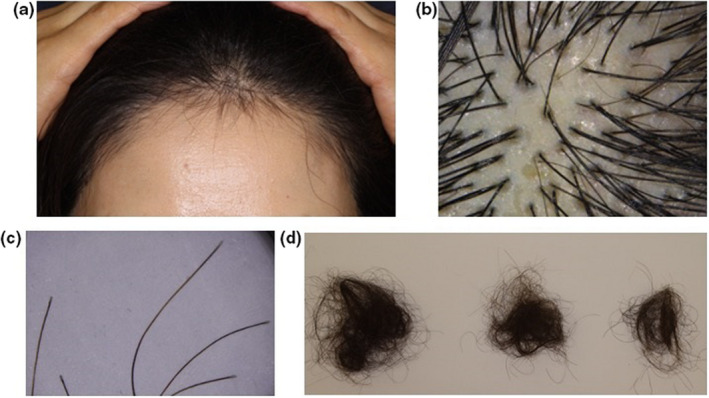
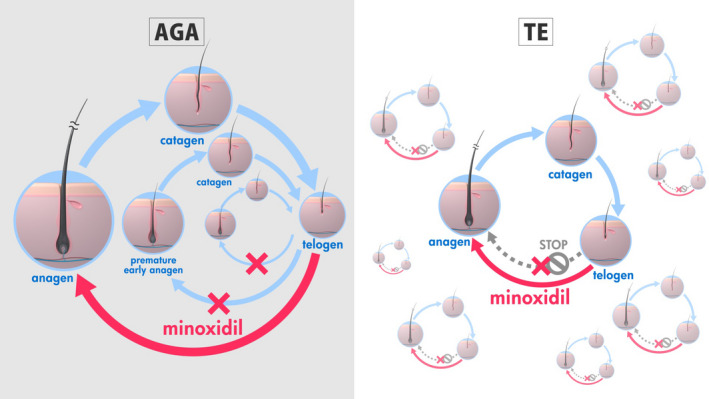
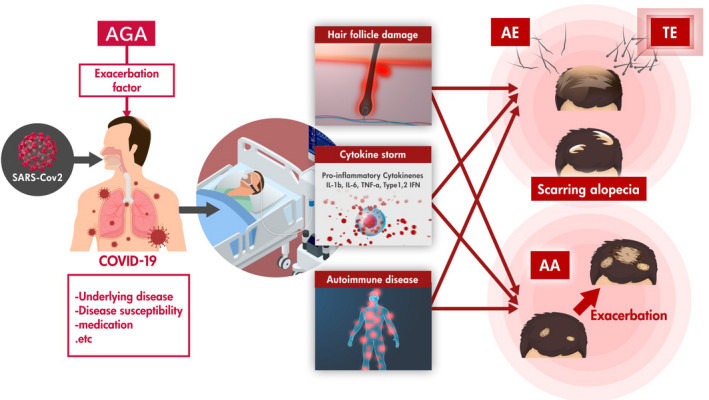
Coronavirus disease 2019 (COVID-19) caused by severe acute respiratory syndrome coronavirus 2 (SARS-CoV-2) was declared a pandemic by the World Health Organization, and COVID-19 continues to have a major impact on society. Numerous studies have reported impaired health sequelae after COVID-19 recovery, one of which is hair loss. Individuals with hair loss experience a substantial mental burden, which potentially hinders their social life. However, few studies have systematically analyzed the details including hair loss. Therefore, we conducted a narrative review using PubMed on the frequency, associated comorbidities, disease characteristics, and treatment of hair loss after SARS-CoV-2 infection (HLASCI). Two search strings were used to identify 28 articles. Of note, most of the literature identified on COVID-19 sequelae reported an emergence/occurrence of hair loss. HLASCI is speculated to be composed of a heterogeneous population, with the onset or exacerbation of telogen effluvium (TE), anagen effluvium, androgenetic alopecia (AGA), and alopecia areata (AA) reported as possible underlying mechanisms. Among these, acute TE is thought to be the primary cause of HLASCI, with COVID-19 treatment and TE improvement being considered crucial for HLASCI management. An association between COVID-19 and AA exacerbation has also been implicated with still insufficient evidence. Spontaneous recovery of TE can be expected once infection reduces; however, faster improvement in symptoms is expected to reduce the mental and social burden of patients. An additional search string identified 11 articles about TE treatment which suggested that the use of minoxidil may be beneficial. Topical minoxidil has been widely used for AGA patients, who have been speculated to exhibit poor resistance to SARS-CoV-2. Topical minoxidil may provide relief from HLASCI, but future clinical research is warranted to confirm this observation.
新型冠状病毒病 2019(COVID-19)由严重急性呼吸综合征冠状病毒 2(SARS-CoV-2)引起,世界卫生组织宣布 COVID-19 为大流行,COVID-19 继续对社会产生重大影响。许多研究报告称 COVID-19 康复后存在健康后遗症,其中之一是脱发。脱发患者会承受很大的精神负担,这可能会影响他们的社交生活。然而,很少有研究系统地分析包括脱发在内的细节。因此,我们使用 PubMed 进行了一项关于 SARS-CoV-2 感染后脱发(HLASCI)的频率、相关合并症、疾病特征和治疗的叙述性综述。使用两个搜索字符串确定了 28 篇文章。值得注意的是,COVID-19 后遗症相关文献大多报道了脱发的出现/发生。推测 HLASCI 由异质人群组成,报告的潜在机制包括休止期脱发(TE)、生长期脱发、雄激素性脱发(AGA)和斑秃(AA)的发作或加重。其中,急性 TE 被认为是 HLASCI 的主要原因,COVID-19 治疗和 TE 改善被认为是 HLASCI 管理的关键。COVID-19 与 AA 加重之间的关联也有报道,但证据仍不充分。一旦感染减少,TE 可自行恢复;然而,更快地改善症状可以减轻患者的精神和社会负担。另一个搜索字符串确定了 11 篇关于 TE 治疗的文章,这些文章表明米诺地尔的使用可能是有益的。局部米诺地尔广泛用于 AGA 患者,这些患者被认为对 SARS-CoV-2 的抵抗力较差。局部米诺地尔可能对 HLASCI 有缓解作用,但需要进一步的临床研究来证实这一观察结果。