Department of Kinesiology, University of North Carolina at Greensboro, Greensboro, North Carolina, USA.
Psychophysiology. 2022 Nov;59(11):e14112. doi: 10.1111/psyp.14112. Epub 2022 May 30.
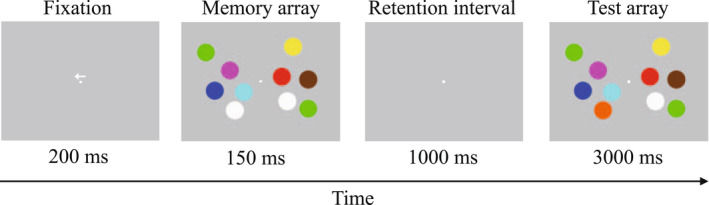
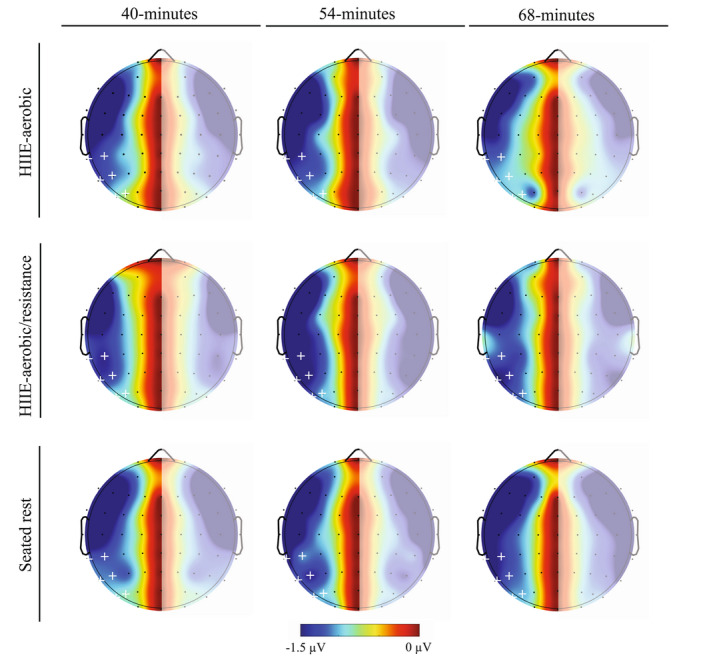
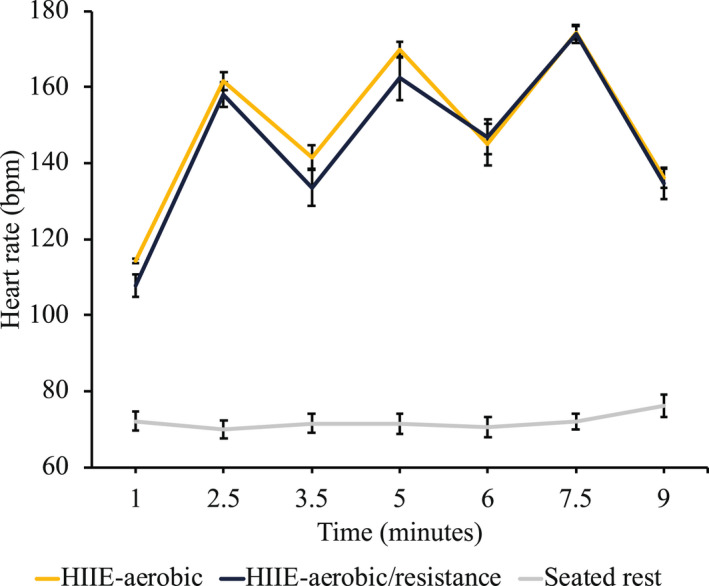
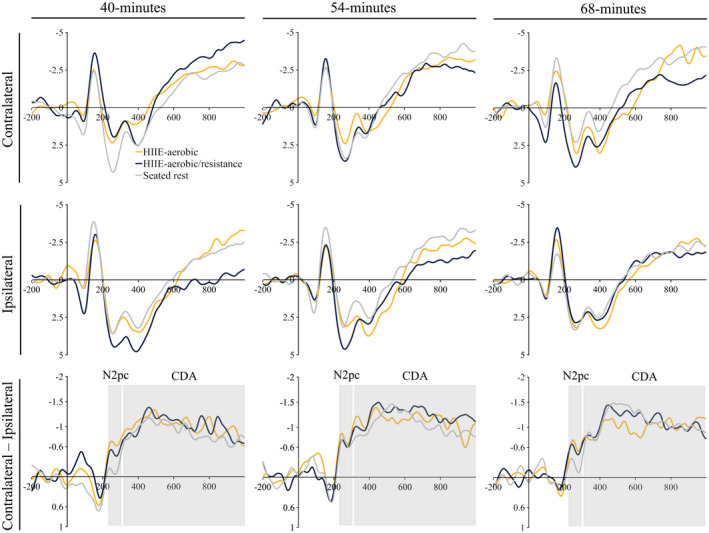
The present investigation examined the acute effects of high-intensity interval exercise (HIIE) on temporal changes in behavioral and neuroelectrical indices of working memory. Young adults (n = 22) performed a visual working memory change detection task of equiprobable 2- to 5-dot set sizes while contralateral delay activity (CDA) and N2pc ERP components were assessed at three consecutive time periods (40-min, 54-min, and 68-min) following three separate counterbalanced 9-min sessions of seated rest, HIIE-aerobic (treadmill intervals of moderate- and high-intensity run/walk periods) and HIIE-aerobic/resistance (intervals of rest and body-weight calisthenics). Behavior results revealed greater 4-dot accuracy for HIIE-aerobic/resistance compared to seated rest only at 40-min, maintenance of 5-dot accuracy across time for HIIE-aerobic compared to HIIE-aerobic/resistance and seated rest, and greater temporal stability in overall accuracy performance (i.e., inter-class correlation between temporally adjacent assessments) for both HIIE conditions compared to seated rest. CDA and N2pc results revealed no change in amplitude across time and between HIIE-aerobic, HIIE-aerobic/resistance, and seated rest. However, greater temporal stability in CDA amplitude was observed for HIIE-aerobic compared to seated rest. These findings suggest that short bouts of HIIE may serve as an effective modality for improvements and temporal stabilization in behavior with some evidence for stabilization of neuroelectrical indices of working memory capacity. Together, these data broadly suggest that short acute bouts of exercise may facilitate improvements in underlying mental operations responsible for temporal stability in cognitive and neurocognitive function.
本研究考察了高强度间歇运动(HIIE)对工作记忆行为和神经电生理指标的时间变化的急性影响。年轻成年人(n=22)在三个连续时间点(40 分钟、54 分钟和 68 分钟)进行了视觉工作记忆变化检测任务,同时评估了对侧延迟活动(CDA)和 N2pc ERP 成分,这三个时间点分别是在三次平衡的 9 分钟坐姿休息、HIIE-有氧(中高强度跑/走的跑步机间隔)和 HIIE-有氧/阻力(休息和体重健身操的间隔)之后。行为结果表明,与坐姿休息相比,HIIE-有氧/阻力仅在 40 分钟时具有更高的 4 点准确性,与 HIIE-有氧/阻力和坐姿休息相比,HIIE-有氧在整个时间内保持 5 点准确性,并且两种 HIIE 条件的整体准确性表现(即时间上相邻评估之间的类内相关)都具有更高的时间稳定性。CDA 和 N2pc 结果表明,HIIE-有氧、HIIE-有氧/阻力和坐姿休息之间,振幅在时间上没有变化。然而,与坐姿休息相比,HIIE-有氧的 CDA 振幅具有更高的时间稳定性。这些发现表明,短时间的 HIIE 可能是改善行为和时间稳定性的有效方式,并且有一些证据表明工作记忆容量的神经电生理指标的稳定性得到了改善。总的来说,这些数据广泛表明,短暂的急性运动可能有助于改善负责认知和神经认知功能时间稳定性的基本心理操作。