School of Pharmacy and State Key Laboratory of Quality Research in Chinese Medicines Macau University of Science and Technology Taipa Macau China.
Department of Public Health Sciences and Canadian Cancer Trials Group Queen's University Kingston Ontario Canada.
J Am Heart Assoc. 2022 Jun 7;11(11):e025071. doi: 10.1161/JAHA.121.025071. Epub 2022 Jun 1.
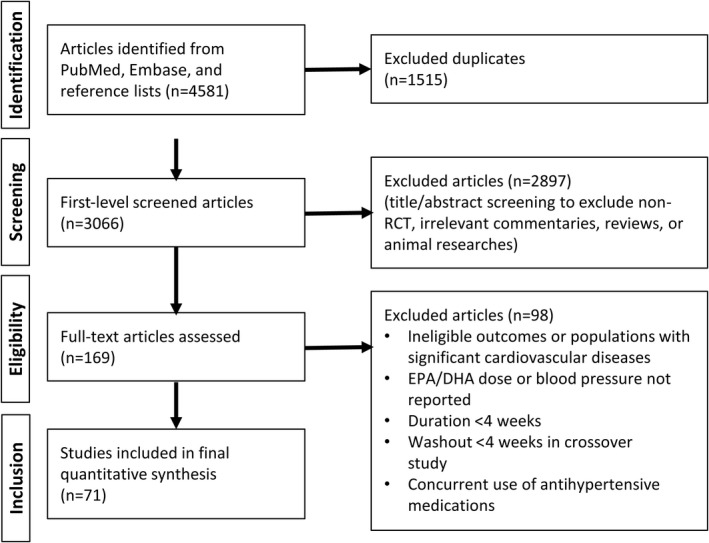
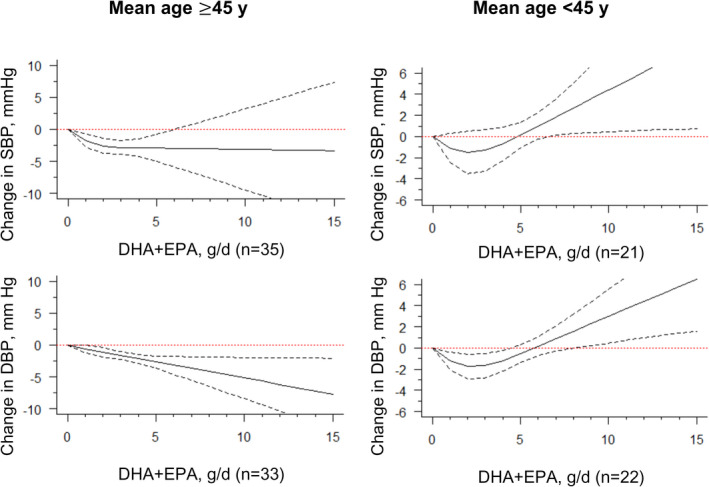
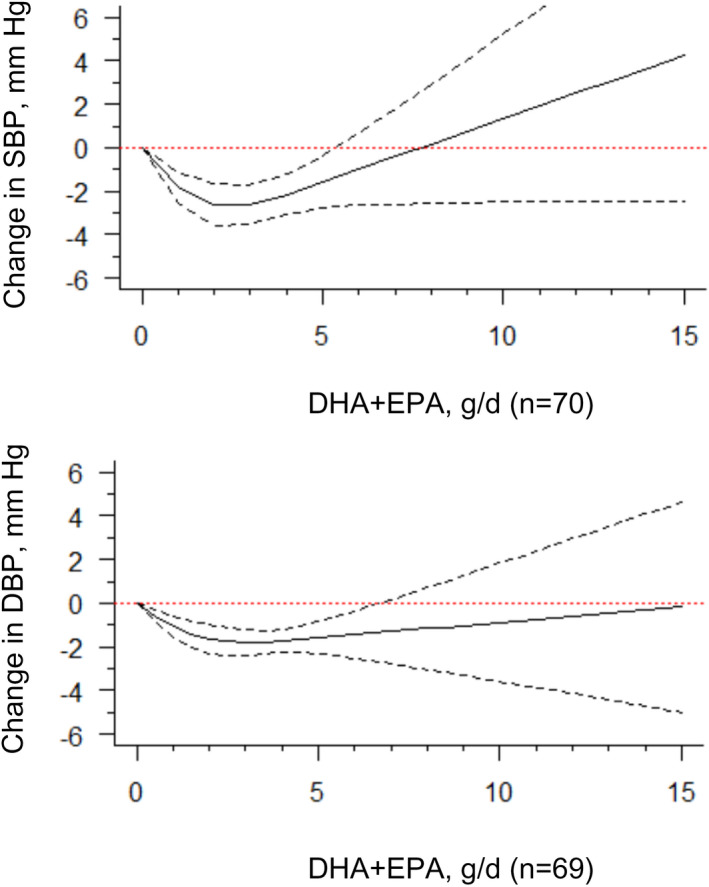
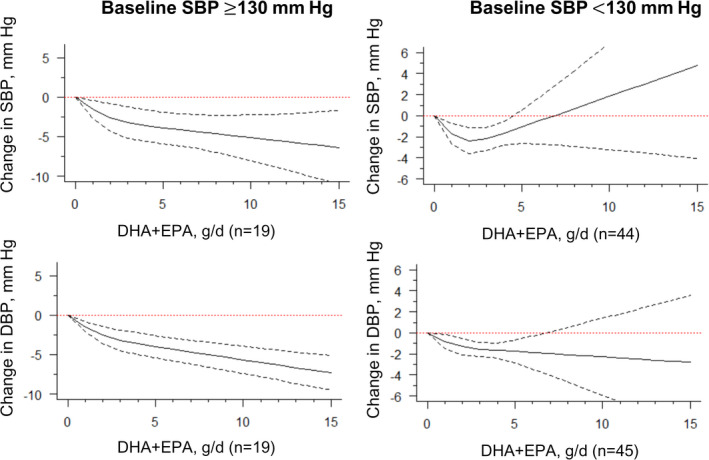
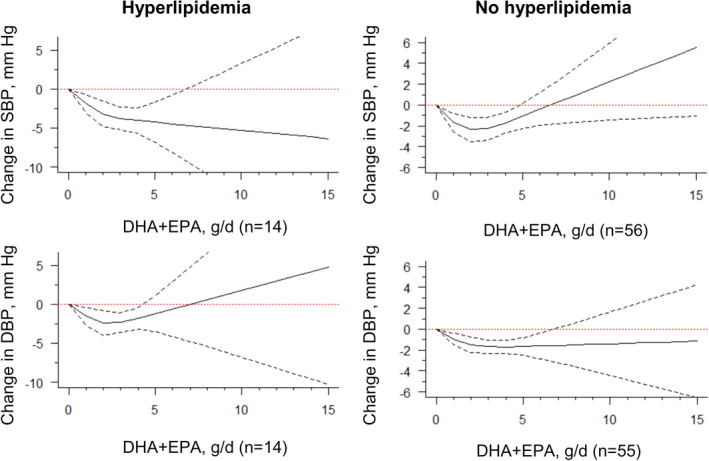
Background Current evidence might support the use of omega-3 fatty acids (preferably docosahexaenoic acid and eicosapentaenoic acid) for lowering blood pressure (BP), but the strength and shape of the dose-response relationship remains unclear. Methods and Results This study included randomized controlled trials published before May 7, 2021, that involved participants aged ≥18 years, and examined an association between omega-3 fatty acids (docosahexaenoic acid, eicosapentaenoic acid, or both) and BP. A random-effects 1-stage cubic spline regression model was used to predict the average dose-response association between daily omega-3 fatty acid intake and changes in BP. We also conducted stratified analyses to examine differences by prespecified subgroups. Seventy-one trials were included, involving 4973 individuals with a combined docosahexaenoic acid+eicosapentaenoic acid dose of 2.8 g/d (interquartile range, 1.3 g/d to 3.6 g/d). A nonlinear association was found overall or in most subgroups, depicted as J-shaped dose-response curves. The optimal intake in both systolic BP and diastolic BP reductions (mm Hg) were obtained by moderate doses between 2 g/d (systolic BP, -2.61 [95% CI, -3.57 to -1.65]; diastolic BP, -1.64 [95% CI, -2.29 to -0.99]) and 3 g/d (systolic BP, -2.61 [95% CI, -3.52 to -1.69]; diastolic BP, -1.80 [95% CI, -2.38 to -1.23]). Subgroup studies revealed stronger and approximately linear dose-response relations among hypertensive, hyperlipidemic, and older populations. Conclusions This dose-response meta-analysis demonstrates that the optimal combined intake of omega-3 fatty acids for BP lowering is likely between 2 g/d and 3 g/d. Doses of omega-3 fatty acid intake above the recommended 3 g/d may be associated with additional benefits in lowering BP among groups at high risk for cardiovascular diseases.
目前的证据可能支持使用ω-3 脂肪酸(最好是二十二碳六烯酸和二十碳五烯酸)来降低血压(BP),但强度和剂量-反应关系的形状仍不清楚。
本研究纳入了 2021 年 5 月 7 日前发表的涉及年龄≥18 岁的参与者的随机对照试验,并检查了 ω-3 脂肪酸(二十二碳六烯酸、二十碳五烯酸或两者兼有)与 BP 之间的关联。采用随机效应 1 阶段立方样条回归模型预测每日 ω-3 脂肪酸摄入量与 BP 变化之间的平均剂量-反应关系。我们还进行了分层分析,以检查按预先指定的亚组的差异。共纳入 71 项试验,涉及 4973 名联合二十二碳六烯酸+二十碳五烯酸剂量为 2.8g/d(四分位距,1.3g/d 至 3.6g/d)的个体。总体或大多数亚组均发现非线性关联,表现为 J 形剂量-反应曲线。在 2g/d(收缩压,-2.61[95%CI,-3.57 至-1.65];舒张压,-1.64[95%CI,-2.29 至-0.99])和 3g/d(收缩压,-2.61[95%CI,-3.52 至-1.69];舒张压,-1.80[95%CI,-2.38 至-1.23])之间,中等剂量可获得收缩压和舒张压降低的最佳摄入量(mmHg)。亚组研究表明,在高血压、高血脂和老年人中,剂量-反应关系更强且大致呈线性。
这项剂量-反应荟萃分析表明,降低血压的最佳 ω-3 脂肪酸联合摄入量可能在 2g/d 和 3g/d 之间。摄入超过推荐剂量 3g/d 的 ω-3 脂肪酸可能与心血管疾病高危人群的 BP 降低相关的额外益处有关。