Department of Biochemistry, University of Utah School of Medicine, Salt Lake City, UT 84112, USA.
Nucleic Acids Res. 2022 Jun 24;50(11):6511-6520. doi: 10.1093/nar/gkac443.
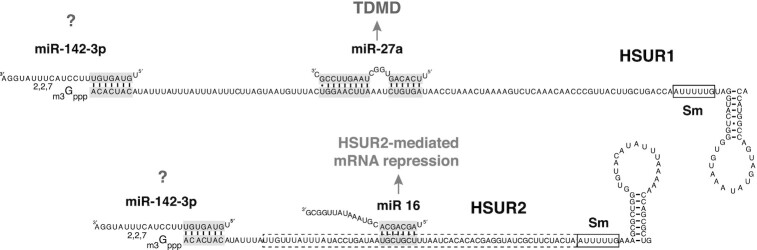
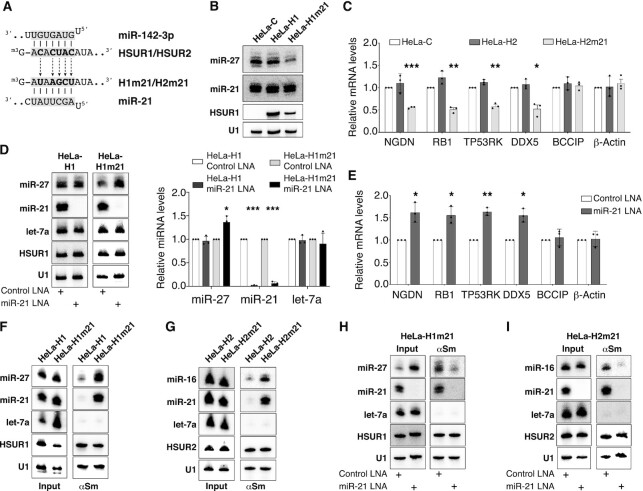
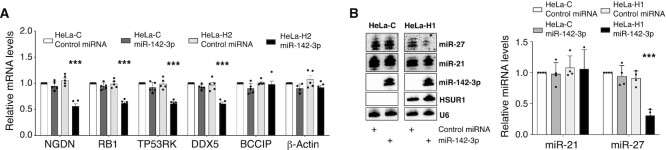
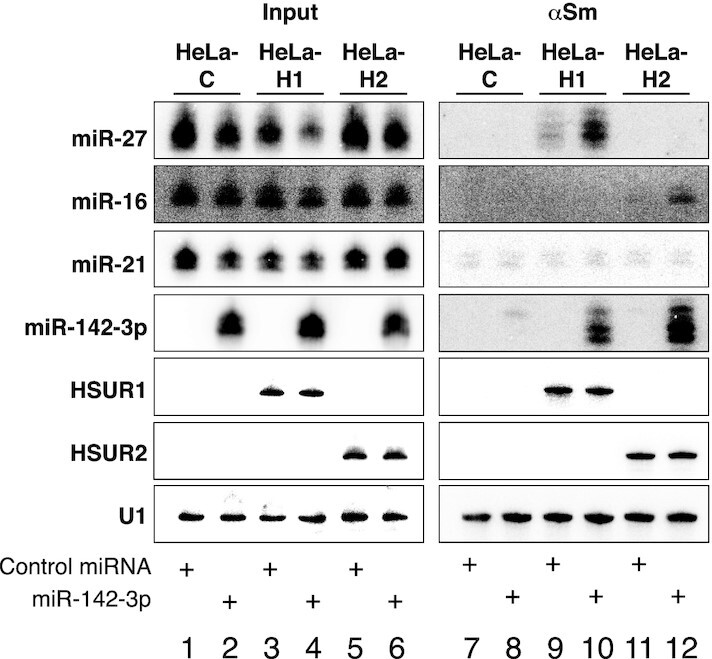
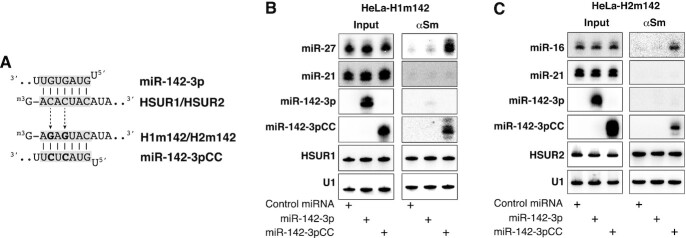
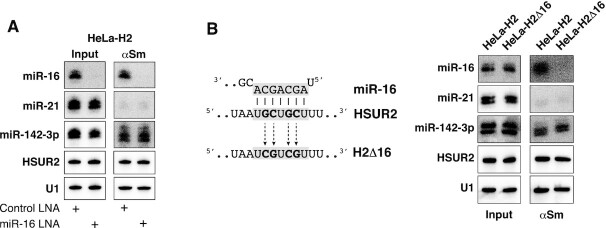
HSUR1 and HSUR2, two noncoding RNAs expressed by the oncogenic Herpesvirus saimiri, bind host microRNAs miR-142-3p, miR-16, and miR-27 with different purposes. While binding of miR-27 to HSUR1 triggers the degradation of the microRNA, miR-16 is tethered by HSUR2 to target host mRNAs to repress their expression. Here we show that the interaction with miR-142-3p is required for the activity of both HSURs. Coimmunoprecipitation experiments revealed that miR-142-3p allosterically regulates the binding of miR-27 and miR-16 to HSUR1 and HSUR2, respectively. The binding of two different miRNAs to each HSUR is not cooperative. HSURs can be engineered to be regulated by other miRNAs, indicating that the identity of the binding miRNA is not important for HSUR regulation. Our results uncover a mechanism for allosteric regulation of noncoding RNA function and a previously unappreciated way in which microRNAs can regulate gene expression.
HSUR1 和 HSUR2 是致瘤性猴疱疹病毒表达的两种非编码 RNA,它们以不同的目的与宿主 microRNAs miR-142-3p、miR-16 和 miR-27 结合。虽然 miR-27 与 HSUR1 的结合触发了 microRNA 的降解,但 miR-16 则被 HSUR2 结合,靶向宿主 mRNA 以抑制其表达。在这里,我们表明与 miR-142-3p 的相互作用对于两个 HSUR 的活性都是必需的。共免疫沉淀实验表明,miR-142-3p 变构调节 miR-27 和 miR-16 与 HSUR1 和 HSUR2 的结合,分别。两种不同的 miRNA 与每个 HSUR 的结合不是协作的。可以对 HSUR 进行工程改造,使其受其他 miRNA 的调节,这表明结合 miRNA 的身份对于 HSUR 调节并不重要。我们的结果揭示了非编码 RNA 功能的变构调节机制,以及 microRNAs 可以调节基因表达的一种先前未被认识的方式。