Department of Psychology, Harvard University, Cambridge, MA, 1-347-302-5900, USA.
Department of Psychology, Ben-Gurion University of the Negev, Beer-Sheva, Israel.
Behav Res Methods. 2023 Apr;55(3):1413-1440. doi: 10.3758/s13428-022-01851-2. Epub 2022 Jun 1.
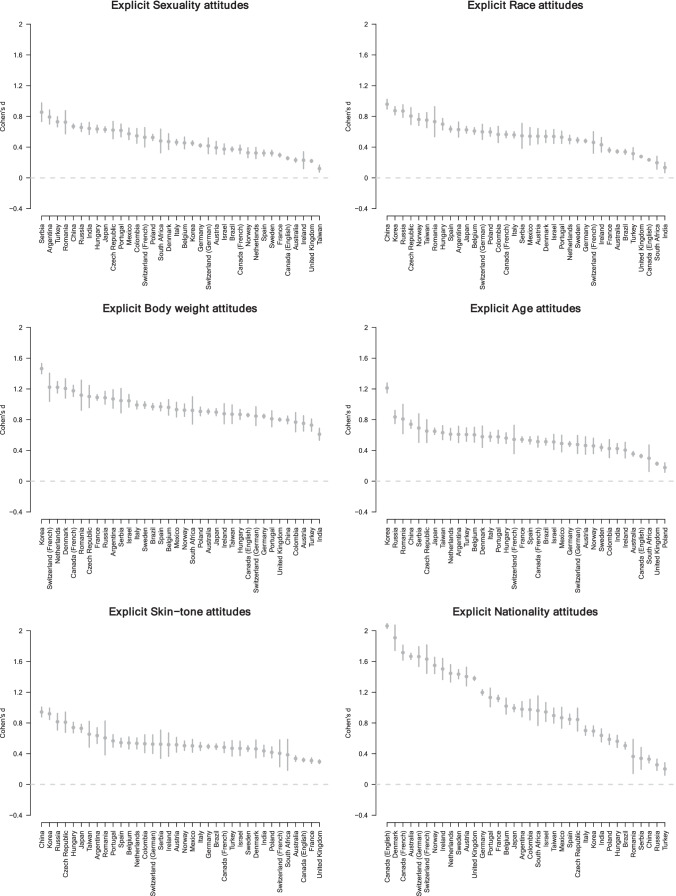
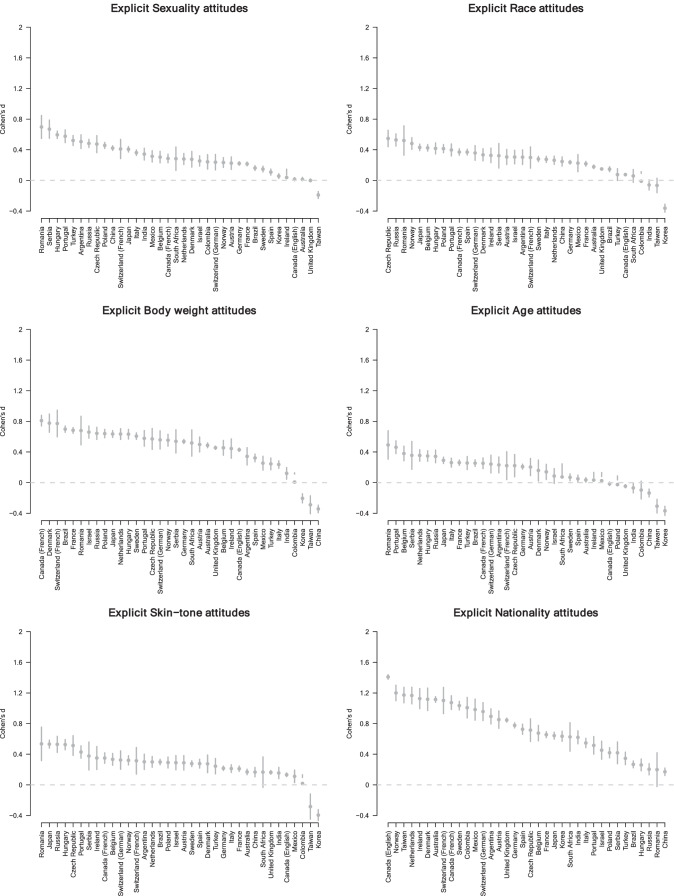
For decades, researchers across the social sciences have sought to document and explain the worldwide variation in social group attitudes (evaluative representations, e.g., young-good/old-bad) and stereotypes (attribute representations, e.g., male-science/female-arts). Indeed, uncovering such country-level variation can provide key insights into questions ranging from how attitudes and stereotypes are clustered across places to why places vary in attitudes and stereotypes (including ecological and social correlates). Here, we introduce the Project Implicit:International (PI:International) dataset that has the potential to propel such research by offering the first cross-country dataset of both implicit (indirectly measured) and explicit (directly measured) attitudes and stereotypes across multiple topics and years. PI:International comprises 2.3 million tests for seven topics (race, sexual orientation, age, body weight, nationality, and skin-tone attitudes, as well as men/women-science/arts stereotypes) using both indirect (Implicit Association Test; IAT) and direct (self-report) measures collected continuously from 2009 to 2019 from 34 countries in each country's native language(s). We show that the IAT data from PI:International have adequate internal consistency (split-half reliability), convergent validity (implicit-explicit correlations), and known groups validity. Given such reliability and validity, we summarize basic descriptive statistics on the overall strength and variability of implicit and explicit attitudes and stereotypes around the world. The PI:International dataset, including both summary data and trial-level data from the IAT, is provided openly to facilitate wide access and novel discoveries on the global nature of implicit and explicit attitudes and stereotypes.
几十年来,社会科学领域的研究人员一直致力于记录和解释全球范围内社会群体态度(评价表现,例如,年轻好/年老坏)和刻板印象(属性表现,例如,男性科学/女性艺术)的变化。事实上,揭示这种国家层面的变化可以为从态度和刻板印象如何在不同地方聚集到为什么地方在态度和刻板印象上存在差异(包括生态和社会相关性)等问题提供关键的见解。在这里,我们介绍了“内隐联想测验:国际”(PI:International)数据集,该数据集有可能通过提供关于多个主题和年份的间接(间接测量)和直接(直接测量)态度和刻板印象的第一个跨国数据集来推动此类研究。PI:International 由来自 34 个国家的 230 万项关于七个主题(种族、性取向、年龄、体重、国籍和肤色态度,以及男性/女性-科学/艺术刻板印象)的测试组成,使用间接(内隐联想测验;IAT)和直接(自我报告)测量方法,从 2009 年到 2019 年连续收集。我们表明,PI:International 的 IAT 数据具有足够的内部一致性(半分可靠性)、收敛有效性(内隐-外显相关)和已知群体有效性。鉴于这种可靠性和有效性,我们总结了全球范围内关于内隐和外显态度和刻板印象的总体强度和可变性的基本描述性统计数据。PI:International 数据集包括 IAT 的汇总数据和试验级数据,以开放的方式提供,以促进对全球范围内内隐和外显态度和刻板印象的广泛访问和新发现。