Cardiovascular Epidemiology and Genetics, Hospital del Mar Medical Research Institute IMIM, Barcelona, Spain
CIBER of Pathophysiology of Obesity and Nutrition (CIBEROBN), Instituto de Salud Carlos III, Madrid, Spain.
BMJ Glob Health. 2022 Jun;7(6). doi: 10.1136/bmjgh-2021-008138.
Use of traditional medicine (TM) is widespread in sub-Saharan Africa as a treatment option for a wide range of disease. We aimed to describe main characteristics of TM users and estimate the association of TM use with control of hypertension.
We used data on 2128 hypertensive patients of a cross-sectional study (convenience sampling), who attended cardiology departments of 12 sub-Saharan African countries (Benin, Cameroon, Congo, Democratic Republic of the Congo, Gabon, Guinea, Côte d'Ivoire, Mauritania, Mozambique, Niger, Senegal, Togo). To model association of TM use with odds of uncontrolled, severe and complicated hypertension, we used multivariable mixed logistic regressions, and to model the association with blood pressure (systolic (SBP) and diastolic (DBP)) we used mixed linear models. All models were adjusted for age, sex, wealth, adherence to hypertension conventional treatment and country (random effect).
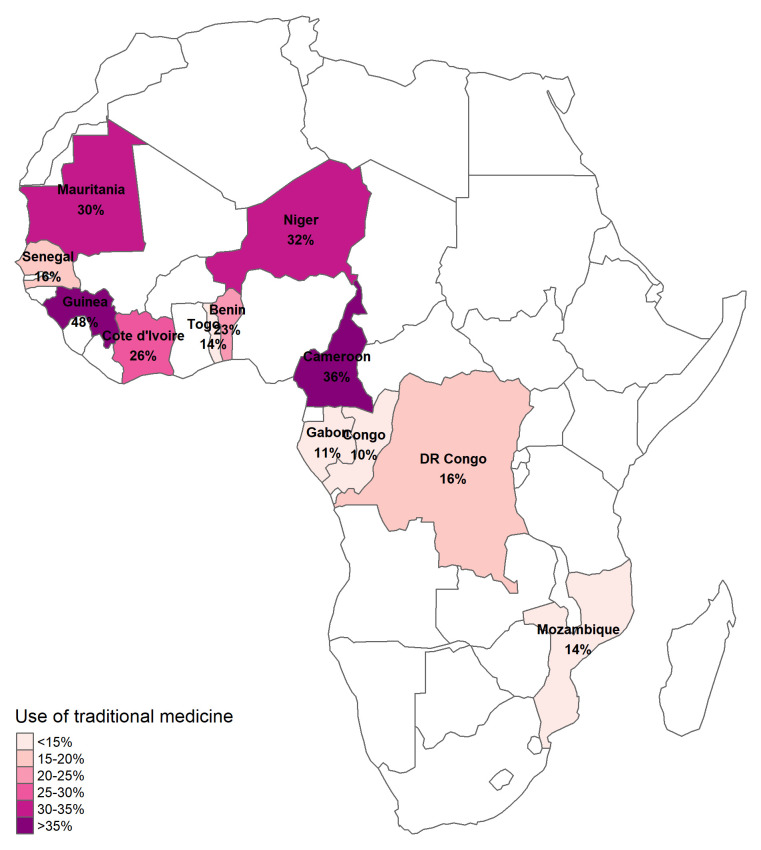
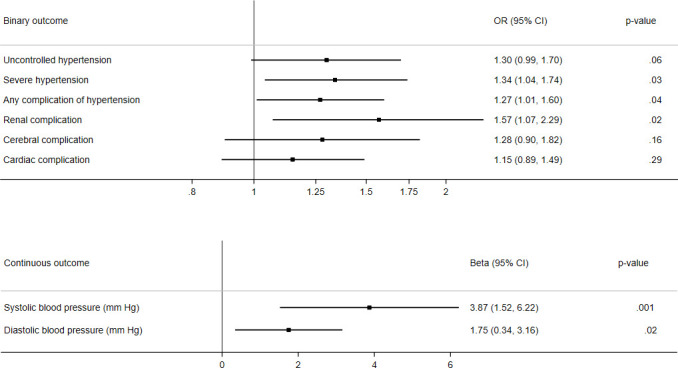
A total of 512 (24%) participants reported using TM, varying across countries from 10% in the Congo to 48% in Guinea. TM users were more likely to be men, living in rural area, poorly adhere to prescribed medication (frequently due to its cost). Use of TM was associated with a 3.87 (95% CI 1.52 to 6.22)/1.75 (0.34 to 3.16) mm Hg higher SBP/DBP compared with no use; and with greater odds of severe hypertension (OR=1.34; 95% CI 1.04 to 1.74) and of any hypertension complication (OR=1.27; 95% CI 1.01 to 1.60), mainly driven by renal complication (OR=1.57; 95% CI 1.07 to 2.29) after adjustment for measured confounders.
The use of TM was associated with higher blood pressure, more severe hypertension and more complications in Sub-Saharan African countries. The widespread use of TM needs to be acknowledged and worked out to integrate TM safely within the conventional healthcare.
在撒哈拉以南非洲,传统医学(TM)作为治疗各种疾病的选择方案被广泛应用。本研究旨在描述 TM 用户的主要特征,并评估 TM 使用与高血压控制之间的关联。
我们使用了横断面研究(便利抽样)中 2128 例高血压患者的数据,这些患者来自撒哈拉以南非洲的 12 个国家(贝宁、喀麦隆、刚果、刚果民主共和国、加蓬、几内亚、科特迪瓦、毛里塔尼亚、莫桑比克、尼日尔、塞内加尔、多哥)。我们使用多变量混合逻辑回归模型来评估 TM 使用与未控制、严重和复杂高血压之间的比值比(OR)关联,使用混合线性模型来评估 TM 使用与血压(收缩压(SBP)和舒张压(DBP))之间的关联。所有模型均根据年龄、性别、财富、对高血压常规治疗的依从性和国家(随机效应)进行了调整。
共有 512 名(24%)参与者报告使用 TM,各国之间的使用情况差异很大,从刚果的 10%到几内亚的 48%不等。与未使用 TM 的患者相比,TM 用户更可能为男性、居住在农村地区、对处方药物的依从性较差(主要是因为药物费用较高)。与不使用 TM 相比,使用 TM 与 SBP/DBP 分别升高 3.87(95%CI 1.52 至 6.22)/1.75(0.34 至 3.16)mmHg 相关,且严重高血压(OR=1.34;95%CI 1.04 至 1.74)和任何高血压并发症(OR=1.27;95%CI 1.01 至 1.60)的可能性更大,这主要归因于调整了测量混杂因素后肾并发症的 OR 为 1.57(95%CI 1.07 至 2.29)。
在撒哈拉以南非洲国家,TM 的使用与血压升高、更严重的高血压和更多的并发症有关。需要认识到 TM 的广泛使用,并努力将 TM 安全地融入常规医疗保健中。