Department of Epidemiology, Biostatistics and Occupational Health, 12367McGill University, Montreal, Canada.
Programa de Pós-Graduação em Epidemiologia em Saúde Pública, Escola Nacional de Saúde Pública Sergio Arouca (ENSP), Fundação Oswaldo Cruz, Rio de Janeiro, Brazil.
Stat Methods Med Res. 2022 Aug;31(8):1590-1602. doi: 10.1177/09622802221102628. Epub 2022 Jun 5.
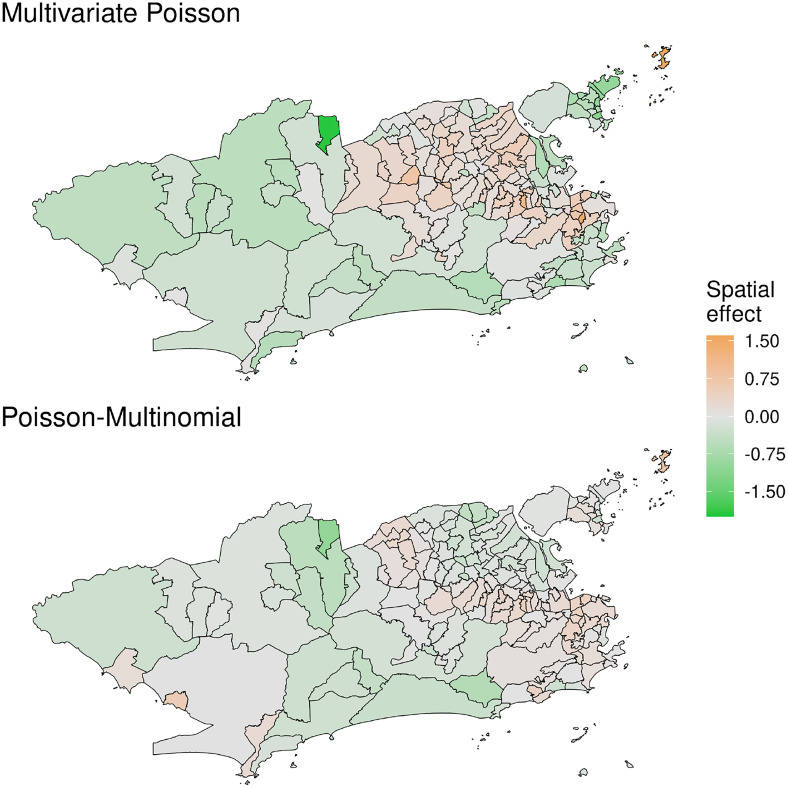
Dengue, Zika, and chikungunya are arboviral diseases (AVD) transmitted mainly by . Rio de Janeiro city, Brazil, has been endemic for dengue for over 30 years, and experienced the first joint epidemic of the three diseases between 2015-2016. They present similar symptoms and only a small proportion of cases are laboratory-confirmed. These facts lead to potential misdiagnosis and, consequently, uncertainty in the registration of the cases. We have available the number of cases of each disease for the neighborhoods of Rio de Janeiro. We propose a Poisson model for the total number of cases of -borne diseases and, conditioned on the total, we assume a multinomial model for the allocation of the number of cases of each of the diseases across the neighborhoods. This provides simultaneously the estimation of the associations of the relative risk of the total cases of AVD with environmental and socioeconomic variables; and the estimation of the probability of presence of each disease as a function of available covariates. Our findings suggest that a one standard deviation increase in the social development index decreases the relative risk of the total cases of AVD by 28%. Neighborhoods with smaller proportion of green area had greater odds of having chikungunya in comparison to dengue and Zika. A one standard deviation increase in population density decreases the odds of a neighborhood having Zika instead of dengue by 18% but increases the odds of chikungunya in comparison to dengue by 18% and by 43% in comparison to Zika.
登革热、寨卡病毒和基孔肯雅热是由虫媒病毒(AVD)引起的疾病,主要通过 传播。巴西里约热内卢市已经出现登革热超过 30 年,并且在 2015 年至 2016 年期间首次出现了这三种疾病的联合流行。这些疾病的症状相似,只有一小部分病例经过实验室确诊。这些事实导致了潜在的误诊,从而导致病例的登记不确定。我们有里约热内卢各个社区的每种疾病的病例数。我们为 - 虫媒疾病的总病例数提出了泊松模型,并在总病例数的条件下,我们假设一个多项模型,用于分配每种疾病在各个社区的病例数。这同时提供了估计 AVD 总病例数与环境和社会经济变量之间的相对风险的关联;并估计了每种疾病的存在概率作为可用协变量的函数。我们的研究结果表明,社会发展指数每增加一个标准差,AVD 总病例的相对风险就会降低 28%。与登革热和寨卡病毒相比,绿色区域比例较小的社区发生基孔肯雅热的几率更大。人口密度每增加一个标准差,与登革热相比,寨卡病毒的社区发生几率就会降低 18%,但与登革热相比,基孔肯雅热的发生几率就会增加 18%,与寨卡病毒相比,基孔肯雅热的发生几率就会增加 43%。