• 文献检索
  • 文档翻译
  • 深度研究
  • 学术资讯
  • Suppr Zotero 插件Zotero 插件
  • 邀请有礼
  • 套餐&价格
  • 历史记录
应用&插件
Suppr Zotero 插件Zotero 插件浏览器插件Mac 客户端Windows 客户端微信小程序
定价
高级版会员购买积分包购买API积分包
服务
文献检索文档翻译深度研究API 文档MCP 服务
关于我们
关于 Suppr公司介绍联系我们用户协议隐私条款
关注我们

Suppr 超能文献

核心技术专利:CN118964589B侵权必究
粤ICP备2023148730 号-1Suppr @ 2026

文献检索

告别复杂PubMed语法,用中文像聊天一样搜索,搜遍4000万医学文献。AI智能推荐,让科研检索更轻松。

立即免费搜索

文件翻译

保留排版,准确专业,支持PDF/Word/PPT等文件格式,支持 12+语言互译。

免费翻译文档

深度研究

AI帮你快速写综述,25分钟生成高质量综述,智能提取关键信息,辅助科研写作。

立即免费体验

NeoSplice:一种预测剪接变体新抗原的生物信息学方法。

NeoSplice: a bioinformatics method for prediction of splice variant neoantigens.

作者信息

Chai Shengjie, Smith Christof C, Kochar Tavleen K, Hunsucker Sally A, Beck Wolfgang, Olsen Kelly S, Vensko Steven, Glish Gary L, Armistead Paul M, Prins Jan F, Vincent Benjamin G

机构信息

Lineberger Comprehensive Cancer Center, University of North Carolina at Chapel Hill, Chapel Hill, NC, 27514, USA.

Curriculum in Bioinformatics and Computational Biology, UNC School of Medicine, Chapel Hill, NC, 27599, USA.

出版信息

Bioinform Adv. 2022 May 6;2(1):vbac032. doi: 10.1093/bioadv/vbac032. eCollection 2022.

DOI:10.1093/bioadv/vbac032
PMID:35669345
原文链接:https://pmc.ncbi.nlm.nih.gov/articles/PMC9154024/
Abstract

MOTIVATION

Splice variant neoantigens are a potential source of tumor-specific antigen (TSA) that are shared between patients in a variety of cancers, including acute myeloid leukemia. Current tools for genomic prediction of splice variant neoantigens demonstrate promise. However, many tools have not been well validated with simulated and/or wet lab approaches, with no studies published that have presented a targeted immunopeptidome mass spectrometry approach designed specifically for identification of predicted splice variant neoantigens.

RESULTS

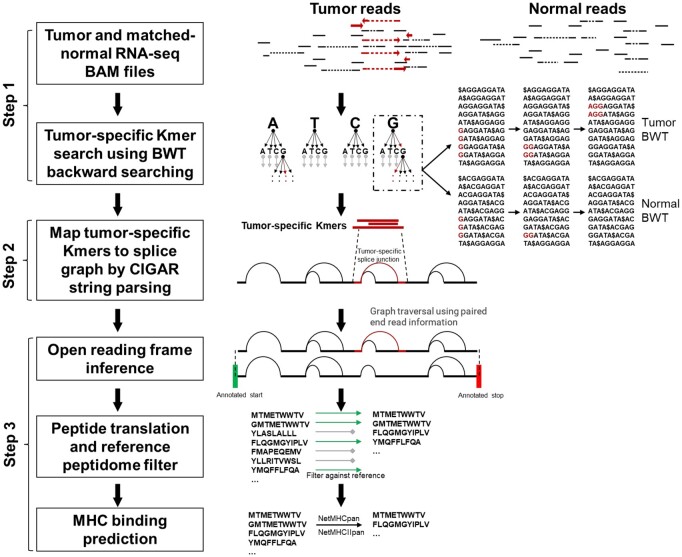
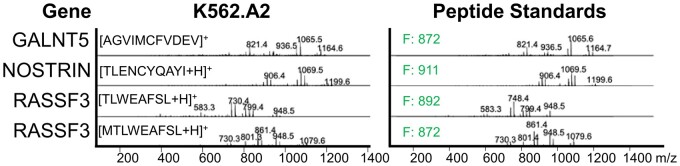
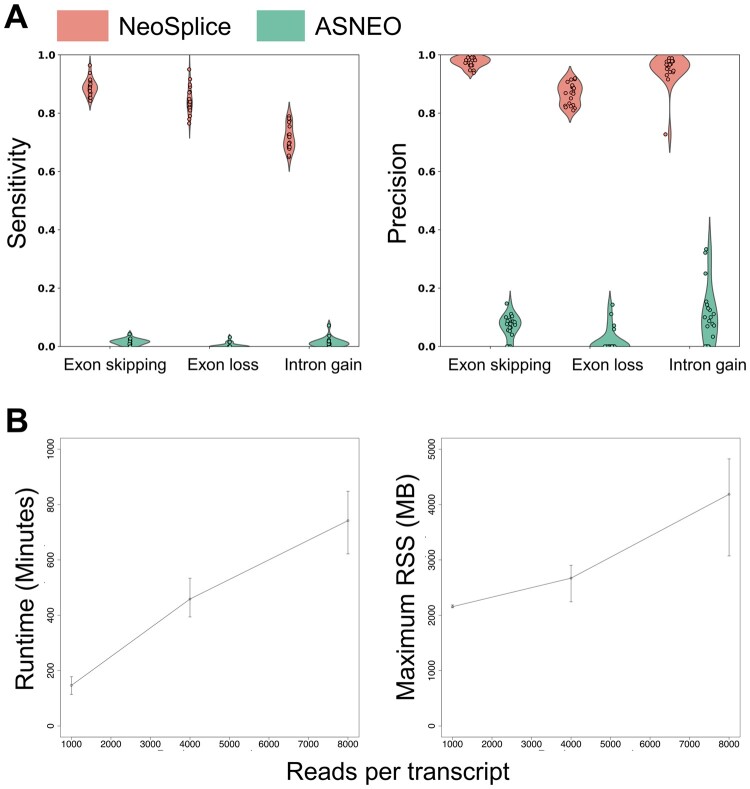
In this study, we describe NeoSplice, a novel computational method for splice variant neoantigen prediction based on (i) prediction of tumor-specific k-mers from RNA-seq data, (ii) alignment of differentially expressed k-mers to the splice graph and (iii) inference of the variant transcript with MHC binding prediction. NeoSplice demonstrates high sensitivity and precision (>80% on average across all splice variant classes) through simulated RNA-seq data. Through mass spectrometry analysis of the immunopeptidome of the K562.A2 cell line compared against a synthetic peptide reference of predicted splice variant neoantigens, we validated 4 of 37 predicted antigens corresponding to 3 of 17 unique splice junctions. Lastly, we provide a comparison of NeoSplice against other splice variant prediction tools described in the literature. NeoSplice provides a well-validated platform for prediction of TSA vaccine targets for future cancer antigen vaccine studies to evaluate the clinical efficacy of splice variant neoantigens.

AVAILABILITY AND IMPLEMENTATION

https://github.com/Benjamin-Vincent-Lab/NeoSplice.

SUPPLEMENTARY INFORMATION

Supplementary data are available at online.

摘要

动机

剪接变体新抗原是肿瘤特异性抗原(TSA)的潜在来源,在包括急性髓系白血病在内的多种癌症患者中具有共享性。目前用于剪接变体新抗原基因组预测的工具显示出了前景。然而,许多工具尚未通过模拟和/或湿实验室方法得到充分验证,且尚未有研究发表专门针对鉴定预测的剪接变体新抗原设计的靶向免疫肽组质谱方法。

结果

在本研究中,我们描述了NeoSplice,这是一种用于剪接变体新抗原预测的新型计算方法,其基于:(i)从RNA测序数据预测肿瘤特异性k - 元组;(ii)将差异表达的k - 元组与剪接图比对;以及(iii)通过MHC结合预测推断变体转录本。通过模拟RNA测序数据,NeoSplice展示了高灵敏度和高精度(在所有剪接变体类别中平均>80%)。通过对K562.A2细胞系的免疫肽组进行质谱分析,并与预测的剪接变体新抗原的合成肽参考进行比较,我们验证了37个预测抗原中的4个,它们对应于17个独特剪接位点中的3个。最后,我们将NeoSplice与文献中描述的其他剪接变体预测工具进行了比较。NeoSplice为预测TSA疫苗靶点提供了一个经过充分验证的平台,用于未来癌症抗原疫苗研究,以评估剪接变体新抗原的临床疗效。

可用性和实现方式

https://github.com/Benjamin-Vincent-Lab/NeoSplice。

补充信息

补充数据可在网上获取。

https://cdn.ncbi.nlm.nih.gov/pmc/blobs/d50c/9710710/76500176fd61/vbac032f4.jpg
https://cdn.ncbi.nlm.nih.gov/pmc/blobs/d50c/9710710/ca3f882b68b1/vbac032f1.jpg
https://cdn.ncbi.nlm.nih.gov/pmc/blobs/d50c/9710710/88e41d98dc7c/vbac032f2.jpg
https://cdn.ncbi.nlm.nih.gov/pmc/blobs/d50c/9710710/ed5955939c0d/vbac032f3.jpg
https://cdn.ncbi.nlm.nih.gov/pmc/blobs/d50c/9710710/76500176fd61/vbac032f4.jpg
https://cdn.ncbi.nlm.nih.gov/pmc/blobs/d50c/9710710/ca3f882b68b1/vbac032f1.jpg
https://cdn.ncbi.nlm.nih.gov/pmc/blobs/d50c/9710710/88e41d98dc7c/vbac032f2.jpg
https://cdn.ncbi.nlm.nih.gov/pmc/blobs/d50c/9710710/ed5955939c0d/vbac032f3.jpg
https://cdn.ncbi.nlm.nih.gov/pmc/blobs/d50c/9710710/76500176fd61/vbac032f4.jpg

相似文献

1
NeoSplice: a bioinformatics method for prediction of splice variant neoantigens.NeoSplice:一种预测剪接变体新抗原的生物信息学方法。
Bioinform Adv. 2022 May 6;2(1):vbac032. doi: 10.1093/bioadv/vbac032. eCollection 2022.
2
Prediction of tumor-specific splicing from somatic mutations as a source of neoantigen candidates.从体细胞突变预测肿瘤特异性剪接作为新抗原候选物的来源。
Bioinform Adv. 2024 May 29;4(1):vbae080. doi: 10.1093/bioadv/vbae080. eCollection 2024.
3
Application of mass spectrometry-based MHC immunopeptidome profiling in neoantigen identification for tumor immunotherapy.基于质谱的 MHC 免疫肽组学分析在肿瘤免疫治疗中新抗原鉴定中的应用。
Biomed Pharmacother. 2019 Dec;120:109542. doi: 10.1016/j.biopha.2019.109542. Epub 2019 Oct 16.
4
ScanNeo: identifying indel-derived neoantigens using RNA-Seq data.ScanNeo:利用 RNA-Seq 数据鉴定移码突变衍生的新抗原。
Bioinformatics. 2019 Oct 15;35(20):4159-4161. doi: 10.1093/bioinformatics/btz193.
5
Cancer Neoantigens: Challenges and Future Directions for Prediction, Prioritization, and Validation.癌症新抗原:预测、优先级排序及验证面临的挑战与未来方向
Front Oncol. 2022 Mar 3;12:836821. doi: 10.3389/fonc.2022.836821. eCollection 2022.
6
TSAFinder: exhaustive tumor-specific antigen detection with RNAseq.TSAFinder:利用 RNAseq 进行全面的肿瘤特异性抗原检测。
Bioinformatics. 2022 Apr 28;38(9):2422-2427. doi: 10.1093/bioinformatics/btac116.
7
Prediction and prioritization of neoantigens: integration of RNA sequencing data with whole-exome sequencing.新抗原的预测与优先级排序:RNA测序数据与全外显子组测序的整合
Cancer Sci. 2017 Feb;108(2):170-177. doi: 10.1111/cas.13131. Epub 2017 Feb 9.
8
NeoFuse: predicting fusion neoantigens from RNA sequencing data.NeoFuse:从 RNA 测序数据中预测融合新抗原。
Bioinformatics. 2020 Apr 1;36(7):2260-2261. doi: 10.1093/bioinformatics/btz879.
9
PGNneo: A Proteogenomics-Based Neoantigen Prediction Pipeline in Noncoding Regions.PGNneo:基于蛋白质基因组学的非编码区新抗原预测管道。
Cells. 2023 Mar 1;12(5):782. doi: 10.3390/cells12050782.
10
nextNEOpi: a comprehensive pipeline for computational neoantigen prediction.nextNEOpi:一个全面的计算新抗原预测管道。
Bioinformatics. 2022 Jan 27;38(4):1131-1132. doi: 10.1093/bioinformatics/btab759.

引用本文的文献

1
Advancements and challenges in personalized neoantigen-based cancer vaccines.基于个性化新抗原的癌症疫苗的进展与挑战。
Oncol Rev. 2025 Mar 14;19:1541326. doi: 10.3389/or.2025.1541326. eCollection 2025.
2
Advances in CAR T cell therapy: antigen selection, modifications, and current trials for solid tumors.嵌合抗原受体T细胞疗法的进展:抗原选择、修饰及实体瘤的当前试验
Front Immunol. 2025 Jan 6;15:1489827. doi: 10.3389/fimmu.2024.1489827. eCollection 2024.
3
Identifying Strong Neoantigen MHC-I/II Binding Candidates for Targeted Immunotherapy with SINE.

本文引用的文献

1
Atypical acute myeloid leukemia-specific transcripts generate shared and immunogenic MHC class-I-associated epitopes.非典型急性髓系白血病特异性转录本产生共享的且具有免疫原性的与MHC I类相关的表位。
Immunity. 2021 Apr 13;54(4):737-752.e10. doi: 10.1016/j.immuni.2021.03.001. Epub 2021 Mar 18.
2
: Identification of personalized alternative splicing based neoantigens with RNA-seq.利用 RNA-seq 鉴定基于个性化剪接的新抗原。
Aging (Albany NY). 2020 Jul 22;12(14):14633-14648. doi: 10.18632/aging.103516.
3
Five-Year Survival with Combined Nivolumab and Ipilimumab in Advanced Melanoma.
利用SINE鉴定用于靶向免疫治疗的强新抗原MHC-I/II结合候选物。
Int J Mol Sci. 2024 Dec 29;26(1):205. doi: 10.3390/ijms26010205.
4
Quantifying tumor specificity using Bayesian probabilistic modeling for drug and immunotherapeutic target discovery.使用贝叶斯概率建模定量评估肿瘤特异性,用于药物和免疫治疗靶点发现。
Cell Rep Methods. 2024 Nov 18;4(11):100900. doi: 10.1016/j.crmeth.2024.100900. Epub 2024 Nov 7.
5
SpliceMutr Enables Pan-Cancer Analysis of Splicing-Derived Neoantigen Burden in Tumors.SpliceMutr可实现对肿瘤中剪接衍生新抗原负荷的泛癌分析。
Cancer Res Commun. 2024 Dec 1;4(12):3137-3150. doi: 10.1158/2767-9764.CRC-23-0309.
6
Prediction of tumor-specific splicing from somatic mutations as a source of neoantigen candidates.从体细胞突变预测肿瘤特异性剪接作为新抗原候选物的来源。
Bioinform Adv. 2024 May 29;4(1):vbae080. doi: 10.1093/bioadv/vbae080. eCollection 2024.
7
DIPAN: Detecting personalized intronic polyadenylation derived neoantigens from RNA sequencing data.DIPAN:从RNA测序数据中检测个性化内含子多聚腺苷酸化衍生的新抗原
Comput Struct Biotechnol J. 2024 May 9;23:2057-2066. doi: 10.1016/j.csbj.2024.05.008. eCollection 2024 Dec.
8
Comprehensive profiling of cancer neoantigens from aberrant RNA splicing.从异常 RNA 剪接中全面分析癌症新抗原。
J Immunother Cancer. 2024 May 15;12(5):e008988. doi: 10.1136/jitc-2024-008988.
9
Computational immunogenomic approaches to predict response to cancer immunotherapies.计算免疫基因组学方法预测癌症免疫疗法的反应。
Nat Rev Clin Oncol. 2024 Jan;21(1):28-46. doi: 10.1038/s41571-023-00830-6. Epub 2023 Oct 31.
10
Comprehensive analysis of neoantigens derived from structural variation across whole genomes from 2528 tumors.对来自 2528 个肿瘤全基因组结构变异的新抗原进行综合分析。
Genome Biol. 2023 Jul 17;24(1):169. doi: 10.1186/s13059-023-03005-9.
纳武利尤单抗联合伊匹木单抗治疗晚期黑色素瘤的 5 年生存数据
N Engl J Med. 2019 Oct 17;381(16):1535-1546. doi: 10.1056/NEJMoa1910836. Epub 2019 Sep 28.
4
Machine-Learning Prediction of Tumor Antigen Immunogenicity in the Selection of Therapeutic Epitopes.基于机器学习的肿瘤抗原免疫原性预测在治疗性表位选择中的应用。
Cancer Immunol Res. 2019 Oct;7(10):1591-1604. doi: 10.1158/2326-6066.CIR-19-0155. Epub 2019 Sep 12.
5
The Immune Landscape of Cancer.癌症的免疫格局
Immunity. 2019 Aug 20;51(2):411-412. doi: 10.1016/j.immuni.2019.08.004.
6
Alternative tumour-specific antigens.肿瘤特异性替代抗原。
Nat Rev Cancer. 2019 Aug;19(8):465-478. doi: 10.1038/s41568-019-0162-4. Epub 2019 Jul 5.
7
Improved indel detection in DNA and RNA via realignment with ABRA2.通过与 ABRA2 重新比对,提高 DNA 和 RNA 中的插入缺失检测。
Bioinformatics. 2019 Sep 1;35(17):2966-2973. doi: 10.1093/bioinformatics/btz033.
8
Neoantigen vaccine generates intratumoral T cell responses in phase Ib glioblastoma trial.在 Ib 期胶质母细胞瘤试验中,新型抗原疫苗可在肿瘤内产生 T 细胞应答。
Nature. 2019 Jan;565(7738):234-239. doi: 10.1038/s41586-018-0792-9. Epub 2018 Dec 19.
9
Intron retention is a source of neoepitopes in cancer.内含子保留是癌症中新表位的来源。
Nat Biotechnol. 2018 Dec;36(11):1056-1058. doi: 10.1038/nbt.4239. Epub 2018 Aug 16.
10
Comprehensive Analysis of Alternative Splicing Across Tumors from 8,705 Patients.对 8705 例肿瘤患者的可变剪接进行全面分析。
Cancer Cell. 2018 Aug 13;34(2):211-224.e6. doi: 10.1016/j.ccell.2018.07.001. Epub 2018 Aug 2.