AnacletoLab - Computer Science Department, Universitá degli Studi di Milano, Via Celoria 18, 20135, Milan, Italy.
European Commission, Joint Research Centre (JRC), Ispra (VA), Italy.
Brief Bioinform. 2022 Jul 18;23(4). doi: 10.1093/bib/bbac207.
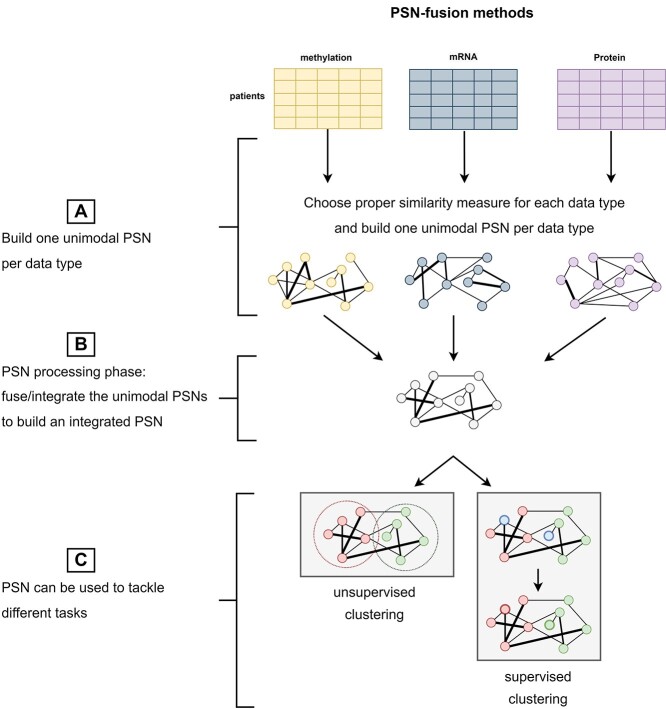
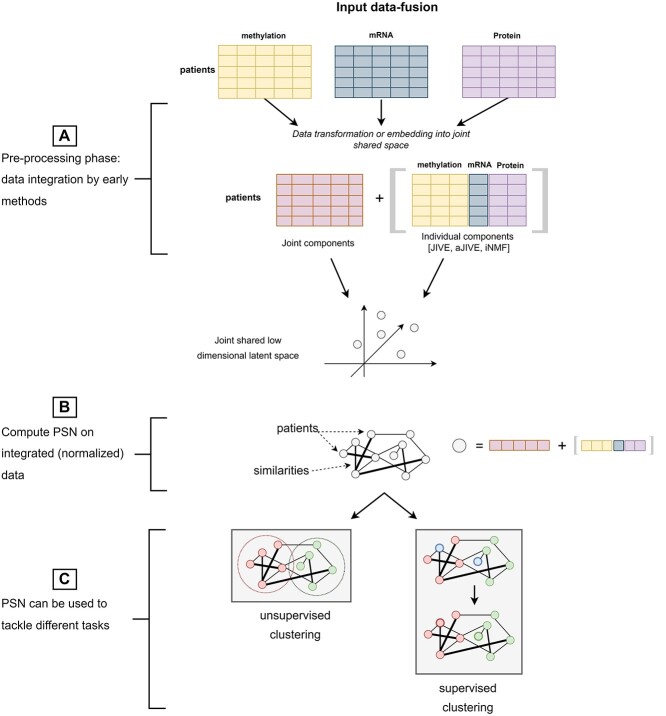
Patient similarity networks (PSNs), where patients are represented as nodes and their similarities as weighted edges, are being increasingly used in clinical research. These networks provide an insightful summary of the relationships among patients and can be exploited by inductive or transductive learning algorithms for the prediction of patient outcome, phenotype and disease risk. PSNs can also be easily visualized, thus offering a natural way to inspect complex heterogeneous patient data and providing some level of explainability of the predictions obtained by machine learning algorithms. The advent of high-throughput technologies, enabling us to acquire high-dimensional views of the same patients (e.g. omics data, laboratory data, imaging data), calls for the development of data fusion techniques for PSNs in order to leverage this rich heterogeneous information. In this article, we review existing methods for integrating multiple biomedical data views to construct PSNs, together with the different patient similarity measures that have been proposed. We also review methods that have appeared in the machine learning literature but have not yet been applied to PSNs, thus providing a resource to navigate the vast machine learning literature existing on this topic. In particular, we focus on methods that could be used to integrate very heterogeneous datasets, including multi-omics data as well as data derived from clinical information and medical imaging.
患者相似性网络(PSN),其中患者被表示为节点,它们的相似性被表示为加权边,在临床研究中越来越多地被使用。这些网络提供了患者之间关系的深入了解,可以通过归纳或转导学习算法用于预测患者的结局、表型和疾病风险。PSN 也可以很容易地可视化,从而提供了一种检查复杂的异质患者数据的自然方式,并为机器学习算法获得的预测提供了一定程度的可解释性。高通量技术的出现,使我们能够获取同一患者的高维视图(例如,组学数据、实验室数据、成像数据),这需要开发 PSN 的数据融合技术,以利用这种丰富的异质信息。在本文中,我们回顾了用于构建 PSN 的整合多种生物医学数据视图的现有方法,以及已经提出的不同患者相似性度量方法。我们还回顾了机器学习文献中出现的但尚未应用于 PSN 的方法,从而为浏览关于该主题的大量机器学习文献提供了资源。特别是,我们关注可用于整合非常异质数据集的方法,包括多组学数据以及来自临床信息和医学成像的数据。