Centre for Healthy Aging and Wellness and Dietetic Program, Faculty of Health Sciences, Universiti Kebangsaan Malaysia, Jalan Raja Muda Aziz, Kuala Lumpur 50300, Selangor, Malaysia.
Center of Community Education and Wellbeing, Faculty of Education, Universiti Kebangsaan Malaysia, Bangi 43600, Selangor, Malaysia.
Int J Environ Res Public Health. 2022 May 30;19(11):6656. doi: 10.3390/ijerph19116656.
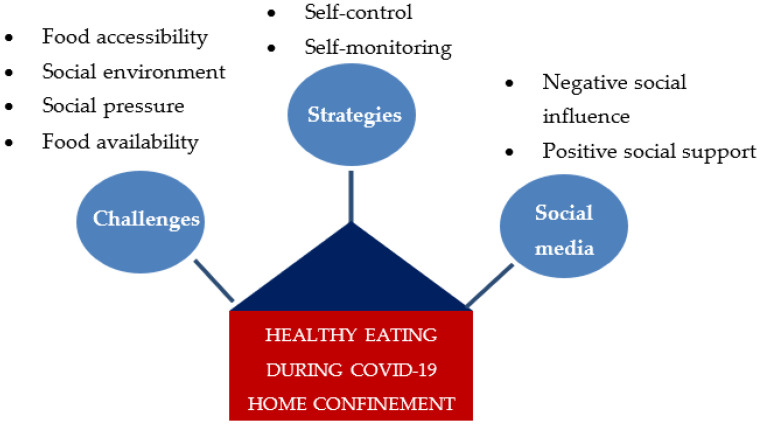
The COVID-19 pandemic has been affecting our lifestyles, such as work, living, and health. In Malaysia, the Restriction of Movement Order (RMO) was first announced in March 2020 to curb the spread of the virus. Since then, many Malaysians have been confined to their own home. This new lifestyle can cause a change of eating habits where healthy eating may be a challenge. Hence, our qualitative study explored the challenges and strategies for healthy eating during the first wave of the COVID-19 home confinement period among working adults overweight and obese in Malaysia. Eleven participants were individually interviewed through phone calls. The interviews were audio-recorded, transcribed verbatim, and then coded with NVIVO 12 based on thematic analysis. We found that social pressure, changes in the social setting, more free time to access food, and extra stock of unhealthy foods at home were among the challenges to healthy eating. Some participants countered these perceived challenges by reducing unhealthy food stock, limiting kitchen visits, and utilizing self-monitoring apps to monitor their calorie intake. Social media was not consistently perceived to influence their eating behavior during this period. We conclude that COVID-19 home confinement has created challenges to healthy eating habits among overweight and obese adults with overweight and obesity. Our study provides evidence that vulnerable groups such as overweight and obese individuals require specific nutritional support during pandemic-related confinement to enhance eating self-efficacy.
新冠疫情对我们的生活方式产生了影响,如工作、生活和健康等。在马来西亚,行动管制令(MCO)于 2020 年 3 月首次宣布,以遏制病毒的传播。从那时起,许多马来西亚人被限制在家中。这种新的生活方式可能导致饮食习惯的改变,健康饮食可能成为一个挑战。因此,我们的定性研究探讨了马来西亚超重和肥胖的在职成年人在新冠疫情居家隔离期间健康饮食所面临的挑战和策略。11 名参与者通过电话进行了单独访谈。访谈以音频形式记录下来,逐字转录,并使用 NVIVO 12 基于主题分析进行编码。我们发现,社会压力、社交环境的变化、更多获取食物的自由时间以及家中不健康食物的存量增加等,都是健康饮食的挑战。一些参与者通过减少不健康食物的存量、限制去厨房的次数以及利用自我监测应用程序来监测卡路里摄入量来应对这些感知到的挑战。社交媒体在这段时间并没有被一致认为会影响他们的饮食行为。我们的结论是,新冠疫情居家隔离给超重和肥胖的成年人的健康饮食习惯带来了挑战。我们的研究表明,超重和肥胖等弱势群体在与大流行相关的隔离期间需要特定的营养支持,以增强饮食自我效能感。