Kessler Amanda, Hedberg Jonas, Blomberg Eva, Odnevall Inger
KTH Royal Institute of Technology, Division of Surface and Corrosion Science, Department of Chemistry, 100 44 Stockholm, Sweden.
Surface Science Western, Western University, London, ON N6G 0J3, Canada.
Nanomaterials (Basel). 2022 Jun 4;12(11):1922. doi: 10.3390/nano12111922.
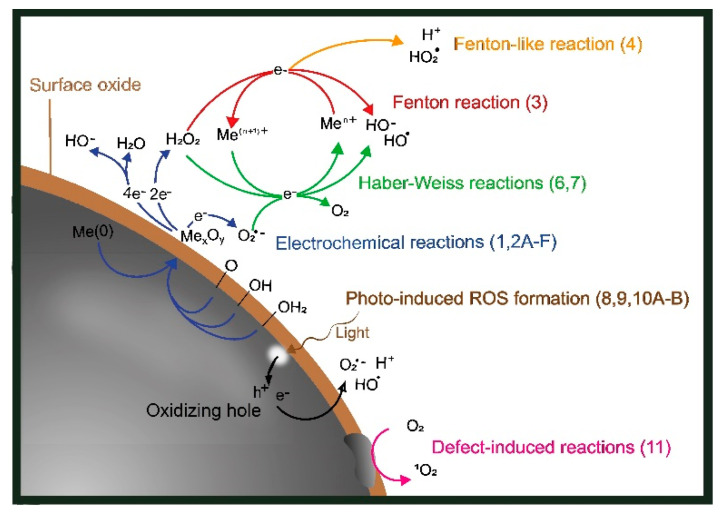
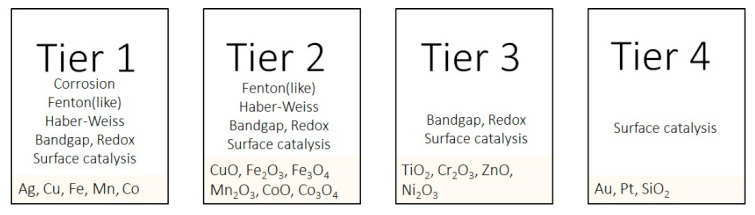
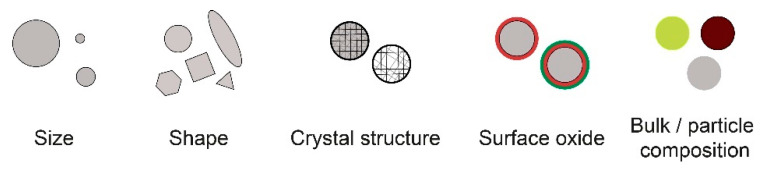
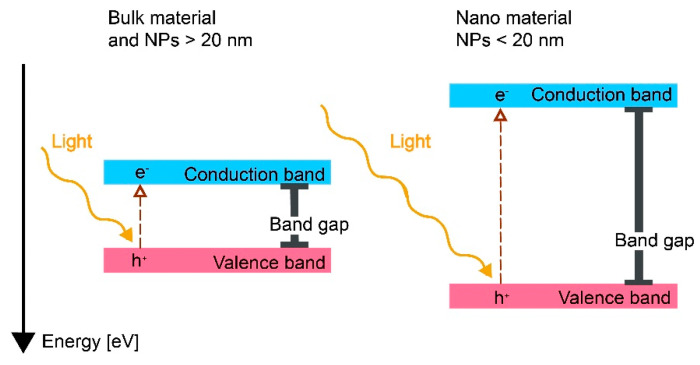
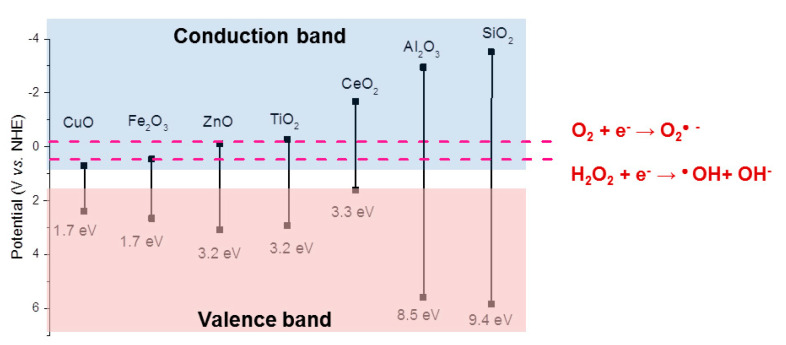
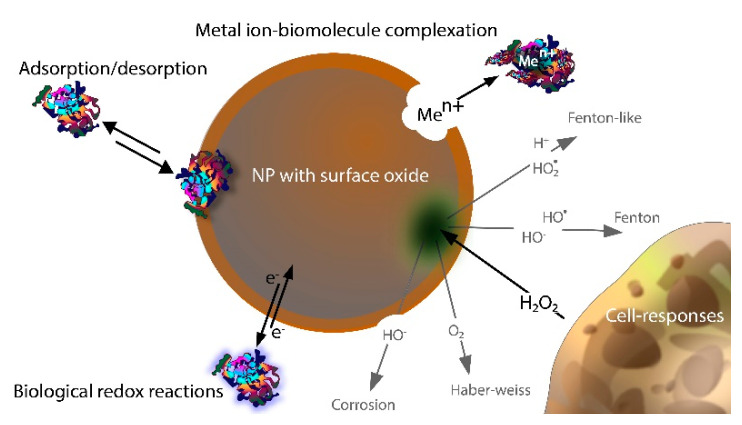
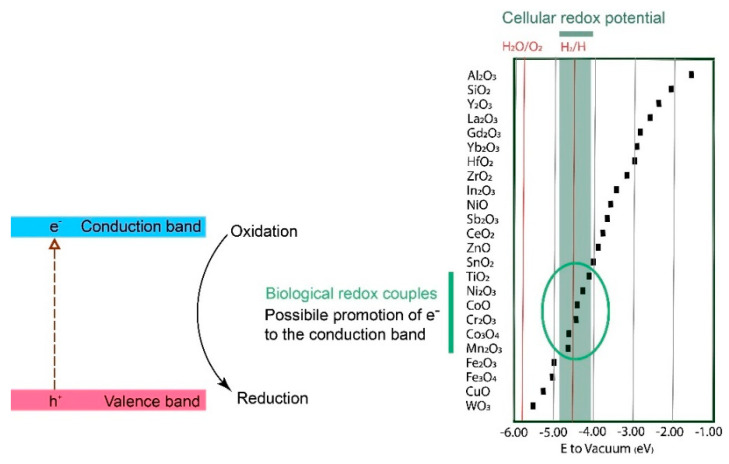
Diffusely dispersed metal and metal oxide nanoparticles (NPs) can adversely affect living organisms through various mechanisms and exposure routes. One mechanism behind their toxic potency is their ability to generate reactive oxygen species (ROS) directly or indirectly to an extent that depends on the dose, metal speciation, and exposure route. This review provides an overview of the mechanisms of ROS formation associated with metal and metal oxide NPs and proposes a possible way forward for their future categorization. Metal and metal oxide NPs can form ROS via processes related to corrosion, photochemistry, and surface defects, as well as via Fenton, Fenton-like, and Haber-Weiss reactions. Regular ligands such as biomolecules can interact with metallic NP surfaces and influence their properties and thus their capabilities of generating ROS by changing characteristics such as surface charge, surface composition, dissolution behavior, and colloidal stability. Interactions between metallic NPs and cells and their organelles can indirectly induce ROS formation via different biological responses. HO can also be generated by a cell due to inflammation, induced by interactions with metallic NPs or released metal species that can initiate Fenton(-like) and Haber-Weiss reactions forming various radicals. This review discusses these different pathways and, in addition, nano-specific aspects such as shifts in the band gaps of metal oxides and how these shifts at biologically relevant energies (similar to activation energies of biological reactions) can be linked to ROS production and indicate which radical species forms. The influences of kinetic aspects, interactions with biomolecules, solution chemistry (e.g., Cl and pH), and NP characteristics (e.g., size and surface defects) on ROS mechanisms and formation are discussed. Categorization via four tiers is suggested as a way forward to group metal and metal oxide NPs based on the ROS reaction pathways that they may undergo, an approach that does not include kinetics or environmental variations. The criteria for the four tiers are based on the ability of the metallic NPs to induce Fenton(-like) and Haber-Weiss reactions, corrode, and interact with biomolecules and their surface catalytic properties. The importance of considering kinetic data to improve the proposed categorization is highlighted.
广泛分散的金属和金属氧化物纳米颗粒(NPs)可通过多种机制和暴露途径对生物体产生不利影响。其毒性的一个潜在机制是它们直接或间接产生活性氧(ROS)的能力,这种能力取决于剂量、金属形态和暴露途径。本文综述了与金属和金属氧化物纳米颗粒相关的ROS形成机制,并为其未来的分类提出了一种可能的方法。金属和金属氧化物纳米颗粒可通过与腐蚀、光化学和表面缺陷相关的过程,以及通过芬顿、类芬顿和哈伯-维伊斯反应形成ROS。诸如生物分子等常规配体可与金属纳米颗粒表面相互作用并影响其性质,从而通过改变表面电荷、表面组成、溶解行为和胶体稳定性等特性来影响其产生活性氧的能力。金属纳米颗粒与细胞及其细胞器之间的相互作用可通过不同的生物学反应间接诱导ROS形成。细胞也可由于与金属纳米颗粒或释放的金属物种相互作用引发芬顿(类)和哈伯-维伊斯反应形成各种自由基而导致炎症,进而产生活性氧。本文讨论了这些不同的途径,此外,还讨论了纳米颗粒特有的方面,如金属氧化物带隙的变化,以及这些在生物相关能量(类似于生物反应的活化能)下的变化如何与活性氧的产生相关联,并指出形成了哪些自由基种类。还讨论了动力学方面、与生物分子的相互作用、溶液化学(如氯离子和pH值)以及纳米颗粒特性(如尺寸和表面缺陷)对活性氧机制和形成的影响。建议通过四个层次进行分类,以此作为根据金属和金属氧化物纳米颗粒可能经历的活性氧反应途径对其进行分组的方法,该方法不包括动力学或环境变化。这四个层次的标准基于金属纳米颗粒诱导芬顿(类)和哈伯-维伊斯反应、腐蚀以及与生物分子相互作用的能力及其表面催化特性。强调了考虑动力学数据以改进所提出分类的重要性。