Asaduzzaman M D, Romel Bhuia Mohammad, Nazmul Alam Zhm, Zabed Jillul Bari Mohammad, Ferdousi Tasnim
Department of Medicine Sylhet MAG Osmani Medical College Hospital Sylhet Bangladesh.
Department of Statistics Shahjalal University of Science and Technology Sylhet Bangladesh.
Health Sci Rep. 2022 Jun 7;5(4):e663. doi: 10.1002/hsr2.663. eCollection 2022 Jul.
To address the problem of resource limitation, biomarkers having a potential for mortality prediction are urgently required. This study was designed to evaluate whether hemogram-derived ratios could predict in-hospital deaths in COVID-19 patients.
This multicenter retrospective study included hospitalized COVID-19 patients from four COVID-19 dedicated hospitals in Sylhet, Bangladesh. Data on clinical characteristics, laboratory parameters, and survival outcomes were analyzed. Logistic regression models were fitted to identify the predictors of in-hospital death.
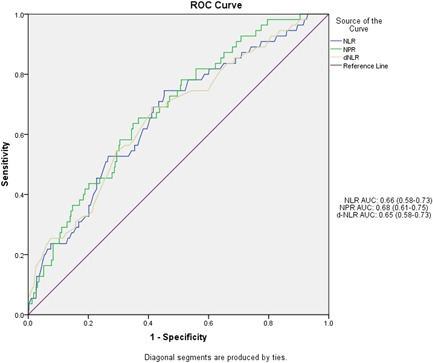
Out of 442 patients, 55 (12.44%) suffered in-hospital death. The proportion of male was higher in nonsurvivor group (61.8%). The mean age was higher in nonsurvivors (69 ± 13 vs. 59 ± 14 years, < 0.001). Compared to survivors, nonsurvivors exhibited higher frequency of comorbidities, such as chronic kidney disease (34.5% vs. 15.2%, ≤ 0.001), chronic obstructive pulmonary disease (23.6% vs. 10.6%, = 0.011), ischemic heart disease (41.8% vs. 19.4%, < 0.001), and diabetes mellitus (76.4% vs. 61.8%, = 0.05). Leukocytosis and lymphocytopenia were more prevalent in nonsurvivors ( < 0.05). Neutrophil-to-lymphocyte ratio (NLR), derived NLR (d-NLR), and neutrophil-to-platelet ratio (NPR) were significantly higher in nonsurvivors ( < 0.05). After adjusting for potential covariates, NLR (odds ratio [OR] 1.05; 95% confidence interval [CI] 1.009-1.08), d-NLR (OR 1.08; 95% CI 1.006-1.14), and NPR (OR 1.20; 95% CI 1.09-1.32) have been found to be significant predictors of mortality in hospitalized COVID-19 patients. The optimal cut-off points for NLR, d-NLR, and NPR for prediction of in-hospital mortality for COVID-19 patients were 7.57, 5.52 and 3.87, respectively.
Initial assessment of NLR, d-NLR, and NPR values at hospital admission is of good prognostic value for predicting mortality of patients with COVID-19.
为解决资源限制问题,迫切需要具有死亡预测潜力的生物标志物。本研究旨在评估血常规衍生比值是否可预测COVID-19患者的院内死亡情况。
这项多中心回顾性研究纳入了来自孟加拉国锡尔赫特四家COVID-19专科医院的住院COVID-19患者。分析了临床特征、实验室参数和生存结局数据。采用逻辑回归模型确定院内死亡的预测因素。
442例患者中,55例(12.44%)发生院内死亡。非存活组男性比例更高(61.8%)。非存活者的平均年龄更高(69±13岁 vs. 59±14岁,<0.001)。与存活者相比,非存活者合并症的发生率更高,如慢性肾脏病(34.5% vs. 15.2%,≤0.001)、慢性阻塞性肺疾病(23.6% vs. 10.6%,=0.011)、缺血性心脏病(41.8% vs. 19.4%,<0.001)和糖尿病(76.4% vs. 61.8%,=0.05)。非存活者中白细胞增多和淋巴细胞减少更为普遍(<0.05)。非存活者的中性粒细胞与淋巴细胞比值(NLR)、衍生NLR(d-NLR)和中性粒细胞与血小板比值(NPR)显著更高(<0.05)。在调整潜在协变量后,发现NLR(比值比[OR] 1.05;95%置信区间[CI] 1.009-1.08)、d-NLR(OR 1.08;95% CI 1.006-1.14)和NPR(OR 1.20;95% CI 1.09-1.32)是住院COVID-19患者死亡的重要预测因素。COVID-19患者院内死亡预测的NLR最佳截断点为7.57,d-NLR为5.52,NPR为3.87。
入院时对NLR、d-NLR和NPR值进行初步评估对预测COVID-19患者的死亡率具有良好预后价值。