Aix Marseille University, Avignon University, CNRS, IRD, IMBE, Institut Méditerranéen de Biodiversité et d'Ecologie marine et continentale, Faculté des Sciences et Techniques St-Jérôme, Marseille, France.
Real Jardín Botánico (RJB), CSIC, Madrid, Spain.
Mol Ecol. 2022 Aug;31(15):4095-4111. doi: 10.1111/mec.16563. Epub 2022 Jun 30.
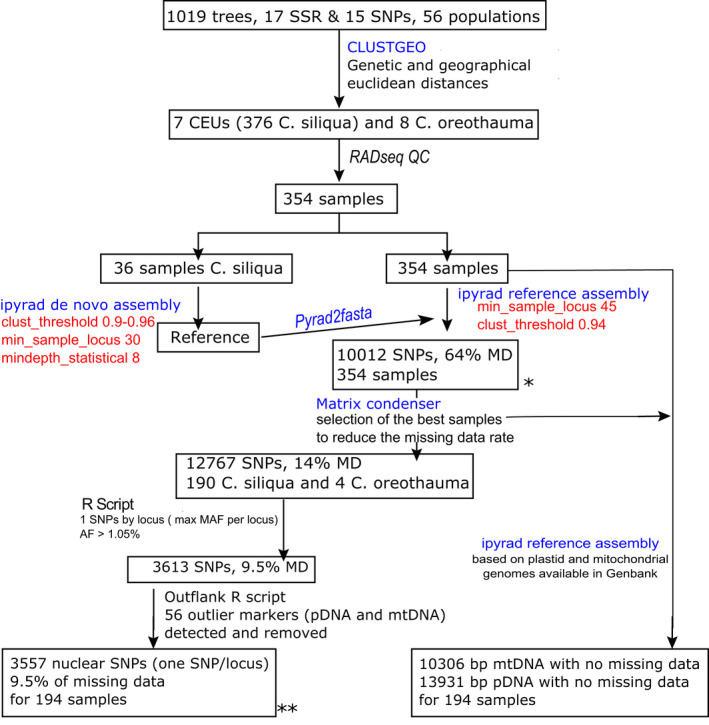
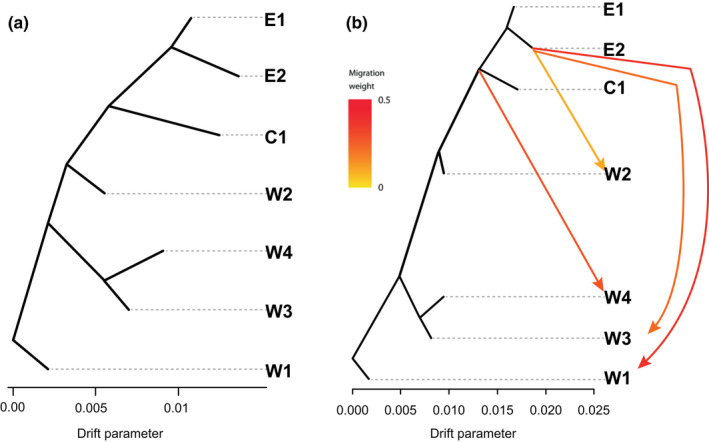
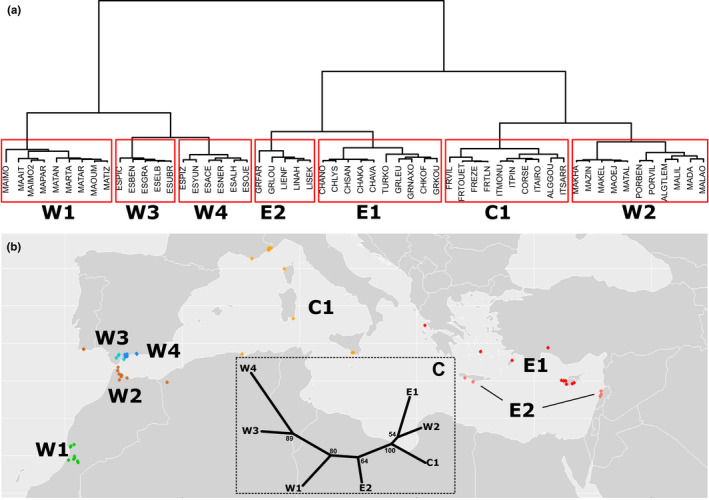
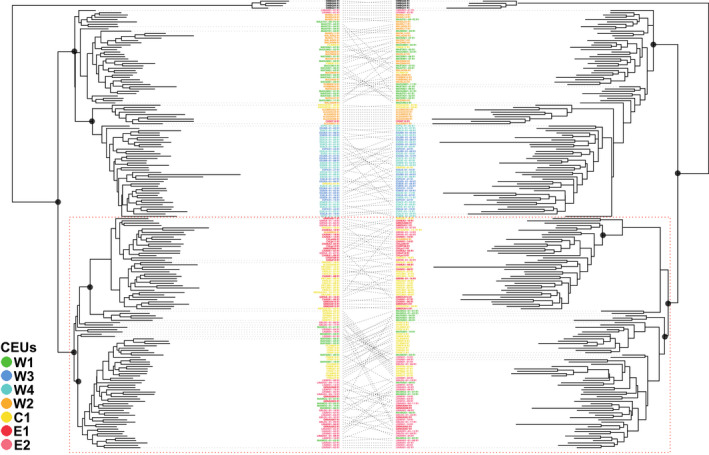
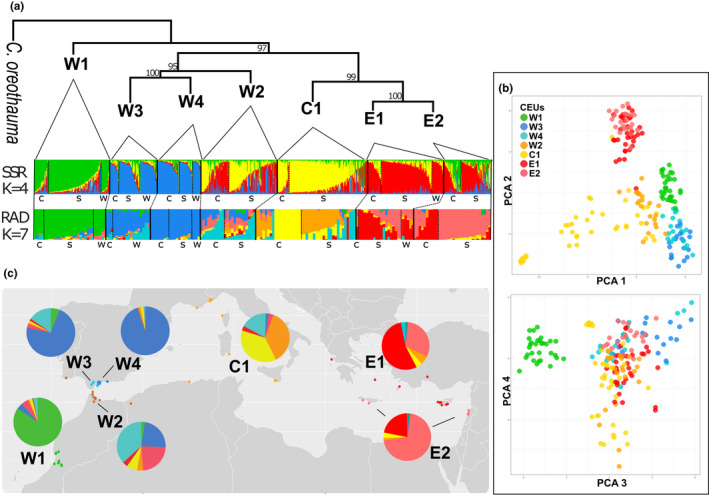
Intense research efforts over the last two decades have renewed our understanding of plant phylogeography and domestication in the Mediterranean basin. Here we aim to investigate the evolutionary history and the origin of domestication of the carob tree (Ceratonia siliqua), which has been cultivated for millennia for food and fodder. We used >1000 microsatellite genotypes to delimit seven carob evolutionary units (CEUs). We investigated genome-wide diversity and evolutionary patterns of the CEUs with 3557 single nucleotide polymorphisms generated by restriction-site associated DNA sequencing (RADseq). To address the complex wild vs. cultivated status of sampled trees, we classified 56 sampled populations across the Mediterranean basin as wild, seminatural or cultivated. Nuclear and cytoplasmic loci were identified from RADseq data and separated for analyses. Phylogenetic analyses of these genomic-wide data allowed us to resolve west-to-east expansions from a single long-term refugium probably located in the foothills of the High Atlas Mountains near the Atlantic coast. Our findings support multiple origins of domestication with a low impact on the genetic diversity at range-wide level. The carob was mostly domesticated from locally selected wild genotypes and scattered long-distance westward dispersals of domesticated varieties by humans, concomitant with major historical migrations by Romans, Greeks and Arabs. Ex situ efforts to preserve carob genetic resources should prioritize accessions from both western and eastern populations, with emphasis on the most differentiated CEUs situated in southwest Morocco, south Spain and eastern Mediterranean. Our study highlights the relevance of wild and seminatural habitats in the conservation of genetic resources for cultivated trees.
在过去的二十年中,激烈的研究努力更新了我们对地中海盆地植物系统地理学和驯化的认识。在这里,我们旨在研究角豆树(Ceratonia siliqua)的进化历史和驯化起源,几千年来,角豆树一直被用于食品和饲料。我们使用了> 1000 个微卫星基因型来划定七个角豆进化单元(CEU)。我们使用通过限制性位点相关 DNA 测序(RADseq)生成的 3557 个单核苷酸多态性来研究 CEU 的全基因组多样性和进化模式。为了解决采样树木复杂的野生与栽培状态,我们将地中海盆地的 56 个采样种群分为野生、半自然或栽培。从 RADseq 数据中鉴定出核和细胞质基因座,并分别进行分析。这些全基因组数据的系统发育分析使我们能够解决从一个可能位于大西洋沿岸高阿特拉斯山脉山麓的长期避难所向西向东扩张的问题。我们的研究结果支持多种驯化起源,对范围广泛的遗传多样性影响较小。角豆主要是从当地选择的野生基因型中驯化而来的,并且人类分散进行了远距离向西的驯化品种扩散,同时伴随着罗马人、希腊人和阿拉伯人的主要历史迁徙。为了保护角豆的遗传资源,应该优先考虑来自西部和东部种群的样本,重点是位于摩洛哥西南部、西班牙南部和地中海东部的最具分化的 CEU。我们的研究强调了野生和半自然生境在保护栽培树木遗传资源方面的重要性。