University Medical Center Mainz, Department of Dermatology, Mainz, Germany.
Front Immunol. 2022 May 25;13:912594. doi: 10.3389/fimmu.2022.912594. eCollection 2022.
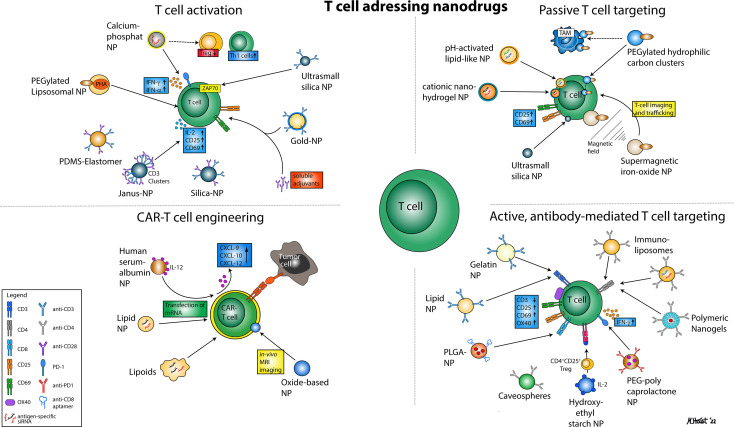
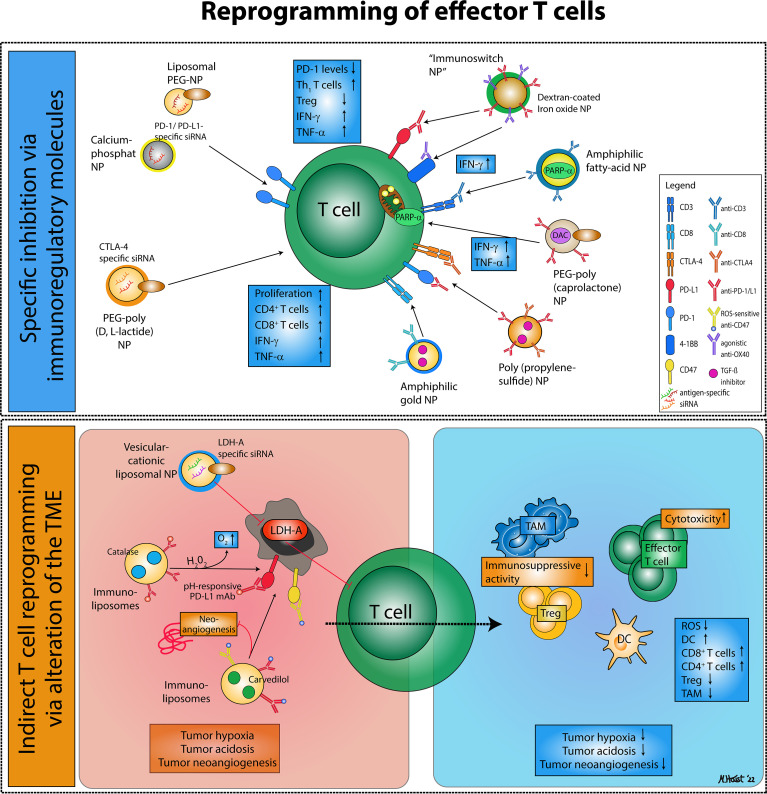
In contrast to conventional anti-tumor agents, nano-carriers allow co-delivery of distinct drugs in a cell type-specific manner. So far, many nanodrug-based immunotherapeutic approaches aim to target and kill tumor cells directly or to address antigen presenting cells (APC) like dendritic cells (DC) in order to elicit tumor antigen-specific T cell responses. Regulatory T cells (Treg) constitute a major obstacle in tumor therapy by inducing a pro-tolerogenic state in APC and inhibiting T cell activation and T effector cell activity. This review aims to summarize nanodrug-based strategies that aim to address and reprogram Treg to overcome their immunomodulatory activity and to revert the exhaustive state of T effector cells. Further, we will also discuss nano-carrier-based approaches to introduce tumor antigen-specific chimeric antigen receptors (CAR) into T cells for CAR-T cell therapy which constitutes a complementary approach to DC-focused vaccination.
与传统的抗肿瘤药物相比,纳米载体允许以细胞类型特异性的方式共同递送不同的药物。到目前为止,许多基于纳米药物的免疫治疗方法旨在直接靶向和杀死肿瘤细胞,或针对树突状细胞 (DC) 等抗原提呈细胞 (APC),以引发肿瘤抗原特异性 T 细胞反应。调节性 T 细胞 (Treg) 通过在 APC 中诱导耐受原性状态并抑制 T 细胞激活和 T 效应细胞活性,构成了肿瘤治疗的主要障碍。本综述旨在总结基于纳米药物的策略,这些策略旨在解决并重新编程 Treg,以克服其免疫调节活性并逆转 T 效应细胞的衰竭状态。此外,我们还将讨论基于纳米载体的方法,将肿瘤抗原特异性嵌合抗原受体 (CAR) 引入 T 细胞用于 CAR-T 细胞治疗,这是一种与针对 DC 的疫苗接种互补的方法。