Department of Medicine, Perelman School of Medicine, University of Pennsylvania, Philadelphia.
Center for Health Care Innovation, University of Pennsylvania, Philadelphia.
JAMA Netw Open. 2022 Jun 1;5(6):e2216649. doi: 10.1001/jamanetworkopen.2022.16649.
COVID-19 vaccine uptake among urban populations remains low.
To evaluate whether text messaging with outbound or inbound scheduling and behaviorally informed content might increase COVID-19 vaccine uptake.
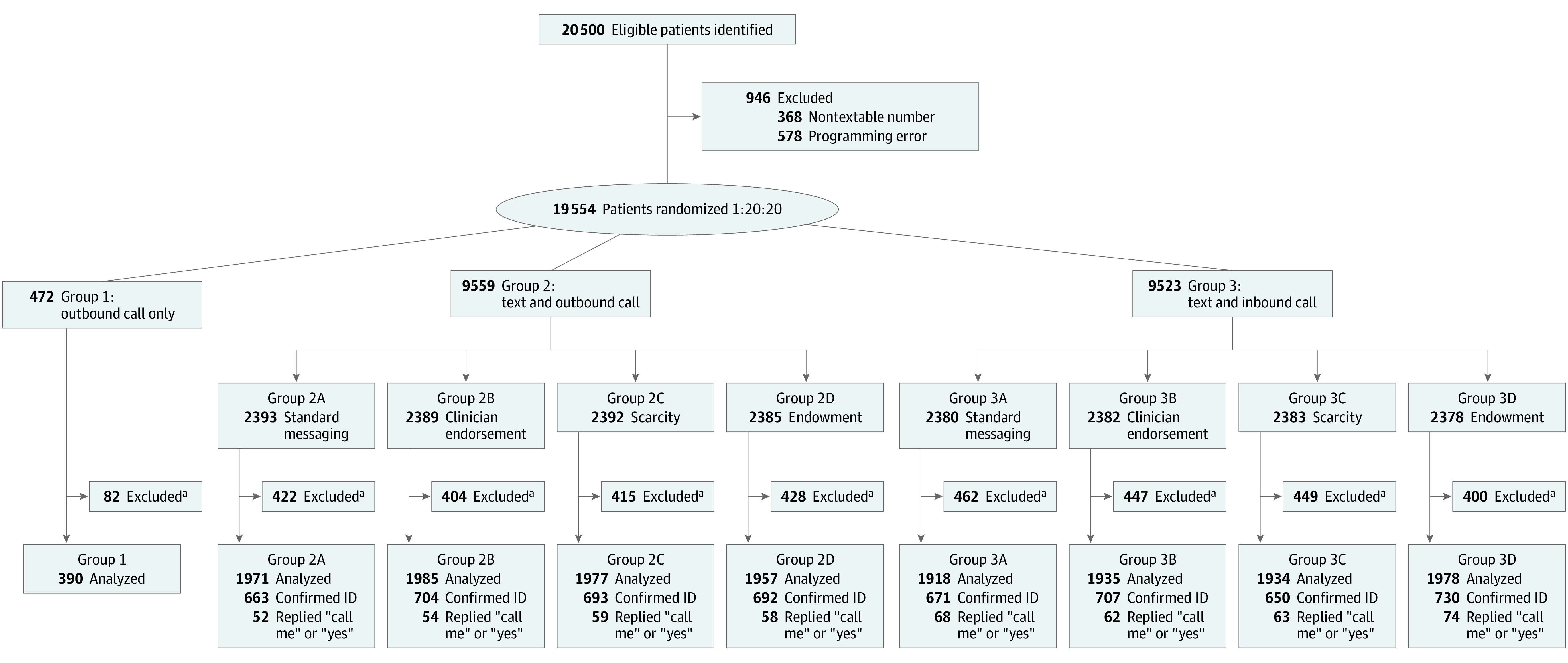
DESIGN, SETTING, AND PARTICIPANTS: This randomized clinical trial with a factorial design was conducted from April 29 to July 6, 2021, in an urban academic health system. The trial comprised 16 045 patients at least 18 years of age in Philadelphia, Pennsylvania, with at least 1 primary care visit in the past 5 years, or a future scheduled primary care visit within the next 3 months, who were unresponsive to prior outreach. The study was prespecified in the trial protocol, and data were obtained from the intent-to-treat population.
Eligible patients were randomly assigned in a 1:20:20 ratio to (1) outbound telephone call only by call center, (2) text message and outbound telephone call by call center to those who respond, or (3) text message, with patients instructed to make an inbound telephone call to a hotline. Patients in groups 2 and 3 were concurrently randomly assigned in a 1:1:1:1 ratio to receive different content: standard messaging, clinician endorsement (eg, "Dr. XXX recommends"), scarcity ("limited supply available"), or endowment framing ("We have reserved a COVID-19 vaccine appointment for you").
The primary outcome was the proportion of patients who completed the first dose of the COVID-19 vaccine within 1 month, according to the electronic health record. Secondary outcomes were the completion of the first dose within 2 months and completion of the vaccination series within 2 months of initial outreach. Additional outcomes included the percentage of patients with invalid cell phone numbers (wrong number or nontextable), no response to text messaging, the percentage of patients scheduled for the vaccine, text message responses, and the number of telephone calls made by the access center. Analysis was on an intention-to-treat basis.
Among the 16 045 patients included, the mean (SD) age was 36.9 (11.1) years; 9418 (58.7%) were women; 12 869 (80.2%) had commercial insurance, and 2283 (14.2%) were insured by Medicaid; 8345 (52.0%) were White, 4706 (29.3%) were Black, and 967 (6.0%) were Hispanic or Latino. At 1 month, 14 of 390 patients (3.6% [95% CI, 1.7%-5.4%]) in the outbound telephone call-only group completed 1 vaccine dose, as did 243 of 7890 patients (3.1% [95% CI, 2.7%-3.5%]) in the text plus outbound call group (absolute difference, -0.5% [95% CI, -2.4% to 1.4%]; P = .57) and 253 of 7765 patients (3.3% [95% CI, 2.9%-3.7%]) in the text plus inbound call group (absolute difference, -0.3% [95% CI, -2.2% to 1.6%]; P = .72). Among the 15 655 patients receiving text messaging, 118 of 3889 patients (3.0% [95% CI, 2.5%-3.6%]) in the standard messaging group completed 1 vaccine dose, as did 135 of 3920 patients (3.4% [95% CI, 2.9%-4.0%]) in the clinician endorsement group (absolute difference, 0.4% [95% CI, -0.4% to 1.2%]; P = .31), 100 of 3911 patients (2.6% [95% CI, 2.1%-3.1%]) in the scarcity group (absolute difference, -0.5% [95% CI, -1.2% to 0.3%]; P = .20), and 143 of 3935 patients (3.6% [95% CI, 3.0%-4.2%]) in the endowment group (absolute difference, 0.6% [95% CI, -0.2% to 1.4%]; P = .14).
There was no detectable increase in vaccination uptake among patients receiving text messaging compared with telephone calls only or behaviorally informed message content.
ClinicalTrials.gov Identifier: NCT04834726.
城市人口的 COVID-19 疫苗接种率仍然较低。
评估向外拨打电话和/或行为信息的短信与增加 COVID-19 疫苗接种率之间的关系。
设计、地点和参与者:本随机临床试验采用析因设计,于 2021 年 4 月 29 日至 7 月 6 日在宾夕法尼亚州费城的一个城市学术医疗系统中进行。试验纳入了至少 18 岁、在过去 5 年内至少有 1 次初级保健就诊记录或未来 3 个月内有计划的初级保健就诊记录、但对先前的外展无反应的 16445 名患者。该研究在试验方案中进行了预先设定,数据来自意向治疗人群。
符合条件的患者按照 1:20:20 的比例随机分为三组:(1)仅由呼叫中心进行外拨电话;(2)呼叫中心的短信和外拨电话,适用于回复的患者;(3)短信,同时要求患者拨打热线电话进行回拨。组 2 和组 3 中的患者被同时随机分为 1:1:1:1 的比例,以接收不同的内容:标准消息、医生背书(例如,“XXX 医生建议”)、短缺(“供应有限”)或捐赠框架(“我们已为您预约了 COVID-19 疫苗”)。
主要结局是根据电子健康记录,在 1 个月内完成 COVID-19 疫苗第一剂的患者比例。次要结局是在 2 个月内完成第一剂和完成整个疫苗接种系列的比例。其他结局包括无效手机号码(错误号码或无法接收短信)的患者比例、未回复短信的患者比例、预约疫苗的患者比例、短信回复率和访问中心拨打的电话数量。分析基于意向治疗原则。
在纳入的 16445 名患者中,平均(SD)年龄为 36.9(11.1)岁;9418 名(58.7%)为女性;12869 名(80.2%)有商业保险,2283 名(14.2%)有医疗补助保险;8345 名(52.0%)为白人,4706 名(29.3%)为黑人,967 名(6.0%)为西班牙裔或拉丁裔。在 1 个月时,在外拨电话组的 390 名患者中,有 14 名(3.6%[95%CI,1.7%-5.4%])完成了 1 剂疫苗接种,在短信加外拨电话组的 7890 名患者中,有 243 名(3.1%[95%CI,2.7%-3.5%])完成了第一剂疫苗接种(绝对差异,-0.5%[95%CI,-2.4%至 1.4%];P=0.57),在短信加回拨电话组的 7765 名患者中,有 253 名(3.3%[95%CI,2.9%-3.7%])完成了第一剂疫苗接种(绝对差异,-0.3%[95%CI,-2.2%至 1.6%];P=0.72)。在接收短信的 15655 名患者中,标准信息组的 3889 名患者中有 118 名(3.0%[95%CI,2.5%-3.6%])完成了 1 剂疫苗接种,医生背书组的 3920 名患者中有 135 名(3.4%[95%CI,2.9%-4.0%])完成了第一剂疫苗接种(绝对差异,0.4%[95%CI,-0.4%至 1.2%];P=0.31),在短缺信息组的 3911 名患者中有 100 名(2.6%[95%CI,2.1%-3.1%])完成了第一剂疫苗接种(绝对差异,-0.5%[95%CI,-1.2%至 0.3%];P=0.20),在捐赠框架组的 3935 名患者中有 143 名(3.6%[95%CI,3.0%-4.2%])完成了第一剂疫苗接种(绝对差异,0.6%[95%CI,-0.2%至 1.4%];P=0.14)。
与仅电话或行为信息短信相比,接受短信的患者疫苗接种率没有明显增加。
ClinicalTrials.gov 标识符:NCT04834726。