Universitat Pompeu Fabra, Barcelona, Catalonia, Spain.
Universitat Autònoma de Barcelona, Barcelona, Catalonia, Spain.
PLoS One. 2022 Jun 13;17(6):e0269639. doi: 10.1371/journal.pone.0269639. eCollection 2022.
Residents of Nursing Homes (NHs) have suffered greater impacts from the COVID-19 pandemic. However, the rates of COVID-19 in these institutions are heterogeneously distributed. Describing and understanding the structural, functional, and socioeconomic differences between NHs is extremely important to avoid new outbreaks.
Analyze inequalities in the cumulative incidences (CIs) and in the mortality rates (MRs) due to COVID-19 in the NHs of Barcelona based on the characteristics of the NHs.
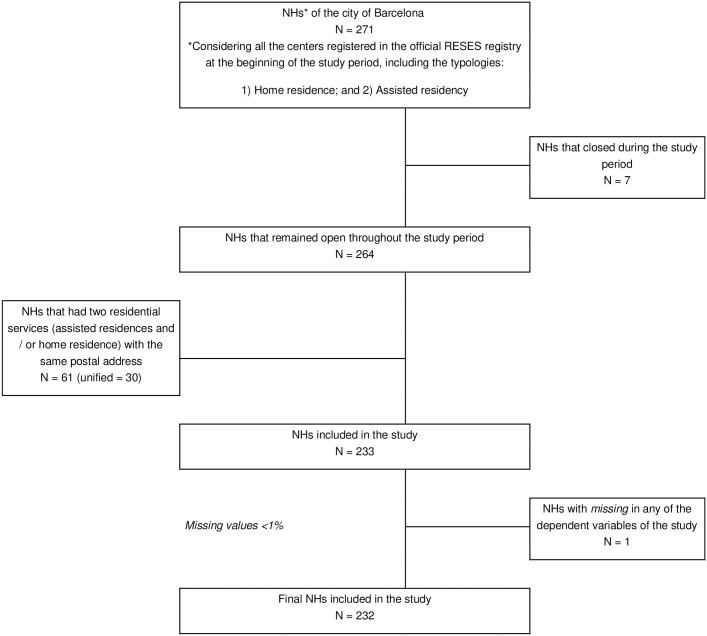
Exploratory ecological study of 232 NHs. The dependent variables were the cumulative incidence and mortality rate due to COVID-19 in NHs between March and June 2020. Structural variables of the NHs were evaluated such as neighborhood socioeconomic position (SEP), isolation and sectorization capacity, occupancy, overcrowding and ownership.
The cumulative incidence and mortality rate were higher in the low SEP neighborhoods and lower in those of high SEP neighborhoods. Regarding the isolation and sectorization capacity, Type B NHs had a higher risk of becoming infected and dying, while Type C had a lower risk of dying than Type A. Greater overcrowding was associated with greater morbidity and mortality, and higher occupancy was associated with higher incidence. The risk of becoming infected and dying in public NHs was significantly higher than for-profit NH.
The social components together with the functional and infrastructure characteristics of the NHs influence the cumulative incidence and the mortality rate by COVID-19. It is necessary to redefine the care model in the NHs to guarantee the health of the residents.
养老院(NH)的居民受到 COVID-19 大流行的影响更大。然而,这些机构的 COVID-19 发病率存在差异。描述和理解 NH 之间的结构、功能和社会经济差异对于避免新的疫情爆发非常重要。
根据 NH 的特征,分析巴塞罗那 NH 因 COVID-19 导致的累积发病率(CI)和死亡率(MR)的不平等现象。
对 232 家 NH 进行了探索性生态研究。因变量为 2020 年 3 月至 6 月 NH 中 COVID-19 的累积发病率和死亡率。评估了 NH 的结构变量,如邻里社会经济地位(SEP)、隔离和分区能力、入住率、过度拥挤和所有权。
低 SEP 邻里的累积发病率和死亡率较高,而高 SEP 邻里的累积发病率和死亡率较低。关于隔离和分区能力,B 型 NH 感染和死亡的风险更高,而 C 型 NH 的死亡风险低于 A 型。过度拥挤与发病率和死亡率的增加有关,入住率的增加与发病率的增加有关。公立 NH 感染和死亡的风险明显高于营利性 NH。
NH 的社会构成以及功能和基础设施特征共同影响 COVID-19 的累积发病率和死亡率。有必要重新定义 NH 的护理模式,以保障居民的健康。