Department of Ophthalmology, Gyeongsang National University Changwon Hospital, #11 Samjeongja-ro, Seongsan-gu, Changwon, 51472, Republic of Korea.
Department of Ophthalmology, Gyeongsang National University College of Medicine, Institute of Health Sciences, Jinju, Republic of Korea.
Sci Rep. 2022 Jun 15;12(1):9925. doi: 10.1038/s41598-022-14140-x.
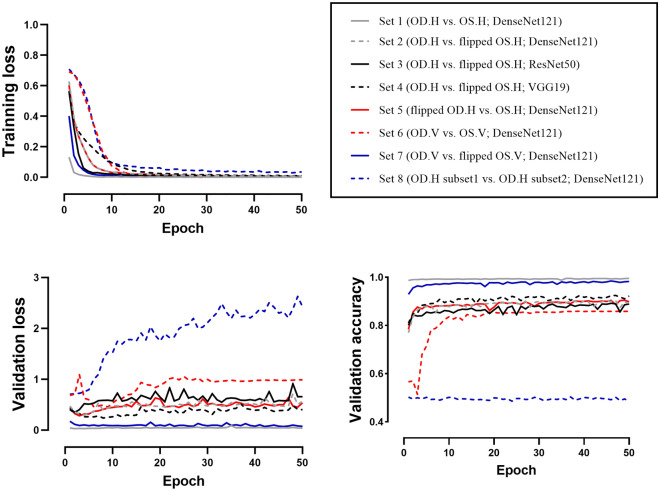
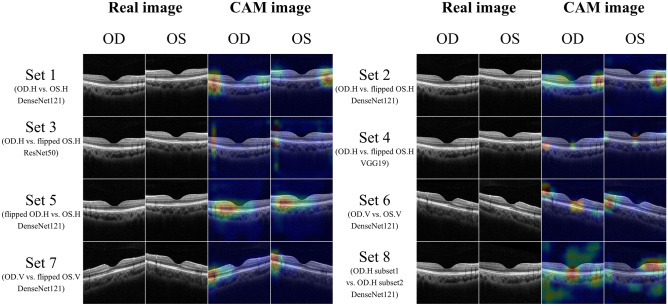
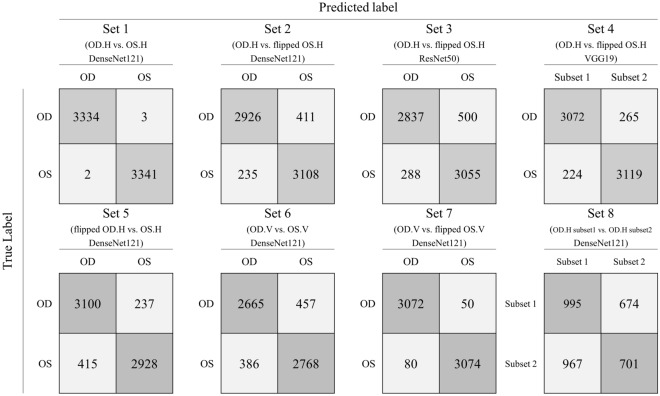
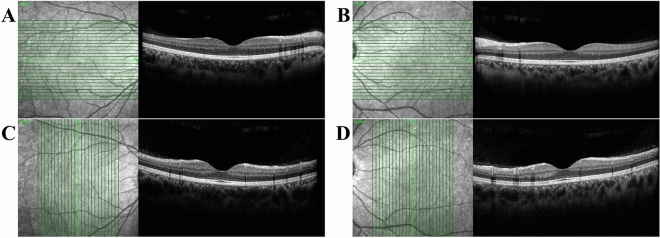
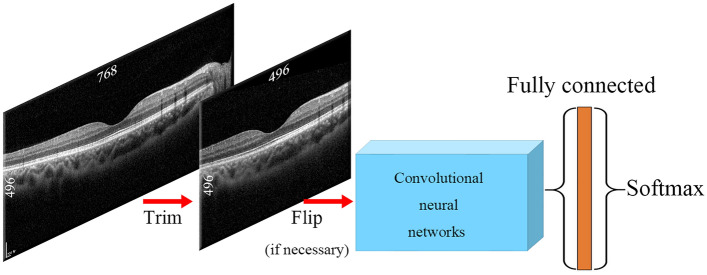
In a previous study, we identified biocular asymmetries in fundus photographs, and macula was discriminative area to distinguish left and right fundus images with > 99.9% accuracy. The purposes of this study were to investigate whether optical coherence tomography (OCT) images of the left and right eyes could be discriminated by convolutional neural networks (CNNs) and to support the previous result. We used a total of 129,546 OCT images. CNNs identified right and left horizontal images with high accuracy (99.50%). Even after flipping the left images, all of the CNNs were capable of discriminating them (DenseNet121: 90.33%, ResNet50: 88.20%, VGG19: 92.68%). The classification accuracy results were similar for the right and left flipped images (90.24% vs. 90.33%, respectively; p = 0.756). The CNNs also differentiated right and left vertical images (86.57%). In all cases, the discriminatory ability of the CNNs yielded a significant p value (< 0.001). However, the CNNs could not well-discriminate right horizontal images (50.82%, p = 0.548). There was a significant difference in identification accuracy between right and left horizontal and vertical OCT images and between flipped and non-flipped images. As this could result in bias in machine learning, care should be taken when flipping images.
在之前的研究中,我们发现眼底照片存在双眼不对称性,而黄斑是区分左右眼底图像的有区分性区域,准确率超过 99.9%。本研究旨在探讨卷积神经网络(CNN)是否可以区分左右眼的光学相干断层扫描(OCT)图像,并验证之前的结果。我们共使用了 129546 张 OCT 图像。CNN 能够非常准确地识别左右水平图像(99.50%)。即使对左眼图像进行翻转,所有 CNN 都能够对其进行区分(DenseNet121:90.33%,ResNet50:88.20%,VGG19:92.68%)。左右翻转图像的分类准确率结果相似(分别为 90.24%和 90.33%,p=0.756)。CNN 还可以区分左右垂直图像(86.57%)。在所有情况下,CNN 的区分能力都产生了显著的 p 值(<0.001)。然而,CNN 无法很好地区分右眼水平图像(50.82%,p=0.548)。左右水平和垂直 OCT 图像以及翻转和非翻转图像之间的识别准确率存在显著差异。由于这可能导致机器学习中的偏差,因此在翻转图像时应谨慎。