Department of Gynecology, Fujian Medical University Cancer Hospital, Fujian Cancer Hospital, Fuzhou, China.
Laboratory of Biochemistry and Molecular Biology Research, Department of Clinical Laboratory, Fujian Medical University Cancer Hospital, Fujian Cancer Hospital, Fuzhou, China.
Bioengineered. 2022 May;13(5):13893-13905. doi: 10.1080/21655979.2022.2086377.
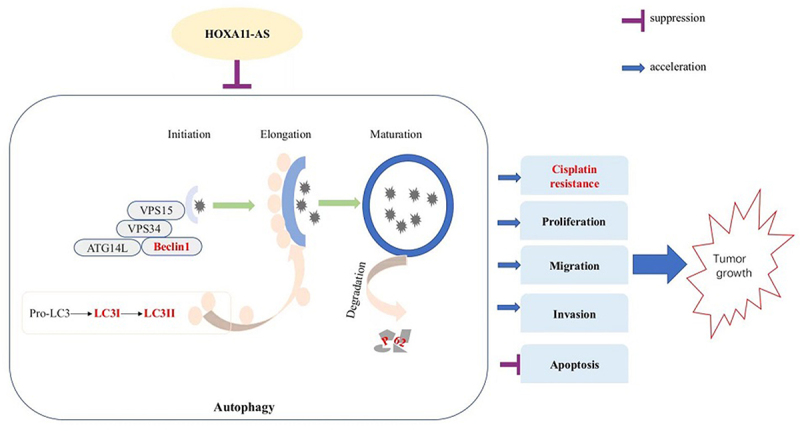
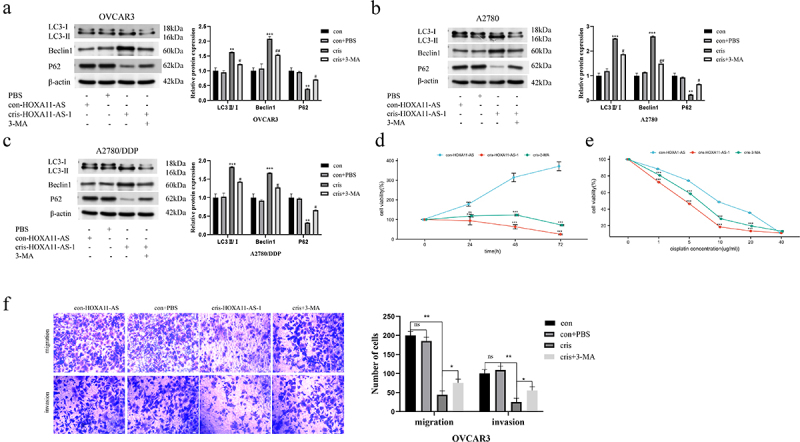
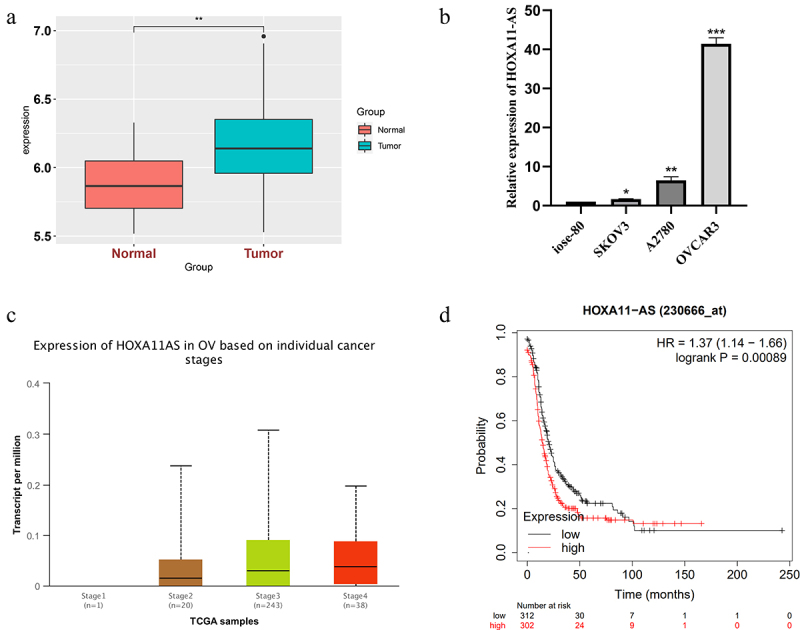
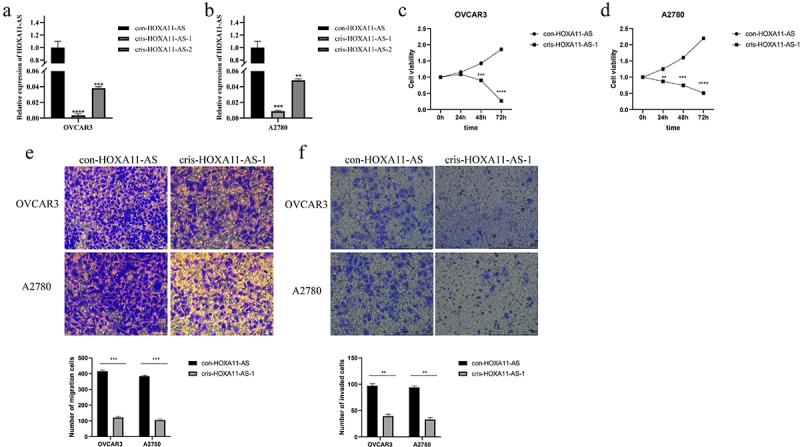
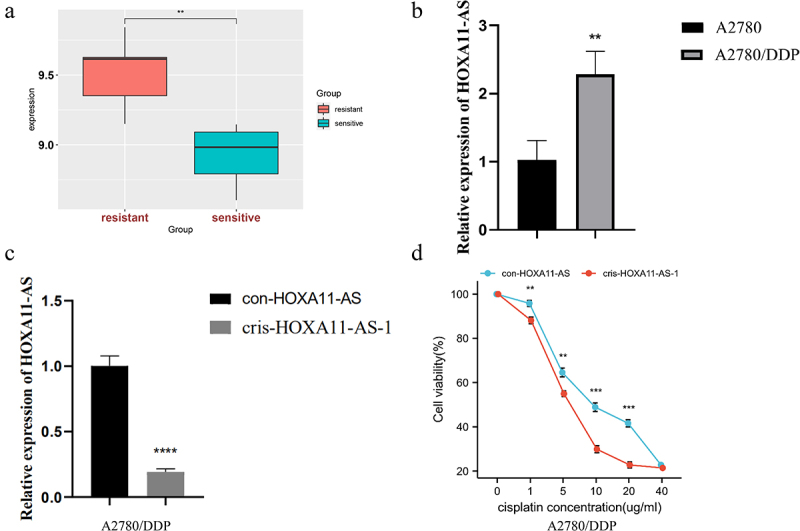
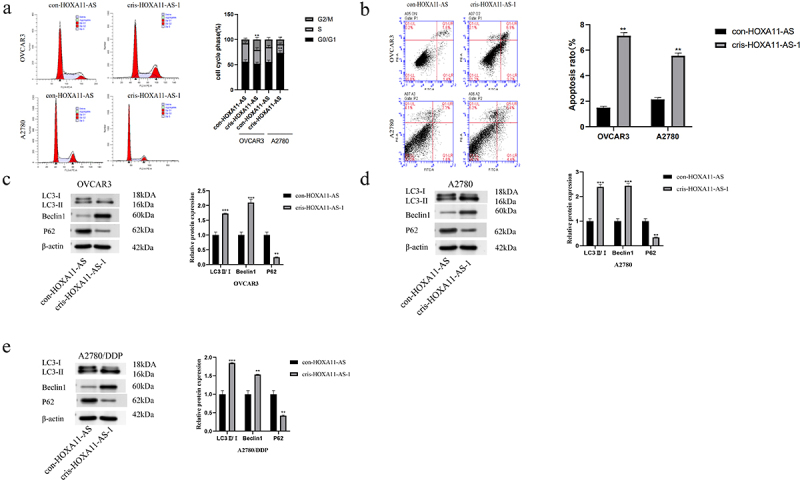
In ovarian carcinogenesis and progression, long non-coding RNAs (lncRNAs) have been shown to have a role, although the underlying processes remain a mystery. By modulating the degree of autophagy in ovarian cancer cells, we sought to learn more about the function lncRNA HOXA11-AS plays in the development of ovarian cancer. The expression of HOXA11-AS in ovarian normal cells and ovarian cancer cell lines was measured using R package and qRT-PCR. Ovarian cancer cells expressed HOXA11-AS substantially higher than normal cells, while cisplatin-resistant cells expressed HOXA11-AS significantly higher than ovarian cancer cells. Next, we studied the prognostic data of HOXA11-AS in ovarian cancer in the Tissue Cancer Genome Atlas (TCGA). In the next step, lentiviral transfection of ovarian cancer cells A2780, OVCAR3, and A2780/DDP (cisplatin-resistant) were performed, and HOXA11-AS knockdown was found to significantly inhibit cell viability, migration, and invasion of A2780 and OVCAR3 cells, and promote apoptosis by CCK-8 assay, transwell assay, cell cycle, and apoptosis assay, and promoted the sensitivity of A2780/DDP cells to cisplatin. It has been shown by the western blot test that HOXA11-AS knockdown increases the amount of cellular autophagy in cells. In contrast, adding the autophagy inhibitor 3-methyladenine (3-MA) to HOXA11-AS cells knocked down in vivo reduced its anti-tumor properties. As a whole, this study found that HOXA11-AS knockdown increased the expression of autophagy-related proteins and improved cisplatin sensitivity, decreased ovarian cancer cell proliferation, and promoted cell apoptosis. This study provides new insights into the role of HOXA11-AS in ovarian cancer regulation.
在卵巢癌的发生和发展过程中,长链非编码 RNA(lncRNA)被证明具有一定的作用,但其潜在的作用机制仍不清楚。本研究通过调节卵巢癌细胞自噬程度,探讨 lncRNA HOXA11-AS 在卵巢癌发生发展中的作用。采用 R 包和 qRT-PCR 检测 HOXA11-AS 在卵巢正常细胞和卵巢癌细胞系中的表达。结果显示,卵巢癌细胞系中 HOXA11-AS 的表达显著高于正常细胞,而顺铂耐药细胞系中 HOXA11-AS 的表达明显高于卵巢癌细胞系。接下来,我们研究了 TCGA 数据库中 HOXA11-AS 在卵巢癌中的预后数据。进一步采用慢病毒转染卵巢癌细胞 A2780、OVCAR3 和 A2780/DDP(顺铂耐药),敲低 HOXA11-AS 可显著抑制 A2780 和 OVCAR3 细胞的活力、迁移和侵袭,并通过 CCK-8 实验、Transwell 实验、细胞周期和凋亡实验促进细胞凋亡,同时增强 A2780/DDP 细胞对顺铂的敏感性。Western blot 实验表明,敲低 HOXA11-AS 可增加细胞内自噬相关蛋白的表达。相反,在体内敲低 HOXA11-AS 细胞中加入自噬抑制剂 3-甲基腺嘌呤(3-MA)可降低其抗肿瘤作用。综上所述,本研究发现,敲低 HOXA11-AS 可增加自噬相关蛋白的表达,提高顺铂敏感性,降低卵巢癌细胞增殖,促进细胞凋亡。该研究为 HOXA11-AS 在卵巢癌调控中的作用提供了新的见解。