Center of Excellence for Poultry Science, University of Arkansas System Division of Agriculture, Fayetteville, AR 72701, USA.
Adisseo France SAS, Center of Expertise and Research in Nutrition, F-03600 Commentry, France.
Poult Sci. 2022 Aug;101(8):101963. doi: 10.1016/j.psj.2022.101963. Epub 2022 May 13.
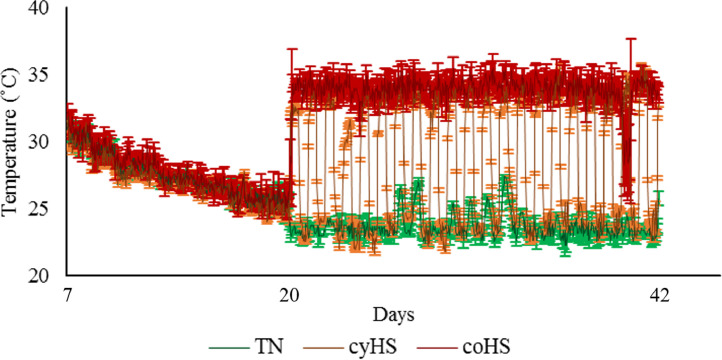
This experiment compared the effects of 2 chronic heat stress (HS) models, constant (coHS), and cyclic (cyHS), on broiler performance, carcass characteristics, and meat quality. A total of 720 male chicks from a Cobb 500 line were placed in 12 environmentally controlled chambers divided into 2 pens of 30 birds. Before the experimental HS models were applied, chamber temperatures were gradually decreased from 32°C at placement to 24°C on d 20. From 20 to 41 d, 4 chambers were set to 35°C (coHS), and 4 chambers were set to 35°C for 12 h and 24°C for the next 12 h (cyHS). Four thermoneutral chambers were maintained at 24°C with half of the birds pair-fed to equalize feed intake (FI) with coHS birds (TN-coPF) and half fed ad-libitum (TN-al). From 20 to 41 d, FI and BW gain (BWG) of cyHS, coHS and TN-coPF birds were decreased (P < 0.001), whereas feed conversion ratio (FCR) was increased (P < 0.001) for coHS and TN-coPF birds compared with TN-al birds. The overall BWG and FCR of coHS birds were lower (P < 0.001) than TN-coPF birds. Both HS models reduced (P < 0.001) carcass weight, pectoralis major yield, total breast meat yield, and increased (P < 0.001) wing yield relative to TN-al birds, with each of these measurements more impacted by coHS than by cyHS. Pair-fed birds had lower (P < 0.001) fat pad and a higher total breast meat yield than coHS birds. They also had the lowest (P < 0.001) pectoralis major ultimate pH and yellowness, and these parameters were lower (P < 0.001) for coHS birds than for TN-al birds. Both HS models reduced (P < 0.001) the incidence of woody breast and white striping. Thus, these data indicate that the detrimental effects of HS cannot be entirely explained by reduced FI and that HS per se affects metabolic pathways associated with muscle and lipid accretion in broilers.
本实验比较了两种慢性热应激(HS)模型,即持续(coHS)和循环(cyHS)对肉鸡生产性能、胴体特性和肉质的影响。总共 720 只雄性科布 500 系小鸡被放置在 12 个环境控制室中,每个室分为 2 个 30 只鸡的栏位。在应用实验性 HS 模型之前,室温和鸡舍温度逐渐从 32°C 降至第 20 天的 24°C。从第 20 天到第 41 天,4 个室被设定为 35°C(coHS),4 个室被设定为 35°C 12 小时,然后 24°C 12 小时(cyHS)。4 个热中性室被维持在 24°C,其中一半的鸡进行限饲以与 coHS 鸡的饲料摄入量(FI)相平衡(TN-coPF),另一半自由采食(TN-al)。从第 20 天到第 41 天,cyHS、coHS 和 TN-coPF 鸡的 FI 和 BW 增重(BWG)降低(P<0.001),而 coHS 和 TN-coPF 鸡的饲料转化率(FCR)增加(P<0.001)与 TN-al 鸡相比。coHS 鸡的整体 BWG 和 FCR 均低于 TN-coPF 鸡(P<0.001)。两种 HS 模型均降低了(P<0.001)与 TN-al 鸡相比, carcass weight、胸肌产量、总胸肉产量,增加(P<0.001) wing yield,其中 coHS 对这些测量值的影响大于 cyHS。限饲鸡的脂肪垫较低(P<0.001),coHS 鸡的胸肌产量较高。它们还具有最低的(P<0.001)胸肌最终 pH 值和黄度,并且这些参数 coHS 鸡比 TN-al 鸡更低(P<0.001)。两种 HS 模型均降低了(P<0.001)木质胸和白条的发生率。因此,这些数据表明,HS 的不利影响不能完全用 FI 减少来解释,HS 本身会影响与肉鸡肌肉和脂质积累相关的代谢途径。