Sun Juan, Zhang Zimu, Liu Zhen, Li Jie, Kang Weiming
Division of General Surgery, Department of Surgery, Peking Union Medical College Hospital, Chinese Academy of Medical Sciences and Peking Union Medical College, Beijing, China.
Front Nutr. 2022 May 31;9:881729. doi: 10.3389/fnut.2022.881729. eCollection 2022.
To evaluate the detailed relationship between total percent fat (TPF) and cardiovascular disease (CVD)-related lipid biomarkers among adults and find a non-invasive indicator for screening and monitoring of the high CVD risk population.
Data of 13,160 adults were obtained from the National Health and Examination Survey (NHANES) from 1999 to 2018. TPF was assessed by dual-energy x-ray absorptiometry (DXA), and CVD-related lipid biomarkers included total cholesterol (TC), triglyceride (TG), low-density lipoprotein cholesterol (LDL-C), and high-density lipoprotein cholesterol (HDL-C). Multivariable linear regression models were used to examine associations between TPF with four kinds of lipid biomarkers, and smooth curve fittings and generalized additive models were used to address the non-linear relationship between them. The inflection points were calculated by the recursive algorithm when non-linearities were detected and then weighted two-piecewise linear regression models were constructed.
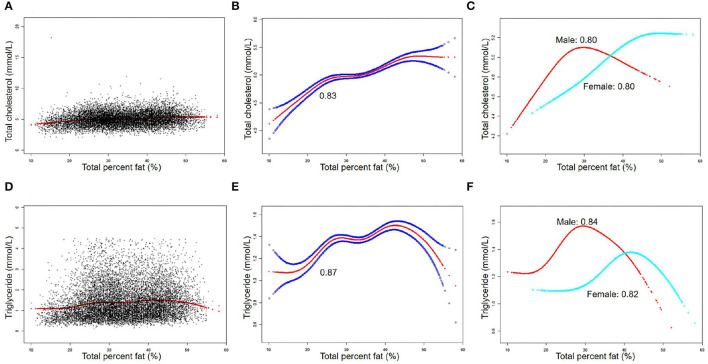
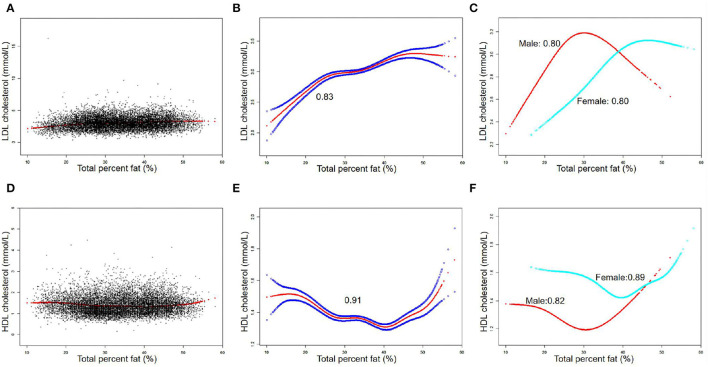
In multivariable regression, increasing TPF was positively associated with TC, TG, and LDL-C and negatively with HDL-C (all < 0.001). In addition, the non-linear relationships between them were also identified by generalized additive models and smooth curve fittings. When further stratified TPF by sex, the fitted smooth curves were nearly inverted U-shaped and U-shaped curves, the inflection points were calculated, and the weighted two-piecewise linear regression models were constructed, respectively. The same results existed between android percent fat and these four lipid biomarkers.
Total percent fat was significantly associated with CVD-related lipid biomarkers in adults, positively with TC, TG, and LDL-C and negatively with HDL-C. It could be used as a non-invasive screener and monitor of high CVD risk population when their TPF values were less than the inflection points.
评估成年人中总脂肪百分比(TPF)与心血管疾病(CVD)相关脂质生物标志物之间的详细关系,并找到一种用于筛查和监测高CVD风险人群的非侵入性指标。
从1999年至2018年的国家健康与营养检查调查(NHANES)中获取了13160名成年人的数据。通过双能X线吸收法(DXA)评估TPF,CVD相关脂质生物标志物包括总胆固醇(TC)、甘油三酯(TG)、低密度脂蛋白胆固醇(LDL-C)和高密度脂蛋白胆固醇(HDL-C)。使用多变量线性回归模型来检验TPF与四种脂质生物标志物之间的关联,并使用平滑曲线拟合和广义相加模型来处理它们之间的非线性关系。当检测到非线性时,通过递归算法计算拐点,然后构建加权两段式线性回归模型。
在多变量回归中,TPF升高与TC、TG和LDL-C呈正相关,与HDL-C呈负相关(均P<0.001)。此外,广义相加模型和平滑曲线拟合也确定了它们之间的非线性关系。当按性别进一步分层TPF时,拟合的平滑曲线分别为近似倒U形和U形曲线,计算了拐点,并构建了加权两段式线性回归模型。腹部脂肪百分比与这四种脂质生物标志物之间也存在相同的结果。
成年人的总脂肪百分比与CVD相关脂质生物标志物显著相关,与TC、TG和LDL-C呈正相关,与HDL-C呈负相关。当TPF值低于拐点时,它可作为高CVD风险人群的非侵入性筛查和监测指标。