Wu Meimei, Liang Yanfang, Zhang Xin
Clinical Experimental Center, Jiangmen Key Laboratory of Clinical Biobanks and Translational Research, Jiangmen Central Hospital, Jiangmen, China.
Department of Pathology, Dongguan Hospital Affiliated to Jinan University, Binhaiwan Central Hospital of Dongguan, Dongguan, China.
Front Oncol. 2022 May 26;12:860932. doi: 10.3389/fonc.2022.860932. eCollection 2022.
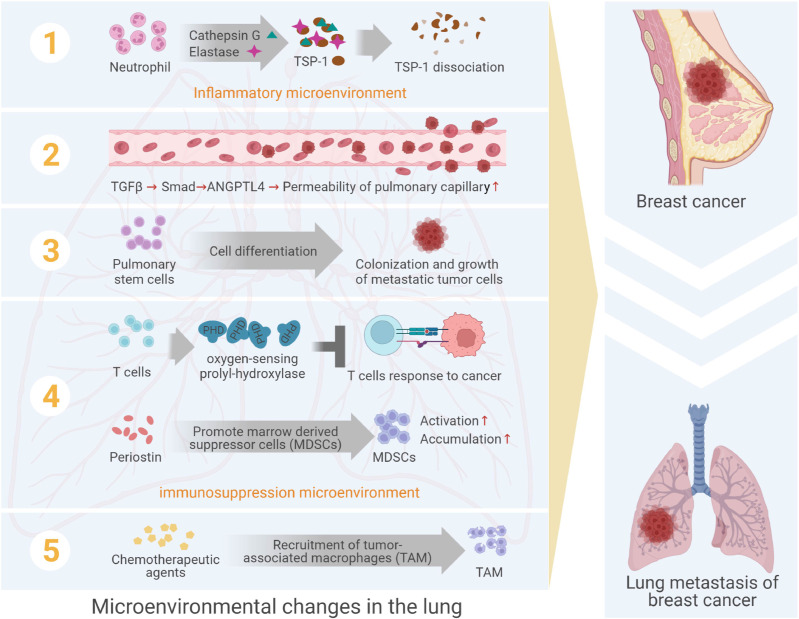
Breast cancer has become the most common malignant disease in the world according to the International Agency for Research on Cancer (IARC), and the most critical cause of death is distant metastasis. The lung is the extremely common visceral site for breast cancer metastasis. Lung metastasis of breast cancer is not only dependent on the invasive ability of the tumor itself, but also closely relates to the pulmonary microenvironment. In the progression of breast cancer, the formation of specific microenvironment in lungs can provide suitable conditions for the metastasis of breast cancer. Pulmonary inflammatory response, angiogenesis, extracellular matrix remodeling, some chemotherapeutic agents and so on all play important roles in the formation of the pulmonary microenvironment. This review highlights recent findings regarding the alterations of pulmonary microenvironment in lung metastasis of breast cancer, with a focus on various cells and acellular components.
根据国际癌症研究机构(IARC)的数据,乳腺癌已成为全球最常见的恶性疾病,而最关键的死亡原因是远处转移。肺是乳腺癌转移极为常见的内脏部位。乳腺癌肺转移不仅取决于肿瘤本身的侵袭能力,还与肺微环境密切相关。在乳腺癌进展过程中,肺部特定微环境的形成可为乳腺癌转移提供适宜条件。肺部炎症反应、血管生成、细胞外基质重塑、某些化疗药物等在肺微环境的形成中均发挥重要作用。本综述重点介绍了乳腺癌肺转移中肺微环境改变的最新研究发现,着重关注各种细胞和无细胞成分。