Ravichandran Sowbarnika, Manickam Nivethitha, Kandasamy Mahesh
Laboratory of Stem Cells and Neuroregeneration, Department of Animal Science, School of Life Sciences, Bharathidasan University, Tiruchirappalli 620024, Tamil Nadu, India.
University Grants Commission, Faculty Recharge Programme (UGC-FRP), New Delhi 110002, India.
Med Drug Discov. 2022 Sep;15:100136. doi: 10.1016/j.medidd.2022.100136. Epub 2022 Jun 13.
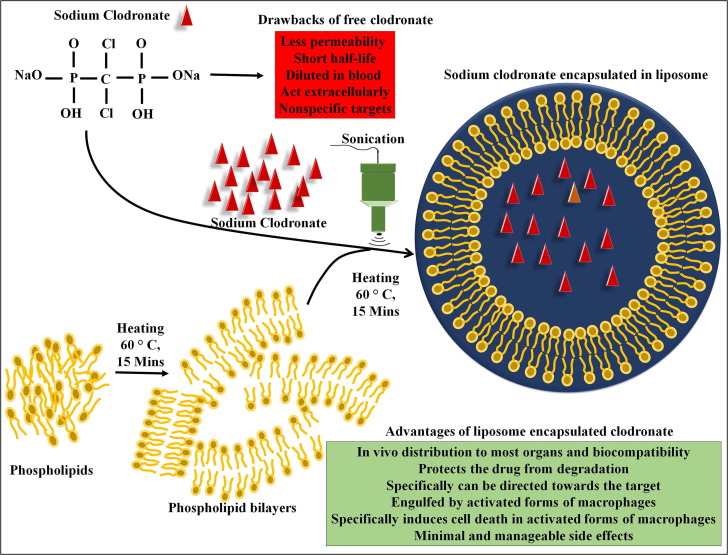
The emergence of new SARS-CoV-2 variants continues to pose an enormous public health concern. The SARS-CoV-2 infection disrupted host immune response accounting for cytokine storm has been linked to multiorgan failure and mortality in a significant portion of positive cases. Abruptly activated macrophages have been identified as the key pathogenic determinant of cytokine storm in COVID-19. Besides, reactive microglia have been known to discharge a surplus amount of proinflammatory factors leading to neuropathogenic events in the brains of SARS-CoV-2 infected individuals. Considering the fact, depletion of activated macrophages and microglia could be proposed to eradicate the life-threatening cytokine storm in COVID-19. Clodronate, a non-nitrogenous bisphosphonate drug has been identified as a potent macrophage and microglial depleting agent. While recent advancement in the field of liposome encapsulation technology offers the most promising biological tool for drug delivery, liposome encapsulated clodronate has been reported to effectively target and induce prominent phagocytic cell death in activated macrophages and microglia compared to free clodronate molecules. Thus, in this review article, we emphasize that depletion of activated macrophages and microglial cells by administration of liposome encapsulated clodronate can be a potential therapeutic strategy to diminish the pathogenic cytokine storm and alleviate multiorgan failure in COVID-19. Moreover, recently developed COVID-19 vaccines appear to render the chronic activation of macrophages accounting for immunological dysregulation in some cases. Therefore, the use of liposome encapsulated clodronate can also be extended to the clinical management of unforeseen immunogenic reactions resulting from activated macrophages associated adverse effects of COVID-19 vaccines.
新型严重急性呼吸综合征冠状病毒2(SARS-CoV-2)变种的出现持续引发巨大的公共卫生担忧。SARS-CoV-2感染扰乱宿主免疫反应并导致细胞因子风暴,这与相当一部分阳性病例的多器官衰竭和死亡有关。突然激活的巨噬细胞已被确定为新冠肺炎细胞因子风暴的关键致病决定因素。此外,已知反应性小胶质细胞会释放过量促炎因子,导致SARS-CoV-2感染个体大脑中发生神经致病事件。鉴于此,可提出清除激活的巨噬细胞和小胶质细胞以根除新冠肺炎中危及生命的细胞因子风暴。氯膦酸盐,一种非含氮双膦酸盐药物,已被确定为一种有效的巨噬细胞和小胶质细胞清除剂。虽然脂质体包封技术领域的最新进展为药物递送提供了最有前景的生物工具,但据报道,与游离氯膦酸盐分子相比,脂质体包封的氯膦酸盐能有效靶向并诱导激活的巨噬细胞和小胶质细胞发生显著的吞噬细胞死亡。因此,在这篇综述文章中,我们强调通过给予脂质体包封的氯膦酸盐来清除激活的巨噬细胞和小胶质细胞可能是一种潜在的治疗策略,以减少致病性细胞因子风暴并减轻新冠肺炎中的多器官衰竭。此外,最近研发的新冠肺炎疫苗在某些情况下似乎会导致巨噬细胞慢性激活,从而造成免疫失调。因此,脂质体包封的氯膦酸盐的应用还可扩展至对新冠肺炎疫苗激活巨噬细胞相关不良反应所导致的意外免疫原性反应的临床管理。