Prang Khic-Houy, Mamani-Mategula Elisabeth, Verbunt Ebony, Chipeta Effie, Ataide Ricardo, Mwangi Martin, Phiri Kamija, Pasricha Sant-Rayn, Kelaher Margaret, Manda-Taylor Lucinda
Centre for Health Policy, Melbourne School of Population and Global Health, The University of Melbourne, Melbourne, Australia.
Kamuzu University of Health Sciences, Blantyre, Malawi.
Implement Sci Commun. 2022 Jun 21;3(1):68. doi: 10.1186/s43058-022-00299-x.
Antenatal iron supplementation is critical to maternal and child health; however, access and adherence to oral iron are inconsistent in many low- and middle-income countries (LMICs). Modern intravenous (IV) iron products have become available in high-income clinical settings and provide an opportunity to deliver high doses of iron in a single-short infusion during pregnancy. However, there is limited knowledge of the drivers and barriers for such an intervention to be effectively delivered and upscaled in LMICs. In this study protocol, we describe the implementation research programme to support an IV iron intervention in Malawi for pregnant women with moderate and severe anaemia.
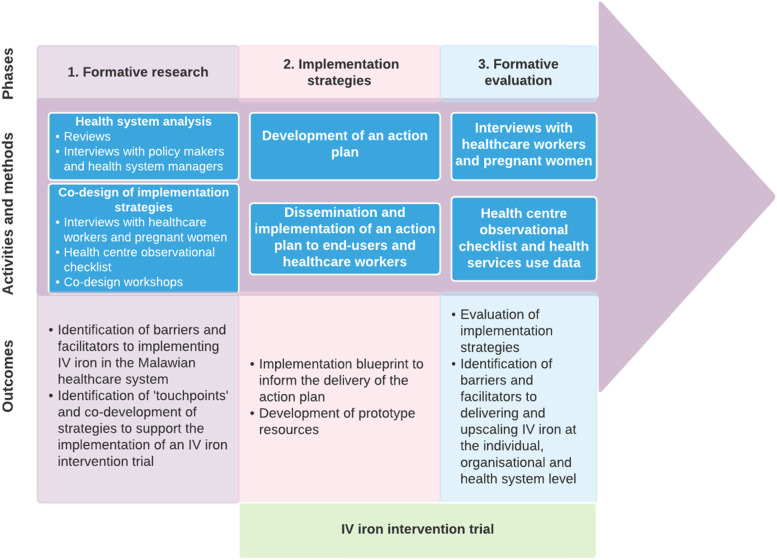
The implementation research programme has three phases, each guided by implementation science conceptual frameworks. In Phase 1, we will conduct formative research (context assessment of the health system with key informant interviews) to determine how IV iron can be effectively introduced into routine antenatal care. We will use the findings to co-develop potential strategies with end-users and healthcare providers to improve intervention implementation. In Phase 2, we will disseminate the implementation strategies to support the uptake and delivery of the intervention in the study settings. In Phase 3, the intervention will be implemented, and we will conduct formative evaluation (interviews with end-users, healthcare providers, and analysis of health services data) to investigate the feasibility and acceptability of the intervention and strategies. We will also identify processes and contextual factors that facilitate or impede the delivery and uptake of IV iron.
In LMICs, modern IV iron products present a novel opportunity to rapidly cure moderate and severe anaemia in pregnancy, thereby improving maternal and child health outcomes. This implementation research programme will provide guidance and recommendations on how best an IV iron intervention for pregnant women with anaemia can be implemented in an LMIC setting like Malawi. We will develop locally relevant and culturally appropriate implementation strategies by engaging with key stakeholders (pregnant women, healthcare providers, and policymakers) and identifying factors likely to facilitate successful implementation. The findings of this research can guide the implementation of an IV iron intervention in Malawi and other LMICs.
孕期补铁对母婴健康至关重要;然而,在许多低收入和中等收入国家(LMICs),口服铁剂的获取和依从性并不一致。现代静脉注射(IV)铁剂产品已在高收入临床环境中可用,并为孕期单次短时间输注高剂量铁剂提供了机会。然而,对于在LMICs有效实施和扩大这种干预措施的驱动因素和障碍,了解有限。在本研究方案中,我们描述了在马拉维针对患有中度和重度贫血的孕妇支持静脉注射铁剂干预的实施研究计划。
实施研究计划分为三个阶段,每个阶段都以实施科学概念框架为指导。在第一阶段,我们将进行形成性研究(通过关键信息访谈对卫生系统进行背景评估),以确定如何将静脉注射铁剂有效地引入常规产前护理。我们将利用研究结果与最终用户和医疗保健提供者共同制定潜在策略,以改善干预措施的实施。在第二阶段,我们将传播实施策略,以支持在研究环境中采用和实施该干预措施。在第三阶段,将实施干预措施,我们将进行形成性评估(与最终用户、医疗保健提供者访谈以及分析卫生服务数据),以调查干预措施和策略的可行性和可接受性。我们还将确定促进或阻碍静脉注射铁剂实施和采用的过程及背景因素。
在LMICs,现代静脉注射铁剂产品为快速治愈孕期中度和重度贫血提供了新机会,从而改善母婴健康结局。这项实施研究计划将为如何在马拉维这样的LMICs环境中最佳地实施针对贫血孕妇的静脉注射铁剂干预提供指导和建议。我们将通过与关键利益相关者(孕妇、医疗保健提供者和政策制定者)合作并确定可能促进成功实施的因素,制定与当地相关且符合文化背景的实施策略。本研究结果可为在马拉维和其他LMICs实施静脉注射铁剂干预提供指导。