• 文献检索
  • 文档翻译
  • 深度研究
  • 学术资讯
  • Suppr Zotero 插件Zotero 插件
  • 邀请有礼
  • 套餐&价格
  • 历史记录
应用&插件
Suppr Zotero 插件Zotero 插件浏览器插件Mac 客户端Windows 客户端微信小程序
定价
高级版会员购买积分包购买API积分包
服务
文献检索文档翻译深度研究API 文档MCP 服务
关于我们
关于 Suppr公司介绍联系我们用户协议隐私条款
关注我们

Suppr 超能文献

核心技术专利:CN118964589B侵权必究
粤ICP备2023148730 号-1Suppr @ 2026

文献检索

告别复杂PubMed语法,用中文像聊天一样搜索,搜遍4000万医学文献。AI智能推荐,让科研检索更轻松。

立即免费搜索

文件翻译

保留排版,准确专业,支持PDF/Word/PPT等文件格式,支持 12+语言互译。

免费翻译文档

深度研究

AI帮你快速写综述,25分钟生成高质量综述,智能提取关键信息,辅助科研写作。

立即免费体验

新冠疫情期间屏幕使用时间变化对焦虑的影响:以睡眠和身体活动作为中介变量

The impact of screen time changes on anxiety during the COVID-19 pandemic: sleep and physical activity as mediators.

作者信息

Chen Qiyu, Dai Wenjuan, Li Guangming, Ma Ning

机构信息

Philosophy and Social Science Laboratory of Reading and Development in Children and Adolescents, (South China Normal University), Ministry of Education, Center for Sleep Research, Center for Studies of Psychological Application, Guangdong Key Laboratory of Mental Health and Cognitive Science, School of Psychology, South China Normal University, Guangzhou, 510631 China.

出版信息

Sleep Biol Rhythms. 2022;20(4):521-531. doi: 10.1007/s41105-022-00398-1. Epub 2022 Jun 16.

DOI:10.1007/s41105-022-00398-1
PMID:35729903
原文链接:https://pmc.ncbi.nlm.nih.gov/articles/PMC9202662/
Abstract

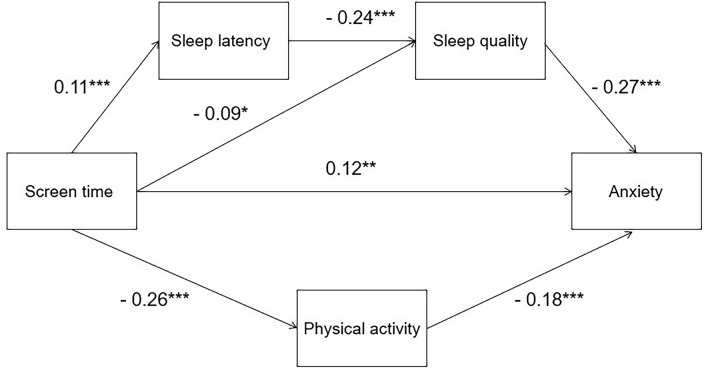
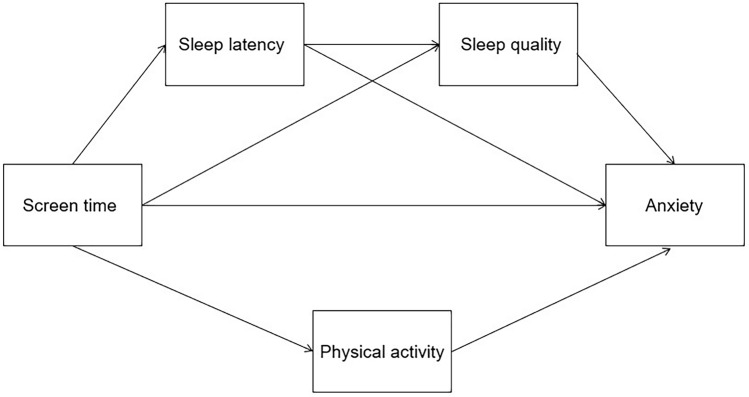
Under the burden caused by COVID-19 and rapid lifestyle changes, many people increased their screen time due to psychological needs and social requirements. The current study investigated the between screen time changes and anxiety symptoms during the pandemic of COVID-19. Furthermore, we examined whether sleep and physical activity would mediate the association between screen time changes and anxiety. The self-developed questionnaire was delivered online to collect people's changes in anxiety, sleep patterns, and screen time during COVID-19. 970 participants (74.4% female) with an average age of 23 years were involved in this study. After adjusting demographic variables, the ordinal logistic regression analyses revealed that a significant increase in screen time was linked with anxiety. Slightly increased screen time, slightly and significantly decreased screen time did not predict anxiety symptoms during the pandemic. The level of anxiety was significantly higher among respondents who reported decreased sleep quality. Sleep quality directly mediated the association between screen time changes and anxiety, while sleep latency did not. The longer sleep latency caused by increased screen time would amplify anxiety by affecting sleep quality. In addition, the relationship between screen time changes and anxiety was also mediated by physical activity. We concluded that the fluctuation of screen time in a modest range does not affect the anxiety level substantially. The significantly increased screen time would contribute to poor sleep (including longer sleep latency and worse sleep quality) and lack of physical activity, which would lead to higher levels of anxiety.

摘要

在新冠疫情带来的负担以及生活方式迅速改变的情况下,许多人因心理需求和社会要求而增加了屏幕使用时间。本研究调查了新冠疫情期间屏幕使用时间变化与焦虑症状之间的关系。此外,我们还研究了睡眠和身体活动是否会介导屏幕使用时间变化与焦虑之间的关联。通过在线发放自行编制的问卷,收集人们在新冠疫情期间焦虑、睡眠模式和屏幕使用时间的变化情况。970名参与者(74.4%为女性)参与了本研究,平均年龄为23岁。在调整人口统计学变量后,有序逻辑回归分析显示,屏幕使用时间的显著增加与焦虑有关。屏幕使用时间略有增加、略有减少和显著减少在疫情期间均未预测到焦虑症状。报告睡眠质量下降的受访者焦虑水平显著更高。睡眠质量直接介导了屏幕使用时间变化与焦虑之间的关联,而睡眠潜伏期则没有。屏幕使用时间增加导致的更长睡眠潜伏期会通过影响睡眠质量加剧焦虑。此外,屏幕使用时间变化与焦虑之间的关系也由身体活动介导。我们得出结论,适度范围内的屏幕使用时间波动不会对焦虑水平产生实质性影响。屏幕使用时间的显著增加会导致睡眠不佳(包括更长的睡眠潜伏期和更差的睡眠质量)以及缺乏身体活动,进而导致更高水平的焦虑。
https://cdn.ncbi.nlm.nih.gov/pmc/blobs/4d67/10899950/f77c1cccba42/41105_2022_398_Fig2_HTML.jpg
https://cdn.ncbi.nlm.nih.gov/pmc/blobs/4d67/10899950/d5594f97de68/41105_2022_398_Fig1_HTML.jpg
https://cdn.ncbi.nlm.nih.gov/pmc/blobs/4d67/10899950/f77c1cccba42/41105_2022_398_Fig2_HTML.jpg
https://cdn.ncbi.nlm.nih.gov/pmc/blobs/4d67/10899950/d5594f97de68/41105_2022_398_Fig1_HTML.jpg
https://cdn.ncbi.nlm.nih.gov/pmc/blobs/4d67/10899950/f77c1cccba42/41105_2022_398_Fig2_HTML.jpg

相似文献

1
The impact of screen time changes on anxiety during the COVID-19 pandemic: sleep and physical activity as mediators.新冠疫情期间屏幕使用时间变化对焦虑的影响:以睡眠和身体活动作为中介变量
Sleep Biol Rhythms. 2022;20(4):521-531. doi: 10.1007/s41105-022-00398-1. Epub 2022 Jun 16.
2
Association of Changes of lifestyle behaviors before and during the COVID-19 pandemic with mental health: a longitudinal study in children and adolescents.新冠肺炎疫情前后生活方式行为变化与心理健康的关联:儿童和青少年的纵向研究。
Int J Behav Nutr Phys Act. 2022 Jul 26;19(1):92. doi: 10.1186/s12966-022-01327-8.
3
Investigating the relationship of COVID-19 related stress and media consumption with schizotypy, depression, and anxiety in cross-sectional surveys repeated throughout the pandemic in Germany and the UK.调查德国和英国在整个大流行期间通过横断面调查重复进行的 COVID-19 相关压力和媒体消费与精神分裂症倾向、抑郁和焦虑之间的关系。
Elife. 2022 Jul 4;11:e75893. doi: 10.7554/eLife.75893.
4
Association of Sleep Duration and Screen Time With Anxiety of Pregnant Women During the COVID-19 Pandemic.新冠疫情期间孕妇睡眠时间和屏幕使用时间与焦虑情绪的关联
Front Psychol. 2021 Apr 20;12:646368. doi: 10.3389/fpsyg.2021.646368. eCollection 2021.
5
Relationship between mental health, sleep status and screen time among university students during the COVID-19 pandemic: a cross-sectional study.新冠疫情期间大学生心理健康、睡眠状况与屏幕时间的关系:一项横断面研究。
BMJ Open. 2023 Dec 9;13(12):e073347. doi: 10.1136/bmjopen-2023-073347.
6
Quality of Sleep and Work Productivity among White-Collar Workers during the COVID-19 Pandemic.新冠肺炎疫情期间白领人群的睡眠质量与工作效率。
Medicina (Kaunas). 2022 Jul 1;58(7):883. doi: 10.3390/medicina58070883.
7
Association of Screen Time with Anxiety and Depressive Symptoms in College Students During COVID-19 Outbreak in Shanghai: Mediation Role of Sleep Quality.上海新冠疫情期间大学生屏幕使用时间与焦虑和抑郁症状的关联:睡眠质量的中介作用
Cyberpsychol Behav Soc Netw. 2023 Oct;26(10):755-763. doi: 10.1089/cyber.2022.0373. Epub 2023 Sep 20.
8
Prevalence of sleep disturbance and anxiety due to the COVID-19 pandemic in Saudi Arabia.沙特阿拉伯因新冠疫情导致的睡眠障碍和焦虑症患病率
Sleep Sci. 2021 Jan-Mar;14(Spec 1):56-62. doi: 10.5935/1984-0063.20200079.
9
Child and Parent Physical Activity, Sleep, and Screen Time During COVID-19 and Associations With Mental Health: Implications for Future Psycho-Cardiological Disease?新冠疫情期间儿童及家长的身体活动、睡眠和屏幕使用时间及其与心理健康的关联:对未来心理心脏病学疾病有何影响?
Front Psychiatry. 2022 Feb 10;12:774858. doi: 10.3389/fpsyt.2021.774858. eCollection 2021.
10
Sociodemographic and mental health characteristics associated with changes in movement behaviours due to the COVID-19 pandemic in adolescents.与新冠疫情导致青少年运动行为变化相关的社会人口学和心理健康特征
J Act Sedentary Sleep Behav. 2022;1(1):5. doi: 10.1186/s44167-022-00004-2. Epub 2022 Oct 2.

引用本文的文献

1
Association of types of on-screen content with mental health problems among Chinese adolescents.中国青少年屏幕内容类型与心理健康问题的关联
Eur Child Adolesc Psychiatry. 2024 Dec 20. doi: 10.1007/s00787-024-02632-2.
2
Internet addiction, sleeping habits and psychological distress in Brazilian adolescents and young adults.巴西青少年和青年中的网络成瘾、睡眠习惯与心理困扰
Psicol Reflex Crit. 2024 Sep 14;37(1):37. doi: 10.1186/s41155-024-00323-0.
3
Comparison of sleep quality, diet quality, and weight change between COVID-19-recovered patients and healthy controls: A matched case-control study.

本文引用的文献

1
Evaluating How Mental Health Changed in Australia through the COVID-19 Pandemic: Findings from the '' (TTPN) Survey.评估澳大利亚在新冠大流行期间心理健康状况的变化:来自“澳大利亚全国性精神健康与福祉追踪调查”(TTPN 调查)的结果。
Int J Environ Res Public Health. 2022 Jan 4;19(1):558. doi: 10.3390/ijerph19010558.
2
Circadian rhythm disorder and anxiety as mental health complications in post-COVID-19.新冠后出现的昼夜节律紊乱和焦虑等心理健康并发症。
Environ Sci Pollut Res Int. 2022 Apr;29(19):28062-28069. doi: 10.1007/s11356-021-18384-4. Epub 2022 Jan 5.
3
Sleep and anxiety: From mechanisms to interventions.
新冠康复患者与健康对照者的睡眠质量、饮食质量及体重变化比较:一项配对病例对照研究。
Health Sci Rep. 2024 Aug 29;7(9):e70042. doi: 10.1002/hsr2.70042. eCollection 2024 Sep.
4
The relationship between screen time and gross motor movement: A cross-sectional study of pre-school aged left-behind children in China.屏幕时间与粗大运动的关系:中国学龄前留守儿童的横断面研究。
PLoS One. 2024 Apr 5;19(4):e0296862. doi: 10.1371/journal.pone.0296862. eCollection 2024.
5
The Associations between Lifestyle Habits and Anxiety: A Prospective Study on Adolescents One Year after the Outbreak of the COVID-19 Pandemic.生活方式习惯与焦虑之间的关联:一项关于新冠疫情爆发一年后青少年的前瞻性研究。
Children (Basel). 2024 Feb 25;11(3):282. doi: 10.3390/children11030282.
6
Movement Behaviors and Mental Health of Catholic Priests in the Eastern United States.美国东部天主教牧师的运动行为与心理健康。
J Relig Health. 2024 Jun;63(3):1867-1879. doi: 10.1007/s10943-023-01894-5. Epub 2023 Aug 17.
7
The associations between screen time and mental health in adolescents: a systematic review.青少年的屏幕时间与心理健康之间的关联:系统评价。
BMC Psychol. 2023 Apr 20;11(1):127. doi: 10.1186/s40359-023-01166-7.
8
Association of Parental Screen Addiction with Young Children's Screen Addiction: A Chain-Mediating Model.父母屏幕成瘾与儿童屏幕成瘾的关系:一个链式中介模型。
Int J Environ Res Public Health. 2022 Oct 6;19(19):12788. doi: 10.3390/ijerph191912788.
睡眠与焦虑:从机制到干预。
Sleep Med Rev. 2022 Feb;61:101583. doi: 10.1016/j.smrv.2021.101583. Epub 2021 Dec 8.
4
Sleep Quality and the Depression-Anxiety-Stress State of Frontline Nurses Who Perform Nucleic Acid Sample Collection During COVID-19: A Cross-Sectional Study.COVID-19疫情期间从事核酸采样的一线护士的睡眠质量与抑郁-焦虑-压力状态:一项横断面研究
Psychol Res Behav Manag. 2021 Nov 26;14:1889-1900. doi: 10.2147/PRBM.S338495. eCollection 2021.
5
Gaming Activity and Possible Changes in Gaming Behavior Among Young People During the COVID-19 Pandemic: Cross-sectional Online Survey Study.新冠疫情期间年轻人的游戏活动及游戏行为可能发生的变化:横断面在线调查研究
JMIR Serious Games. 2022 Jan 25;10(1):e33059. doi: 10.2196/33059.
6
Incidence of PTSD and generalized anxiety symptoms during the first wave of COVID-19 outbreak: an exploratory study of a large sample of the Italian population.COVID-19 爆发第一波期间 PTSD 和广泛性焦虑症状的发生率:对意大利大样本人群的探索性研究。
BMC Public Health. 2021 Jun 16;21(1):1158. doi: 10.1186/s12889-021-11168-y.
7
The relationship between burden caused by coronavirus (Covid-19), addictive social media use, sense of control and anxiety.冠状病毒(新冠病毒-19)造成的负担、社交媒体成瘾性使用、控制感与焦虑之间的关系。
Comput Human Behav. 2021 Jun;119:106720. doi: 10.1016/j.chb.2021.106720. Epub 2021 Jan 28.
8
Self-Reported Screen Time on Social Networking Sites Associated With Problematic Smartphone Use in Chinese Adults: A Population-Based Study.中国成年人社交网站自我报告的屏幕使用时间与问题智能手机使用的关联:一项基于人群的研究
Front Psychiatry. 2021 Jan 14;11:614061. doi: 10.3389/fpsyt.2020.614061. eCollection 2020.
9
Anxiety and Leisure-Domain Physical Activity Frequency, Duration, and Intensity During Covid-19 Pandemic.新冠疫情期间焦虑情绪与休闲领域身体活动的频率、时长及强度
Front Psychol. 2020 Dec 29;11:603770. doi: 10.3389/fpsyg.2020.603770. eCollection 2020.
10
Maintaining normal sleep patterns, lifestyles and emotion during the COVID-19 pandemic: The stabilizing effect of daytime napping.在 COVID-19 大流行期间保持正常的睡眠模式、生活方式和情绪:日间小睡的稳定作用。
J Sleep Res. 2021 Aug;30(4):e13259. doi: 10.1111/jsr.13259. Epub 2021 Jan 8.