Institute for Genomics and Evolutionary Medicine, Temple University, Philadelphia, PA, USA.
Department of Biology, Temple University, Philadelphia, PA, USA.
Commun Biol. 2022 Jun 22;5(1):617. doi: 10.1038/s42003-022-03560-0.
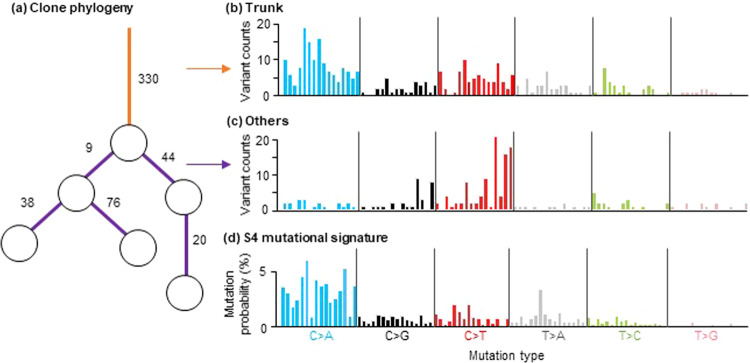
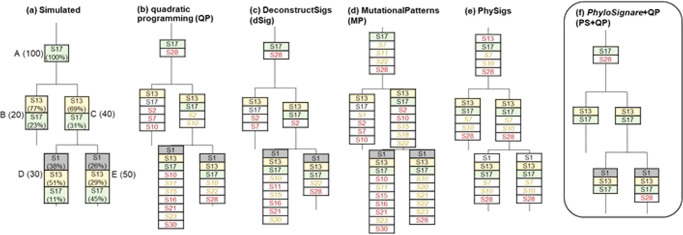
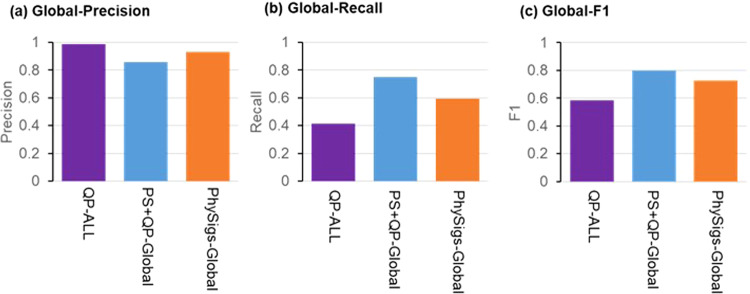
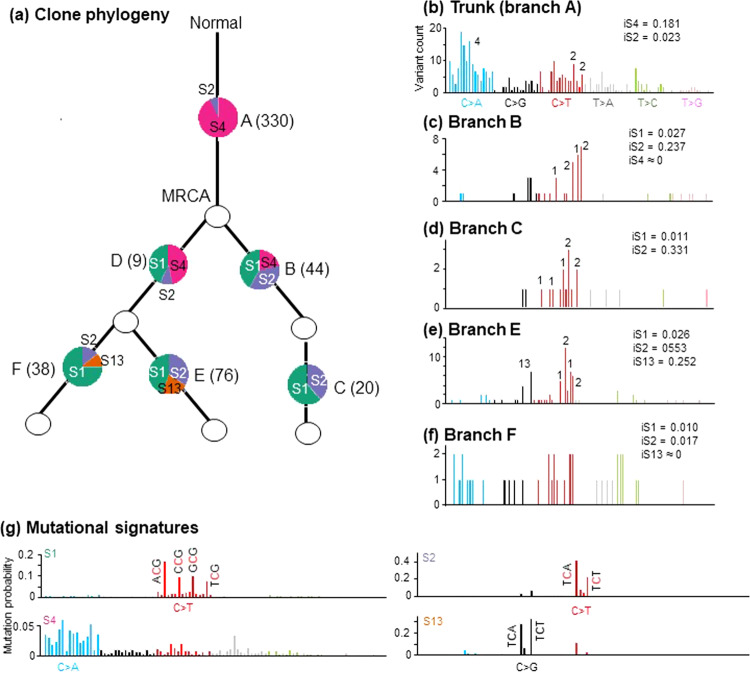
Cancer cell genomes change continuously due to mutations, and mutational processes change over time in patients, leaving dynamic signatures in the accumulated genomic variation in tumors. Many computational methods detect the relative activities of known mutation signatures. However, these methods may produce erroneous signatures when applied to individual branches in cancer cell phylogenies. Here, we show that the inference of branch-specific mutational signatures can be improved through a joint analysis of the collections of mutations mapped on proximal branches of the cancer cell phylogeny. This approach reduces the false-positive discovery rate of branch-specific signatures and can sometimes detect faint signatures. An analysis of empirical data from 61 lung cancer patients supports trends based on computer-simulated datasets for which the correct signatures are known. In lung cancer somatic variation, we detect a decreasing trend of smoking-related mutational processes over time and an increasing influence of APOBEC mutational processes as the tumor evolution progresses. These analyses also reveal patterns of conservation and divergence of mutational processes in cell lineages within patients.
由于突变,癌细胞的基因组不断变化,并且在患者中,突变过程随时间而变化,在肿瘤中积累的基因组变异中留下了动态特征。许多计算方法可以检测已知突变特征的相对活性。然而,当将这些方法应用于癌症细胞系统发育的单个分支时,可能会产生错误的特征。在这里,我们表明,通过对癌症细胞系统发育近端分支上映射的突变集合进行联合分析,可以改善分支特异性突变特征的推断。这种方法降低了分支特异性特征的假阳性发现率,有时还可以检测到微弱的特征。对来自 61 位肺癌患者的经验数据的分析支持了基于计算机模拟数据集的趋势,而这些模拟数据集中已知正确的特征。在肺癌体细胞变异中,我们检测到随着时间的推移,与吸烟相关的突变过程呈下降趋势,而 APOBEC 突变过程的影响随着肿瘤的进化而增加。这些分析还揭示了患者内细胞谱系中突变过程的保守和发散模式。