The University of Adelaide's School of Public Health, Adelaide, Australia.
Health Policy Centre, South Australian Health and Medical Research Institute, North Terrace, Adelaide, South Australia, 5000, Australia.
BMC Public Health. 2022 Jun 22;22(1):1241. doi: 10.1186/s12889-022-13648-1.
Several jurisdictions have introduced nutrient warning front of pack (FoP) labels in an effort to curb consumption of ultra-processed foods and beverages high in free sugars (sugars added to foods and beverages, and sugars naturally present in honey, syrups, fruit juices and fruit juice concentrates). This study aimed to explore consumer understanding and perceptions of FoP warning labels that convey different nutritional and health information messages regarding the consumption of sugary drinks.
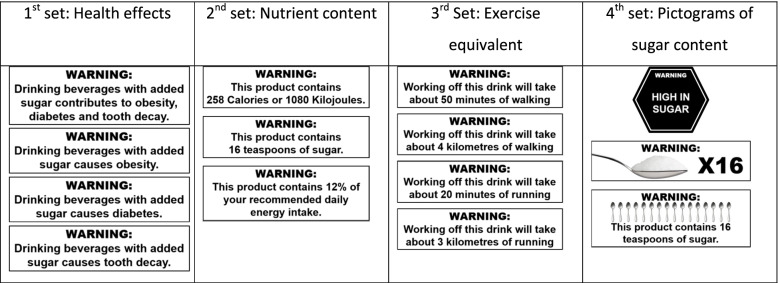
Sixteen focus groups were held with 4-8 young adults per group (aged 18-24; n = 105 participants in total) stratified by education level, location (rural centres, large cities) and gender (males, females) to ensure diversity. Labels shown to participants during group discussions included text warning labels of health effects, exercise equivalents, calorie/kilojoule information and sugar content as a "high in" label and as teaspoons (text and pictograms). Thematic analysis was undertaken.
Four themes were identified related to participants' perceived effectiveness of labels: the extent to which labels were perceived to be useful, relevant and credible; the extent to which a label elicited shock or disgust (perceived aversiveness); the extent to which the label message was resistant to self-exemption; and participants' perceived potential of the label to reduce purchasing and consumption behaviour. Across all four themes, labels communicating the number of teaspoons of sugar in a sugary drink (whether by text or pictogram) were perceived as the most impactful, resistant to self-exemption and to have the greatest potential to reduce consumption, with enhanced reactions to the pictogram label. Labels depicting health effects, exercise equivalents, calorie/kilojoule information or a general 'high in sugar' warning were perceived by consumers to be less effective in one or more themes.
Labels conveying the amount of sugar in a beverage in teaspoons were perceived as highly factual, relatable and interpretable, and as having the greatest potential to impact consumption attitudes and intentions. Further quantitative studies are required to compare the potential effectiveness of the teaspoons of sugar labels in reducing purchasing and consumption behaviour than other alternative warning labels, such as health effects or "high in" sugar labels.
为了遏制对超高加工食品和高游离糖饮料(添加到食品和饮料中的糖以及蜂蜜、糖浆、果汁和果汁浓缩物中天然存在的糖)的消费,一些司法管辖区引入了营养警示前置标签(FoP)。本研究旨在探索消费者对 FoP 警示标签的理解和看法,这些标签传达了有关含糖饮料消费的不同营养和健康信息。
对 16 组共 105 名参与者(年龄 18-24 岁;分为 4-8 名参与者一组,按教育程度、地点(农村中心、大城市)和性别(男性、女性)分层)进行了 16 次焦点小组讨论,以确保多样性。在小组讨论中向参与者展示了标签,包括健康影响的文字警示标签、运动等效标签、卡路里/千焦耳信息标签以及“高糖”标签和糖含量标签(文字和图形标签)。采用主题分析法进行分析。
确定了与参与者对标签的有效性的看法相关的四个主题:标签被认为有用、相关和可信的程度;标签引起震惊或厌恶(感知到的不愉快)的程度;标签信息抗拒自我豁免的程度;以及标签对减少购买和消费行为的潜在影响。在所有四个主题中,传达含糖饮料中糖的用量的标签(无论是文字还是图形标签)被认为最具影响力、最抗拒自我豁免且最有可能减少消费,而图形标签的反应更为强烈。消费者认为传达健康影响、运动等效、卡路里/千焦耳信息或一般“高糖”警示的标签在一个或多个主题中效果较差。
传达饮料中糖用量的标签以茶匙为单位,被认为是高度真实、相关和可解释的,并且最有可能影响消费态度和意图。需要进一步的定量研究来比较以茶匙为单位的糖标签在减少购买和消费行为方面的潜在效果,与其他替代警示标签(如健康影响或“高糖”标签)相比。