School of Public Health, The University of Adelaide, Adelaide, Australia.
Health Policy Centre, South Australian Health and Medical Research Institute, Adelaide, Australia.
BMC Med. 2024 Nov 18;22(1):541. doi: 10.1186/s12916-024-03740-1.
Front-of-pack (FOP) warning labels have demonstrated effectiveness for reducing sugar-sweetened beverage (SSB) consumption and switching to water. However, an unintended consequence is that they may also increase switching to non-sugar-sweetened beverages (NSSBs). A non-hypothetical experimental study examined the effectiveness of combining sugar and sweetener FOP warning labels to reduce sugary drink consumption and prevent NSSB substitution. The study also examined potential integration with Australia and New Zealand's existing Health Star Rating (HSR) system to determine suitability for local context and other jurisdictions with interpretive labelling schemes already in place.
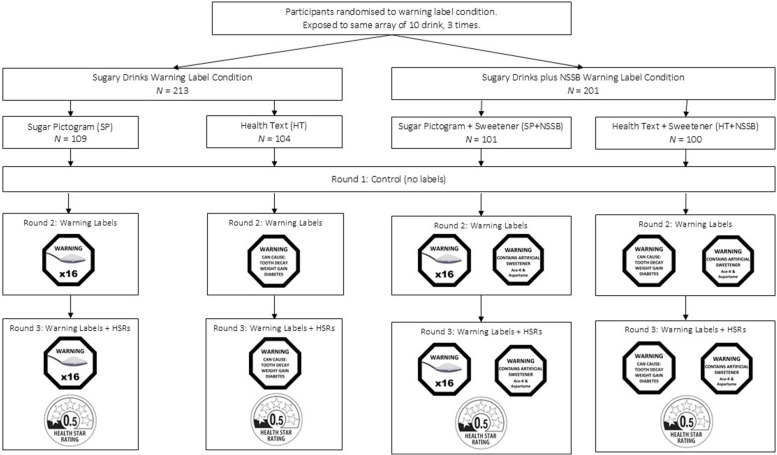
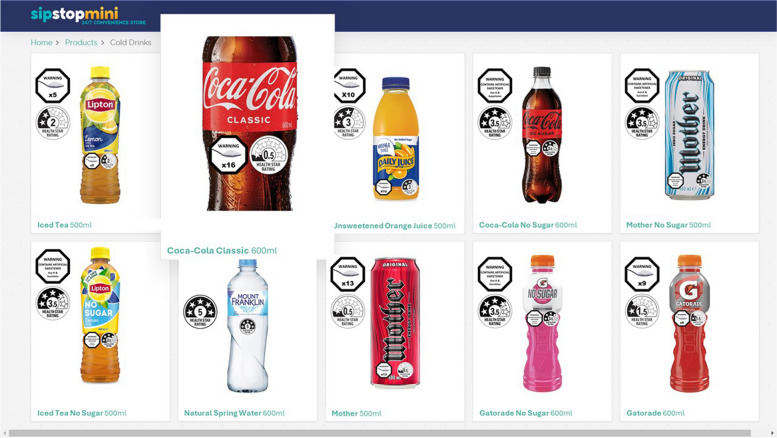
Participants (N = 414) accessed an online convenience store app via an on-campus laptop to select one drink from an array of 10 beverages, on three occasions. Drink options included a variety of SSBs, 100% fruit juice, NSSBs, and water. Following an escalating exposure procedure, drinks were presented (1) without any additional labelling, (2) with warning labels added to sugary drinks or to both sugary drinks and NSSBs (according to allocated condition), then (3) with HSR icons added to all drinks. Participants were informed they would receive a complementary drink, based on their selections, following the completion of a brief questionnaire.
Baseline results indicated that SSBs and water were the most and least popular drink choices, respectively. Placing FOP warning labels on sugary drinks decreased selection of SSBs and increased NSSB and water choices. Water became the most popular individual drink choice in response to warnings on sugary drinks. Placing FOP warning labels on both sugary drinks and NSSBs successfully avoided an increase in NSSB choices, whilst also increasing water selections, but did not significantly decrease selection of SSBs until HSR ratings were added. The incorporation of HSR icons consolidated warning label effects on NSSB and water selection across both conditions.
Results demonstrate the potential of FOP sugar warning labels for addressing beverage consumption behaviours. The incorporation of sweetener warning labels may successfully avoid substitution towards NSSBs, whilst still promoting water choices, but may also dilute the impact of the sugary drinks warning labels. Warning labels were complementary to existing interpretive FOP labels.
(front-of-pack,FOP)警示标签在减少含糖饮料(SSB)的消费和转向水方面已被证明具有效果。然而,一个意想不到的后果是,它们也可能增加对非含糖饮料(NSSB)的消费。一项非假设性的实验研究检验了结合糖和甜味剂 FOP 警示标签来减少含糖饮料消费和防止 NSSB 替代的有效性。该研究还检验了与澳大利亚和新西兰现有的健康星级评级(HSR)系统的潜在整合,以确定其在当地背景下和其他已经实施解释性标签计划的司法管辖区的适用性。
参与者(N=414)通过校园笔记本电脑访问在线便利商店应用程序,从 10 种饮料的数组中选择一种饮料,共进行三次。饮料选项包括各种 SSB、100%果汁、NSSB 和水。在进行逐步增加曝光的程序后,饮料呈现方式如下:(1)不添加任何其他标签,(2)根据分配条件,在含糖饮料上添加警示标签或在含糖饮料和 NSSB 上同时添加警示标签,然后(3)在所有饮料上添加 HSR 图标。参与者在完成简短的问卷后,会收到一份基于他们选择的免费饮料。
基线结果表明,SSB 和水分别是最受欢迎和最不受欢迎的饮料选择。在含糖饮料上放置 FOP 警示标签会减少 SSB 的选择,并增加 NSSB 和水的选择。在对含糖饮料发出警告后,水成为最受欢迎的个人饮料选择。在含糖饮料和 NSSB 上都放置 FOP 警示标签成功地避免了 NSSB 选择的增加,同时也增加了水的选择,但直到添加 HSR 评级后,才显著减少 SSB 的选择。HSR 图标的纳入巩固了两种条件下 FOP 糖警示标签对 NSSB 和水选择的影响。
结果表明,FOP 糖警示标签在解决饮料消费行为方面具有潜力。添加甜味剂警示标签可能成功地避免对 NSSB 的替代,同时仍促进水的选择,但也可能淡化含糖饮料警示标签的影响。警示标签与现有的解释性 FOP 标签相辅相成。